The best monitor arms under $100
A hundred dollars buys more arm than most people expect — including a dual mount for two screens and a ten-year warranty. We ranked five on the published weight floor first, because the minimum is the figure that decides whether a cheap counterbalanced arm actually holds your panel.
By Stephen V.Last reviewed
Compare the five
Ranked on the published weight floor, which is the figure to read first: a counterbalanced arm below its own minimum drifts down instead of holding position. Every cell is the manufacturer's own stated number, cited in the write-up below it. An em-dash means they do not publish it.
| # | Arm | Weight floor | Weight ceiling | Screens | Warranty | Price |
|---|---|---|---|---|---|---|
| 1 | 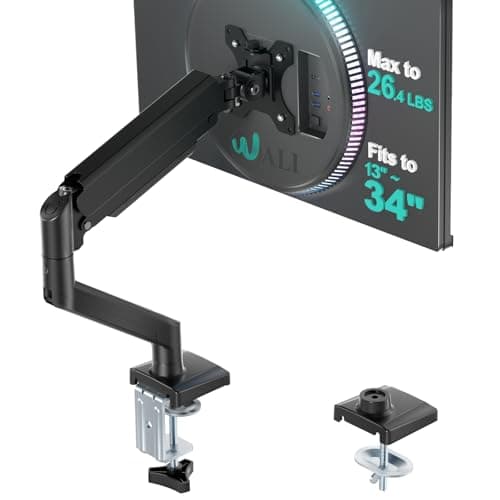 1. WALI GSMP001N Single Monitor Gas Spring Arm The longest warranty in the band
| — | 26.4 lb | 1 (17–34") | 10 yr | |
| 2 | 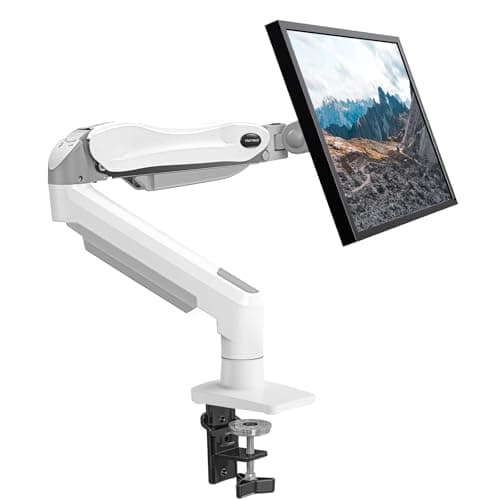 2. HUANUO Single Monitor Gas Spring Arm Both ends of the weight window published
| 4.4 lb | 19.8 lb | 1 (≤32") | 3 yr | |
| 3 | 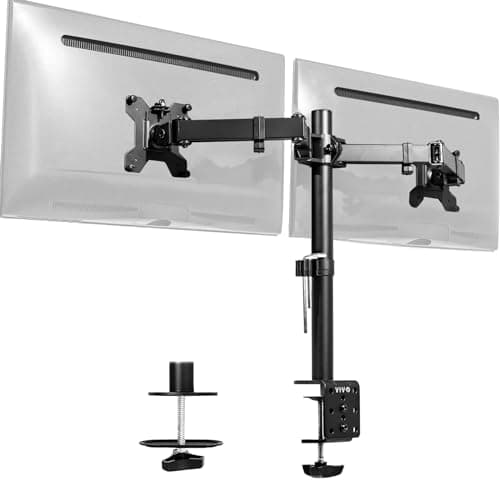 3. VIVO Dual Monitor Desk Mount (STAND-V002) Two screens, no minimum weight
| None — no spring | 22 lb each | 2 (13–30") | 3 yr | |
| 4 | 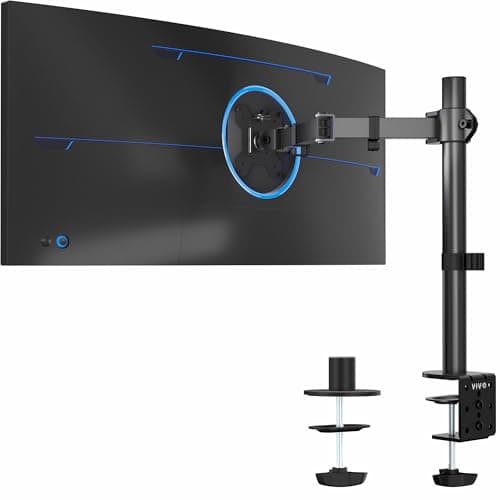 4. VIVO STAND-V001 Single Monitor Arm A light screen, set once
| None — no spring | 22 lb | 1 (≤32") | 3 yr | |
| 5 | 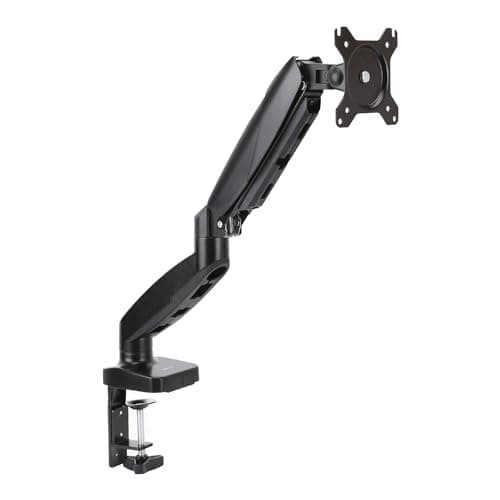 5. Amazon Basics Gas Spring Single Monitor Arm Budget pick — the cheapest published floor
| 4.4 lb | 15.4 lb | 1 (15–27") | 1 yr |
Read the floor column, not the ceiling. Almost every arm in this band will hold a normal monitor’s weight; what differs is the bottom of the range, and that is the end cheap arms fail at. A gas-spring arm loaded under its own published minimum does not hold a position — it sags down the pole, which looks exactly like a broken arm. “None — no spring” is not a missing figure. The two VIVO mounts are pole clamps with no counterbalance in them, so there is no minimum to fall under at all; they hold the height you set and do not float to a new one. Two of these five publish no floor— WALI states only a maximum — which is why the warranty column is worth reading beside it. One of the five is a dual mount, rated per monitor, so its ceiling is not comparable to the single arms beside it. The band was checked against our live price layer, dated under the picks; prose here carries no dollar figures.
Prices and stock as of November 8, 2026, from Amazon’s API. They change; we show a live number or none at all. #ad — we earn a commission.
Buy the WALI GSMP001N if you want the most arm per dollar inside this budget: a published 26.4 lb ceiling, a stated 17–34″ screen window, and a 10-year warranty that is three times the term of anything else on this page. It is the pick for a normal single monitor on a desk with a usable edge. Buy the HUANUO single gas spring if your panel is light, because HUANUO is the only maker here that publishes both ends of its weight window — 4.4–19.8 lb— and the floor is the number that matters. If you have two screens, the VIVO STAND-V002 dual mount fits inside the same budget as one arm. And the budget pick is the Amazon Basics gas spring arm: the cheapest counterbalanced arm we rank that still states a floor, at the cost of the band’s lowest ceiling and its shortest warranty.
That is the page. What follows is the one number almost nobody checks, and why it is the only sensible thing to rank a cheap arm on.
The finding: cheap arms fail at the bottom of the range
Every arm on this page will hold a normal monitor’s weight. Holding weight is the easy half — a gas cylinder strong enough for a 20 lb panel is a solved problem at every price, and the published ceilings here run from 15.4 to 26.4 lb against a screen that probably weighs seven or eight pounds with its stand off.
The figures that actually differ are at the bottom. A counterbalanced arm is a spring fighting a known load: load it under its own published minimum and the spring wins, so the monitor does not stay where you put it — it creeps up, or it sinks down the pole over an afternoon. That looks exactly like a broken arm, and it is the single most common way a cheap monitor arm disappoints someone who bought the right weight class.
So the floor is what we ranked on, and the spread inside this band is stark: HUANUO publishes 4.4 lb, Amazon publishes 4.4 lb, WALI publishes nothing at all, and the two VIVO mounts have nofloor because they contain no spring to fight. Weigh your panel with the stand off — how much a monitor weighs is a two-minute job — and the table above sorts itself.
How we ranked them
1. Published weight floor. For the reason above. A stated minimum is a maker telling you the one thing that can go wrong with the mechanism it sold you; no stated minimum is a gap you fill with a guess.
2. Published screen-size ceiling.Second because it catches a case the weight figure misses. A wide panel is a longer lever at the same mass, which is why makers publish a diagonal limit alongside a weight limit at all. The spread here is real — 27″ at one end, 34″ at the other — and VESA and weight ratings explains why the two numbers are not interchangeable.
3. Warranty term.The longevity slot, and the widest spread on the page: 1 year against 10. On a product whose failure mode is a gas cylinder losing tension after a few years, the warranty is covering precisely the part most likely to need covering — which is why the cheapest arm here publishing the longest term is the finding that put it first.
Spring or no spring: the real choice inside this band
The five arms here split into two mechanisms, and the split matters more than the price differences between them. Three are counterbalanced: a gas spring holds the monitor at whatever height you nudge it to, so you can move the screen through the day with one hand. Two are pole clamps: you set the height once with a hex key and it stays there until you get the hex key out again.
Neither is better. A counterbalanced arm is what you want on a sit-stand desk, where the right monitor height changes every time the desk moves, and it is the only kind that can be repositioned casually. A pole clamp cannot drift, has no cylinder inside it to lose tension over years, and has no minimum weight to fall under — so for a light panel at a fixed height it is the more reliable object, not the lesser one. Gas spring vs mechanical is the whole decision if you are unsure which side you are on.
Every arm here needs something from your desk
All five are C-clamp or grommet mounts: they anchor to the desk itself, which is where their rigidity comes from and also the one thing that can rule them out before weight or price enters the discussion. A clamp needs an accessible front edge inside the arm’s thickness window, with clearance under the lip for the jaw and behind the desk for the pole; a grommet needs a hole in a usable place. A drawer, an apron, or a wall in the wrong spot is enough to settle it.
Measure first: will a monitor arm fit my desk is the five-minute check, and clamp vs grommet is how to choose between the two anchors once you know both are available. If the answer is that your desk takes neither — glass, stone, rented, or hard against a wall — then nothing on this page fits, and freestanding vs clamp is the page that covers what to do instead.
What we can’t tell you
We have not mounted, loaded or lived with any of these five. We cannot tell you how the WALI’s cylinder feels after two years, whether the Amazon arm’s 15.4 lb ceiling has margin in it, how much the VIVO pole flexes with two 27″ screens on it, or how any of these warranties is administered when you actually call. Those answers need years, not a spec sheet. What this page is, is every number the makers publish, arranged on the figure that decides the purchase, with the gaps left as gaps — our methodology is explicit about where the published-spec evidence stops.
The picks, in detail
1. The longest warranty in the band
WALI GSMP001N Single Monitor Gas Spring Arm
Publishes a 26.4 lb ceiling, a 17–34 inch screen window and a ten-year warranty — the longest term in the band by a factor of three, on the cheapest arm in it. The gap is the floor: WALI states no minimum.
- Weight range
- ≤26.4 lb
- VESA
- 75/100, 17–34"
- Warranty
- 10 yr
This is first because it is the only arm inside this budget whose warranty reads like a premium arm’s. WALI publishes 10 years— the same term Ergotron puts behind the LX at several times the money — along with a 26.4 lb ceiling and a stated 17–34″ screen window, which is the widest screen range on this page. Its own listing title states a clamp and grommet base and the 75/100 mm VESA patterns, so both ways of anchoring to the desk are in the box.
The honest gap is the figure this page ranks on. WALI publishes the maximum and not the minimum, so there is no stated number telling you whether a light panel will hold its position on a gas spring or sag down the pole. If your monitor is a bare 24″ with the stand removed, that is a real question — how much a monitor weighs is where to get your own figure, and the two pole-clamp picks below are the answer if it comes in light.
Good
- 10-year warranty — the longest on the page, on the cheapest arm on the page, which is genuinely surprising
- 26.4 lb ceiling (flat panels) is the highest here, and the 34" screen cap the widest
- 19.3" of extension and 17.3" of rise, both published, both generous for the price
- WALI runs its own manufacturer site, so the specs are fetchable and citable rather than listing-only
Not so good
- Publishes NO minimum weight — the single most important spec on a gas-spring arm, and the reason it is not ranked first despite the warranty
- The 26.4 lb figure is for flat panels; curved screens drop to 19.8 lb, which the headline number does not say
- The Amazon listing says 13–34" while WALI's own site says 17–34" — a discrepancy on the maker's own product
- No cycle test, no third-party standard
Don’t buy it if: you are mounting a light panel and cannot weigh it first. With no published floor, this is the one arm here where you are guessing whether your monitor is heavy enough to hold position — and a light screen on an over-sprung arm creeps upward no matter how good the warranty is.
Price as of November 8, 2026. #ad — we earn a commission.
2. Both ends of the weight window published
HUANUO Single Monitor Gas Spring Arm
The only arm in the band that publishes both ends of its window — 4.4 to 19.8 lb — and the highest stated screen ceiling at 32 inches, with three years behind it.
- Weight range
- 4.4–19.8 lb
- VESA
- 75/100, ≤32"
- Warranty
- 3 yr
Second, and the pick if you want the band’s most complete paperwork. HUANUO states 4.4–19.8 lb — a published floor and ceiling, which nothing else here manages — a 32″ screen ceiling, and a 3-yearwarranty. A stated 4.4 lb floor is low enough that a stripped 24″ panel clears it, which is exactly the check the WALI above leaves you to make on your own.
It is a C-clamp or grommet mount like everything in this band, so the desk-edge measurement comes first either way — will a monitor arm fit my desk is the five-minute version of that.
Good
- Publishes both ends of the range, 4.4–19.8 lb — the only arm here besides the Amazon Basics that tells you its minimum
- 19.8 lb ceiling covers most 32" panels, where the Amazon Basics runs out at 15.4 lb
- 3-year warranty, three times the Amazon Basics'
- HUANUO cites a 20,000-cycle motion test — more than most of the tier claims
Not so good
- The 20,000-cycle figure is HUANUO's own internal test, not a third-party certification — a real number, but not a comparable one
- A third-party brand rather than the retailer-owner, so the specs are a manufacturer page you have to go and read, not a first-party listing
- No published lift/travel figure on the listing itself
- No UL, ANSI or BIFMA claim, like everything here
Don’t buy it if: you want the reassurance of a first-party spec above all else. HUANUO’s numbers come from HUANUO’s own site, which is the correct source — but if you would rather the brand owner and the retailer be the same entity, the Amazon Basics is the arm that gives you that.
$49.99 −14%
Price as of November 8, 2026. #ad — we earn a commission.
Where these numbers came from
- HUANUO single gas-spring monitor arms — HUANUO's own manufacturer site (screen 13–32", 4.4–19.8 lb weight range, VESA 75/100, 20,000-cycle internal test, 3-year warranty) — read 2026-08-03
- HUANUO Single Monitor Mount, 13–32" Gas Spring (B0CTJYYSML) — HUANUO's own Amazon listing confirming the 4.4–19.8 lb range and gas-spring mechanism — read 2026-08-03
3. Two screens, no minimum weight
VIVO Dual Monitor Desk Mount (STAND-V002)
Two monitors off the desk, inside the same budget as one arm: a pole-clamp dual mount with no spring and therefore no minimum weight, rated 22 lb per monitor for screens up to 30 inches.
- Weight range
- ≤22 lb/monitor
- VESA
- 75/100mm, 13–30″
- Warranty
- 3 yr
This is the pick that makes the band interesting, and the reason this page is not simply the budget single-arm roundup again: a hundred dollars buys a dual mount, not just one arm. VIVO publishes 22 lb per monitor and a stated 13–30″ screen window on 75/100 mm VESA, with 3 years behind it.
And because there is no gas spring in it, there is no minimum weight to fall under— the pole-clamp design holds whatever height you set it to, so a very light panel is a non-problem rather than the main risk. The trade is the other side of the same coin: you set the height once with a hex key and you do not nudge it during the day, and the 30″ ceiling is the tightest here. If you sit-stand, or reposition screens through the day, buy a counterbalanced arm and accept its minimum — gas spring vs mechanical is that decision in full, and the dual-arm roundup ranks this one against the rest.
Good
- No minimum weight — the pole-clamp design cannot drift, so a very light monitor is a non-problem
- 22 lb per monitor, which covers most panels up to 30"
- Nothing in it to lose tension over time — no spring to sag
- By some distance the cheapest way to get two monitors off the desk
Not so good
- Height is set by clamping to a pole — you set it once with a hex key, you do not nudge it during the day
- 30" screen limit is the tightest here
- 3-year warranty against HUANUO's 5
- VIVO publishes no lift/travel figure, because there isn't one in the usual sense
Don’t buy it if: you want to reposition your monitors through the day, or you sit-stand. This arm holds a height; it does not float to a new one. If you are moving between sitting and standing, you want a counterbalanced arm and you want to accept its minimum weight.
Price as of November 8, 2026. #ad — we earn a commission.
Where these numbers came from
4. A light screen, set once
VIVO STAND-V001 Single Monitor Arm
The single-screen version of the same idea: a mechanical arm with no cylinder to lose tension, 22 lb rated for screens up to 32 inches, three years. Set it once.
- Weight range
- ≤22 lb
- VESA
- 75/100, ≤32"
- Warranty
- 3 yr
Buy this one if your monitor is light and your eye height is not going to change. VIVO publishes 22 lb and a 32″ ceiling with a 3-year warranty, and like the dual mount above it has no gas cylinder in it, so nothing inside it can lose tension over the years — the failure mode this whole band is otherwise exposed to.
The cost is adjustability. This holds a height rather than floating to a new one, so it is the wrong arm for a sit-stand desk; for that, see monitor arms for a standing desk.
Good
- Mechanical spring tension, not a gas cylinder — the slow gas-spring sag that a long warranty is meant to cover simply isn't the failure mode here
- 3-year warranty, from a maker whose own site (vivo-us.com) publishes the spec
- 22 lb ceiling and support for ultrawides up to 38", wider than the Amazon Basics
- 17" pole with 16" of extension, both published on VIVO's page
Not so good
- Publishes no minimum weight — same gap as the WALI, so a light panel is again a guess
- Mechanical tension is set with a hex key, not a knob, and a light screen can need re-tightening as the spring settles
- Less fingertip-smooth to reposition than a good gas spring — you feel the mechanism
- No cycle test, no third-party standard
Don’t buy it if: you want to nudge the screen up and down through the day and have it float wherever you leave it. A mechanical arm holds a set position well but is stiffer to move; if effortless repositioning is the point, a gas spring like the HUANUO is the better feel.
Price as of November 8, 2026. #ad — we earn a commission.
5. Budget pick — the cheapest published floor
Amazon Basics Gas Spring Single Monitor Arm
Budget pick. The cheapest counterbalanced arm here that publishes both ends of its window — 4.4 to 15.4 lb — and the narrowest screen window in the band at 15 to 27 inches, with one year of cover.
- Weight range
- 4.4–15.4 lb
- VESA
- 75/100, 15–27"
- Warranty
- 1 yr
This is the budget pick: the least you can spend in our registry on a counterbalanced arm that tells you both ends of what it will hold. Amazon publishes 4.4–15.4 lb and a stated 15–27″ screen window on 75/100 mm VESA. A published 4.4 lb floor at this price is the thing worth having: it means a light panel is a decision you can check rather than a gamble.
Two honest limits, both published. The 15.4 lb ceiling is the lowest in the band, and 27″is the tightest screen ceiling of the five — a 32″ panel is outside what Amazon states for it. And the warranty is 1 yearagainst WALI’s ten. If your screen is at the large end, the HUANUO above costs a little more and publishes a window that covers it.
Good
- Publishes a real minimum (4.4 lb) as well as a maximum — the spec that decides whether a light panel will hold, and the one this tier usually hides
- Amazon is the brand owner, so the listing is the first-party spec sheet, not a retailer paraphrase of someone else's product
- 4.4 lb floor is low enough for most bare panels — a stripped 24" screen clears it
- Standard VESA 75/100 and a clamp-or-grommet base, like everything here
Not so good
- 15.4 lb ceiling and a 27" screen cap — the tightest envelope of the four, so a 32" panel is out
- 1-year warranty, the shortest here by a distance — WALI covers the same kind of arm for ten
- No cycle-test figure and no third-party standard, like every arm on this page
Don’t buy it if: your monitor is a 32" panel or weighs over about 15 lb. This arm is built for a normal 24–27" screen, and its honest, narrow window is the reason to trust it — but a heavier screen sits outside it, and the HUANUO's 19.8 lb ceiling exists for exactly that case.
Price as of November 8, 2026. #ad — we earn a commission.
Where these numbers came from
Common questions
Can you get a decent monitor arm for under $100?
Yes, and the published figures are the reason to believe it. Inside this band the stated ceilings run 15.4 lb to 26.4 lb and the warranties run 1 to 10 years, against a monitor that probably weighs under ten pounds with its stand off. What you do not get at this price is a published weight floor from every maker, a screen ceiling above 34″, or the third-party certification nobody in this category has at any price. Our main monitor arm roundup ranks the whole market if you want to see what the extra money buys.
Is a cheap gas spring monitor arm safe for a heavy monitor?
Check two published numbers against your own screen and the answer is usually straightforward. The first is weight: weigh the panel with the stand removed — how much a monitor weighs explains why that distinction matters — and confirm it sits inside the arm’s stated range at both ends. The second is the screen-size ceiling, which exists because a wide panel puts leverage on the mount that its weight alone does not describe. A 32″ monitor on an arm rated to 27″ is outside what the maker states even if the weight clears. VESA and weight ratings is the full version of both checks.
Can you get a dual monitor arm for under $100?
Yes — one of the five here is a dual mount, and it is a real one: VIVO publishes 22 lb per monitor for screens 13–30″with a 3-year warranty. The compromise is that it is a pole clamp rather than a counterbalanced arm, so you set each monitor’s height once with a hex key instead of moving it through the day. If you want two screens that float, dual arm vs two single arms is the cheaper-than-it-looks alternative, since two single arms from this page can also land inside the band.
What do you give up buying a monitor arm under $100?
Three things, all visible in the table above. A published weight floor from every maker, which the premium arms state as a matter of course. A screen ceilingabove 34″, which rules out ultrawides — see ultrawide monitor arms. And published travel figures: none of these states how much vertical range it actually offers, where Ergotron publishes 13″ for the LX. What you do not give up is warranty — the longest term in our whole monitor-arm registry outside Humanscale is on the cheapest arm on this page.
Sources
Every figure on this page comes from one of these. If a manufacturer doesn’t publish a number, we print “—” rather than estimate it.
- WALI GSMP001N single gas-spring monitor mount — walielectric.com, WALI's own manufacturer page (17–34", up to 26.4 lb flat / 19.8 lb curved, VESA 75/100, 19.3" extension, 17.3" rise, "10 Year Protection") — read 2026-08-03
- HUANUO single gas-spring monitor arms — HUANUO's own manufacturer site (screen 13–32", 4.4–19.8 lb weight range, VESA 75/100, 20,000-cycle internal test, 3-year warranty) — read 2026-08-03
- HUANUO Single Monitor Mount, 13–32" Gas Spring (B0CTJYYSML) — HUANUO's own Amazon listing confirming the 4.4–19.8 lb range and gas-spring mechanism — read 2026-08-03
- VIVO STAND-V002 dual monitor desk mount product page — 22 lb per monitor, 13–30", VESA 75/100, 3-year warranty — read 2026-07-16
- VIVO STAND-V001 single monitor desk mount — vivo-us.com's own product page (up to 22 lb, VESA 75/100, 13"–32" standard / ultrawide to 38", 17" pole with 16" extension, "3 Year Warranty"; no minimum weight published) — read 2026-08-03
- Amazon Basics Gas Spring Single Monitor Arm — Amazon is the brand owner, so this listing is the manufacturer's spec (15–27", 4.4–15.4 lb, VESA 75/100, 1-year) — read 2026-08-03
Read next
The best budget monitor arms
The single-arm version of this question, ranked on how much of the weight window each maker actually publishes.
The best monitor arms
The unbounded roundup — read it to see exactly what the money above this band buys.
Will a monitor arm fit my desk
Every arm on this page is a clamp or grommet mount, so run this check before you buy any of them.
The best monitor stands
If your desk cannot take a clamp or a grommet, a platform that stands on it costs less than anything here.