The best dual monitor arms
Two arms that solve the same problem in opposite ways. One has a gas spring and therefore a minimum weight; the other has no spring at all, and needs no minimum — which is why its spec sheet looks incomplete and isn't.
By Stephen V.Last reviewed
Quick picks
Ranked, with the manufacturer’s own longevity figure next to each one. Tap a row to jump to the full write-up.
| # | Product | Best for | Longevity | Price |
|---|---|---|---|---|
| 1 | 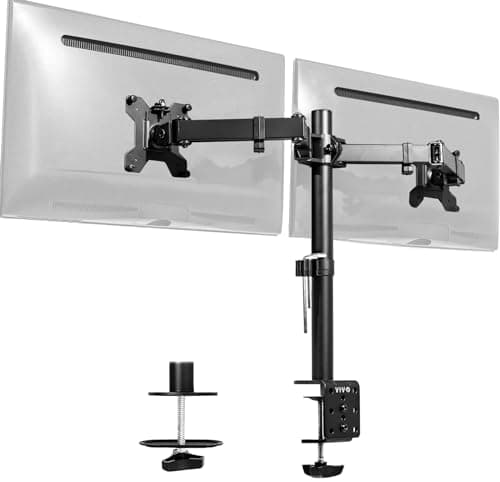 VIVO Dual Monitor Desk Mount (STAND-V002) No gas spring, no counterbalance, and therefore no minimum weight to fall under. The cheapest arm here is also the one with the fewest ways to go wrong. | Light monitors, set once | 3 yrWarranty | |
| 2 | 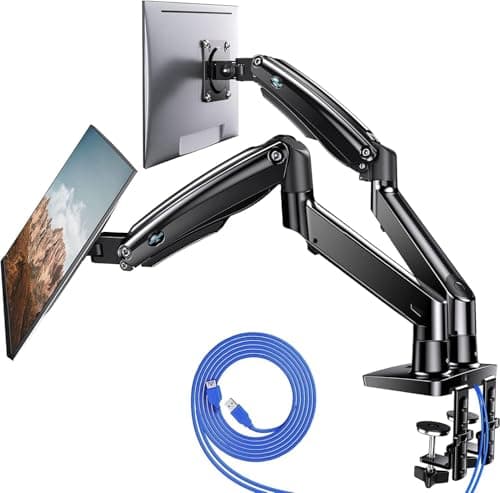 HUANUO HNDS7 Dual Monitor Mount The widest envelope here by a distance — 40" screens, 26.4 lb an arm — and a gas spring, which means a minimum weight comes back into play. | Big or mismatched screens | 5 yrWarranty | $109.98Amazon $149.99 −27% |
Prices as of October 18, 2026, from Amazon’s API. They change; we show a live number or none at all.
These two arms hold two monitors each, cost roughly the same as each other, and are engineered on opposite principles. That makes them unusually useful to put side by side — because the comparison exposes something the category normally hides.
The VIVO publishes a maximum weight and no minimum. The HUANUO publishes both. On a spec table that reads as VIVO being sloppy and HUANUO being thorough. It is nothing of the sort. It is two honest spec sheets describing two different machines, and reading it as an omission gets the engineering exactly backwards.
The missing number that shouldn't be there
A minimum weight is a property of counterbalancedarms. Those arms carry a spring — gas or mechanical — that pushes up against the monitor hanging off the end. Balance the two and the screen floats. Fail to balance them and it drifts: too heavy and the arm sags, too light and the arm rises on its own. That second failure is the one nobody warns you about, and it is why a minimum exists at all.
The HUANUO HNDS7 is a gas-spring arm, so it has a floor: 4.4 lb per arm. Low, but real.
The VIVO V002has no spring. The mount clamps to a vertical pole at whatever height you tighten it at, and gravity does the rest. Nothing pushes back, so there is nothing a light monitor can fail to overcome. Its floor is not unpublished — it does not exist. A dash in that slot would imply VIVO owes you a number they do not have.
This cuts both ways, which is why the VIVO is not simply the smarter design. What you give up is exactly what the spring was buying: movement. The V002 holds a height. It does not travel to a new one because you stood up. Set it with a hex key and leave it.
Two model numbers, and only one of them is on this page
HUANUO sells the HNDS7 and the HNDS6. They photograph almost identically. They are not the same arm: the HNDS7 is 13–40″ and 4.4–26.4 lb per arm, the HNDS6 is 13–32″ and 4.4–19.8 lb. Eight inches and nearly seven pounds, hiding behind one digit.
Every HUANUO figure on this page is the HNDS7’s, because that is the ASIN this entry links. If you shop by picture you will not be able to tell them apart, which is a good argument for shopping by model string.
Two cycle claims that don't compare
HUANUO says its gas springs are “20,000 times cycle-tested”. Ergotron says its LX passes a 10,000-cycle motion test. The obvious move is to put those in a table and let the reader conclude HUANUO is twice as durable. We are not going to, because the conclusion would be unsupported in three separate ways.
Both figures are internal— neither cites an external standard or an independent lab. They test different objects— a gas spring component versus whole-arm motion. And nobody has defined what a “cycle” is, under what load, or what counts as passing. Two numbers only compare if they measure the same thing the same way, and these do neither.
So there is no cycle column here. The same reasoning is why there is no certification column: no arm in this category, at any price, claims a third-party standard.
The listing said USB
Small thing, useful habit. The Amazon title for the HNDS7 advertises a USB port. HUANUO’s own product page mentions no USB port or hub at all.
We have not printed it as a spec. It may genuinely be in the box — listing titles are not usually fabricated out of nothing — but a feature that lives in a retail title and not on the manufacturer’s page is a claim we cannot show you the source of, and this site’s only real asset is that everything on it has one.
What we did, and what it can't tell you
We have not mounted anything on either of these. What we did was read both manufacturers’ own product pages, take the three numbers that decide the purchase, and cite them. Our methodology page is explicit about what that does and does not buy you.
What it cannot tell you: whether the VIVO’s pole flexes with two 27″ panels on it, whether the HUANUO’s springs still hold at year three, or whether either clamp marks your desk. Real questions, all needing hands. Owner reviews are better than we are on that half.
How to choose between them
Ask one question: do your monitors need to move?
If they live at one height — fixed desk, one seating position, you set it and forget it — the VIVO does that job for less money, with no spring to sag and no minimum weight to check. Its limits are 30″ and 22 lb.
If you sit-stand, share the desk, or reposition through the day, you need the spring, and that means the HUANUO — bigger envelope, longer warranty, and a 4.4 lb floor to check both monitors against. Weigh the panels without their stands before you order.
And once either is on the desk, the harder question is where the two screens actually go, which is not an arm problem at all: dual monitor ergonomics covers whether you center one screen or straddle the pair.
The picks, in detail
1. Light monitors, set once
VIVO Dual Monitor Desk Mount (STAND-V002)
No gas spring, no counterbalance, and therefore no minimum weight to fall under. The cheapest arm here is also the one with the fewest ways to go wrong.
- Weight range
- ≤22 lb/monitor
- VESA
- 75/100mm, 13–30″
- Warranty
- 3 yr
This arm is on the page to make a point that the rest of the category obscures.
VIVO publishes a maximum only: 22 lb per monitor, no minimum. On any other product on this site, a missing number would earn a dash and a paragraph about manufacturers not doing their homework. Not here. The V002 has no minimum because it cannot have one.
There is no gas spring and no counterbalance in this arm. Height is set by clamping the mount at a position along a vertical pole and tightening it. There is no spring pushing back, so there is nothing for a light monitor to fail to overcome, so there is no floor to fall under. A two-pound monitor and a twenty-pound monitor are equally well held. Publishing a minimum would be publishing a fiction.
What you trade for that is adjustment. You set the height once, with a hex key, and it stays there — which is completely fine if your monitors live at one height, and completely wrong if you expect to move them.
Good
- No minimum weight — the pole-clamp design cannot drift, so a very light monitor is a non-problem
- 22 lb per monitor, which covers most panels up to 30"
- Nothing in it to lose tension over time — no spring to sag
- By some distance the cheapest way to get two monitors off the desk
Not so good
- Height is set by clamping to a pole — you set it once with a hex key, you do not nudge it during the day
- 30" screen limit is the tightest here
- 3-year warranty against HUANUO's 5
- VIVO publishes no lift/travel figure, because there isn't one in the usual sense
Don’t buy it if: you want to reposition your monitors through the day, or you sit-stand. This arm holds a height; it does not float to a new one. If you are moving between sitting and standing, you want a counterbalanced arm and you want to accept its minimum weight.
Price as of October 18, 2026. #ad — we earn a commission.
Where these numbers came from
2. Big or mismatched screens
HUANUO HNDS7 Dual Monitor Mount
The widest envelope here by a distance — 40" screens, 26.4 lb an arm — and a gas spring, which means a minimum weight comes back into play.
- Weight range
- 4.4–26.4 lb/arm
- VESA
- 75/100, 13–40"
- Warranty
- 5 yr
The HNDS7 is the more capable arm here and the more complicated purchase, in both cases for the same reason: it has a gas spring.
That buys you real height adjustment through the day and an envelope nothing else on this page approaches — 40″ screens, 26.4 lb an arm, which is enough for two large panels or one large and one odd. It also brings back the minimum weight the VIVO is immune to. At 4.4 lb the floor is low, but it is not zero, and a very light secondary panel is a real edge case.
Two model numbers, one digit apart
Check what you are buying. HUANUO sells the HNDS7(13–40″, 4.4–26.4 lb per arm) and the HNDS6(13–32″, 4.4–19.8 lb). They are visually similar, the model numbers differ by one character, and the specs differ by eight inches and nearly seven pounds. The figures on this page are the HNDS7’s.
The USB ports that aren't a spec
The Amazon listing title for this ASIN advertises USB. HUANUO’s own product page does not mention a USB port or hub anywhere. We have left it out of the specs entirely, because a feature that appears in a listing title and not on the manufacturer’s page is a listing claim, not a specification. It may well be in the box. We just cannot show you the manufacturer saying so.
About that 20,000-cycle number
HUANUO states its gas springs are “20,000 times cycle-tested”. Ergotron states a 10,000-cycle motion test for the LX. It is very tempting to read that as HUANUO winning by a factor of two. Do not.
Both are internal tests citing no external standard, and more importantly they are tests of different things— a gas spring component versus whole-arm motion. There is no defined cycle, no shared load, no common pass criterion. Putting 20,000 and 10,000 in adjacent table cells would produce a comparison out of two numbers that have nothing to do with each other. That is why there is no cycle column on this page.
Good
- 26.4 lb per arm and screens to 40" — the largest envelope on this page
- Publishes both ends of the weight range, unlike the VIVO (which does not need to)
- Gas-spring height adjustment you can actually move during the day
- 5-year warranty, against VIVO's 3
Not so good
- "Up to 5-Years Warranty" — the "up to" is HUANUO's own hedge, and they do not publish what shortens it
- The 20,000-cycle gas spring claim is HUANUO's internal test, citing no standard
- USB ports appear in the Amazon listing title but are absent from HUANUO's own product page
- Easily confused with the HNDS6, which is a different arm (13–32", 4.4–19.8 lb)
Don’t buy it if: either monitor weighs under 4.4 lb. This is a gas-spring arm, so the floor is real — and unlike the VIVO next to it, a monitor below the minimum will not stay where you put it.
$149.99 −27%
Price as of October 18, 2026. #ad — we earn a commission.
Where these numbers came from
Common questions
Why doesn't the VIVO publish a minimum weight?
Because it does not have one, and that is a design fact rather than an oversight. A minimum weight exists only on counterbalancedarms — the ones with a spring pushing back, which a monitor has to be heavy enough to overcome. The V002 has no spring: it clamps to a pole at a fixed height. Nothing pushes back, so nothing needs to be overcome, so there is no floor. This is the one place on this site where a blank in a spec table is the honest answer.
HNDS6 or HNDS7 — which one am I looking at?
The HNDS7takes 13–40″ screens at up to 26.4 lb per arm. The HNDS6takes 13–32″ at up to 19.8 lb. Same look, one character apart in the model number, and about seven pounds and eight inches apart in what they will actually hold. Every figure on this page is the HNDS7’s. If you are shopping from photographs, check the model string before you check anything else.
Is a 20,000-cycle gas spring twice as durable as a 10,000-cycle one?
There is no way to know, and the comparison is not valid in the first place. HUANUO’s 20,000-cycle figure tests a gas spring; Ergotron’s 10,000-cycle figure tests whole-arm motion. Both are internal tests against no published standard, with no shared definition of a cycle, no shared load and no shared pass criterion. Two true numbers that measure different things do not become comparable by being printed in the same font.
Do I need a dual arm, or two single arms?
Two singles give you more independent movement and survive one monitor changing size; a dual mount is cheaper, uses one clamp point, and keeps the pair aligned. The honest deciding factor is desk depth and clamp space, not the arm — two clamps need two clear edges. If your desk is shallow, read what size desk you need before you buy either.
Sources
Every figure on this page comes from one of these. If a manufacturer doesn’t publish a number, we print “—” rather than estimate it.
Read next
The best desks for dual monitors
The surface under the arm, ranked on published width and on top thickness — 0.75″ to 1.25″, which is what decides whether the clamp fits.
Dual arm vs two single arms
One shared pole or two independent arms — range vs cost.
Single vs dual monitors
Not sure two screens is the right call? The honest comparison against one large or ultrawide.
Gas spring vs mechanical counterbalance
Why one of these arms has a minimum weight and the other cannot have one.
Dual monitor ergonomics
Which screen goes in front of you — the question two arms force you to answer.
VESA and weight ratings explained
Whether these will bolt to your monitors at all.
Best single monitor arms
If you'd rather run two independent arms than one dual mount.