The best budget monitor arms
You do not need a premium arm to get a monitor off the desk. What you need to avoid is the specific trap of the cheap tier: arms that print how much they hold and stay silent about the least they will hold. We read four makers' own spec pages and found the ones that tell you both.
By Stephen V.Last reviewed
Quick picks
Ranked, with the manufacturer’s own longevity figure next to each one. Tap a row to jump to the full write-up.
| # | Product | Best for | Longevity | Price |
|---|---|---|---|---|
| 1 | 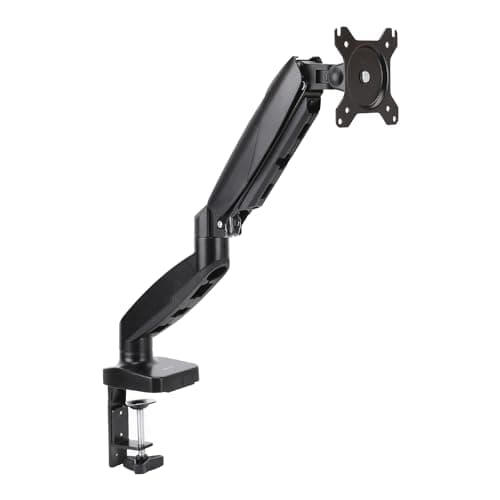 Amazon Basics Gas Spring Single Monitor Arm The one budget arm whose specs you can actually trust, because Amazon owns the brand. It publishes both ends of the weight window — most of the tier prints only the top. | Trusting the numbers | 1 yrWarranty | $27.29Amazon $29.99 −9% |
| 2 | 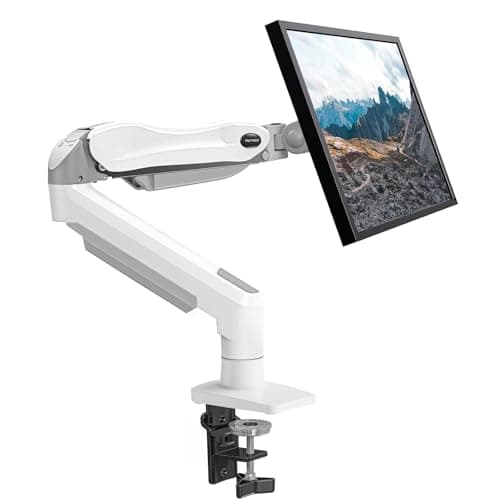 HUANUO Single Monitor Gas Spring Arm The widest usable window in the budget tier that still publishes its floor — 4.4 to 19.8 lb — with a three-year warranty and a cycle test the cheaper arms skip. | A larger screen on a budget | 3 yrWarranty | $39.99Amazon $49.99 −20% |
| 3 | 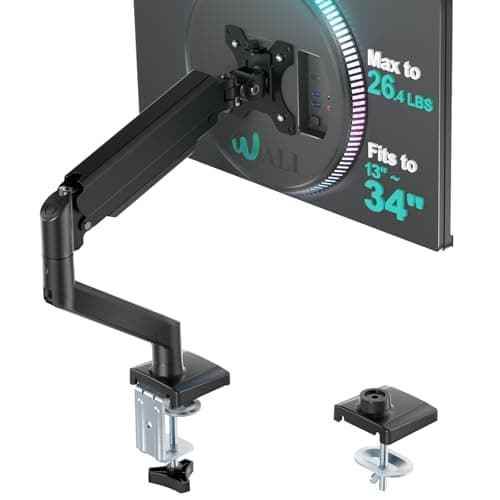 WALI GSMP001N Single Monitor Gas Spring Arm The cheapest arm here, and the one with the longest warranty by a mile — ten years. The catch is the one this whole page is about: it never tells you its minimum weight. | The longest warranty per dollar | 10 yrWarranty | $25.49Amazon $26.99 −6% |
| 4 | 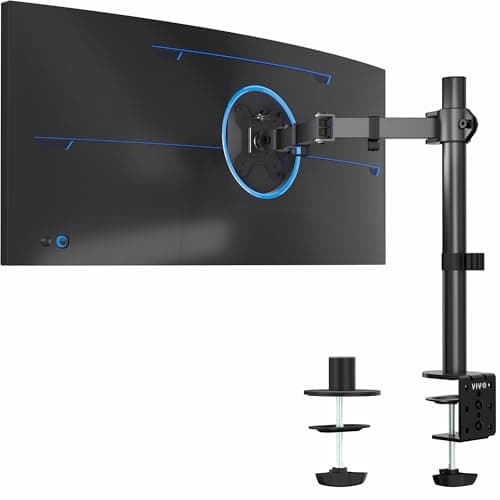 VIVO STAND-V001 Single Monitor Arm A mechanical tension arm rather than a gas spring — there is no gas cylinder to sag over the years. The trade is that you re-tighten it yourself, and it too hides its floor. | No gas cylinder to fail | 3 yrWarranty |
Prices as of Sep 17, 2026, from Amazon’s API. They change; we show a live number or none at all.
A monitor arm is the cheapest fix for the most common desk problem — a screen sitting too low — and you do not need a premium one to get it. The arms on our main monitor arm pageare excellent and start around two hundred dollars. The four here cost a fraction of that, hold a normal monitor perfectly well, and are what most people should actually buy. The catch is that the budget tier has a specific trap, and it is the same one the premium page is about — only meaner down here.
Every arm listing leads with how much it holds. Twenty-two pounds. Twenty-six pounds. It is on the box and it is the first line of the listing. And for most buyers it is nearly irrelevant, because the average monitor weighs about twelve pounds and every arm here clears that. The number that actually decides whether a cheap arm works is the minimum— and in this tier, most makers do not print it.
Why the floor is the spec that matters, and the budget tier hides it
A gas-spring arm does not hold your monitor up. It pushes back against it with a spring you tension to match the weight. When the two balance, the screen floats and stays where you leave it. Hang something too heavy and the spring loses and the arm sags; hang something too lightand the spring wins and the arm creeps upward on its own. Owners describe a too-light monitor as a “faulty” arm. It is almost never faulty. It is a screen sitting below a minimum the maker never told them about.
On the premium page, Ergotron and Humanscale publish both ends of that window. Down here, only two of the four do. The Amazon Basics prints 4.4 to 15.4 lb and the HUANUO prints 4.4 to 19.8 lb. The WALI and the VIVOprint only their ceilings — 26.4 lb and 22 lb — and leave you to guess whether your particular monitor is heavy enough to hold position. That gap is the entire reason the ranking is ordered the way it is: the two arms that tell you their floor sit above the two that do not, regardless of how much the silent ones hold at the top.
Below about twenty dollars, you may not be buying an arm at all
There is a floor to the price, too, and it is worth naming. Under roughly twenty dollars a lot of what is sold as a “monitor arm” is really a fixed or friction mount with no counterbalance — it will hold a screen at one height you set with a bolt, but it does not float, so the whole benefit of an arm (nudging the screen and having it stay) is gone. That can be fine if you just want the monitor off the desk at a set height. It is not the same product, and the listings rarely make the difference obvious.
The other thing that happens at the bottom of the market is that the spec sheet disappears. Several arms in this price band — ErGear, MOUNT PRO, the North Bayou G-series — are sold on numbers that live only in Amazon listing copy, with no manufacturer document behind them. North Bayou’s own web address now resolves to a domain-for-sale page; there is no maker’s site left to check. By this site’s rule that is a disqualification, not a demotion: if we cannot read the number at the manufacturer, we will not rank the arm on it. That is why those brands are named here and not in the table.
The warranty column tells a genuinely odd story
The third spec on every arm here is the longevity number — the warranty — and in the budget tier it does something the premium tier does not: it runs backwards. The cheapest arm on the page, the WALI, carries the longest warranty on the page: ten years. The Amazon Basics, which usually costs more, carries one. VIVO and HUANUO sit in the middle at three.
Resist reading that as a quality ranking. A ten-year warranty from a smaller brand and a one-year warranty from Amazon are not the same promise even though they share a column — one is a longer term, the other is a shorter term from a company far more likely to still be answering the phone in year nine. The longevity slot is there so you can see the claim and weigh it yourself, which on this page means noticing that the number does not track the price and asking why.
Gas spring or mechanical
Three of these are gas-spring arms and one, the VIVO, is a mechanical tension arm, and at this price the distinction earns its place. A gas spring is smoother to move but can slowly lose its lift over years — which is exactly the failure a long warranty is meant to cover, and exactly the reason a cheap gas cylinder is a fair thing to be wary of. A mechanical arm has no cylinder to weaken, so it holds a set height for the long haul, but you tension it by hand with a hex key and it is stiffer to reposition. Neither is better in the abstract. Set the screen once and the mechanical wins; move it all day and the gas spring does. The mechanism guide is the long version.
What we did, and what it can't tell you
We have not mounted a monitor on any of these. There is no lab here, we have not loaded one to failure or cycled one twenty thousand times, and we are not going to imply otherwise. What we did was read each maker’s own spec page — Amazon’s first-party listing, vivo-us.com, walielectric.com and huanuo.com — pull the three numbers that decide the purchase, and cite every one. Where a maker does not publish a number, the methodology says to print a dash rather than guess, and the missing floors on the WALI and VIVO are exactly that.
So this page cannot tell you whether a clamp bites into a soft desktop, whether the tension screw is a knuckle-skinner, or whether a given arm wobbles when you type. Those need hands, and owner reviews will serve you better than we can. HUANUO’s 20,000-cycle claim and Ergotron’s 10,000-cycle claim are both internal tests of different things, and lining them up would be a lie told with true numbers.
How to actually use this
Weigh your monitor first — the bare panel with the stand off, which is what hangs off the arm, not the boxed weight. It is on the maker’s spec page under “weight without stand”, and our weight guide has typical figures by size.
Then check it against a floor you can actually see. If your panel is light — a bare 24″ can come in around 5 or 6 lb — buy the Amazon Basics or the HUANUO, because they are the two arms here that tell you they bottom out at 4.4 lb. If it is a heavier 32″, the HUANUO’s 19.8 lb ceiling is the widest window with a published floor. Only reach for the WALI or the VIVO if your monitor is comfortably mid-range and you have weighed it, because with no published minimum you are the one carrying the risk that it sits too low. And check the hole pattern, which decides fit as much as weight does — VESA and weight ratings covers what the standard does and does not promise.
Finally, the same gut-check the premium page ends on applies twice as hard when the arm is cheap: if you have one monitor on a fixed desk and no complaint about where it sits, a fixed riser may do the whole job for less than any arm here.
The picks, in detail
1. Trusting the numbers
Amazon Basics Gas Spring Single Monitor Arm
The one budget arm whose specs you can actually trust, because Amazon owns the brand. It publishes both ends of the weight window — most of the tier prints only the top.
- Weight range
- 4.4–15.4 lb
- VESA
- 75/100, 15–27"
- Warranty
- 1 yr
This ranks first for the same reason the premium page trusts it: Amazon is the brand owner of Amazon Basics, so the number on the listing is not a retailer describing someone else’s product — it isthe manufacturer’s spec. And the manufacturer publishes both ends of the weight window, 4.4 to 15.4 lb, which sounds unremarkable until you notice that the other three arms here print only the top.
The floor is the whole game on a budget gas-spring arm. Below it, the spring wins and the monitor drifts upward or refuses to stay put; owners call the arm “faulty” when it is simply holding a screen lighter than it was built for. Knowing the arm bottoms out at 4.4 lb means you can check a bare panel against it before you buy. Most of this tier will not let you.
What you pay for that honesty is envelope. The 15.4 lb ceiling and 27″ screen cap are the tightest here, so this is a 24-to-27-inch arm and not a 32-inch one. And the one-year warranty is the genuine weakness — it is the shortest on the page, and a gas spring slowly losing its lift is exactly the failure a longer term is for. That it still ranks first tells you how much the site weights a number you can trust over a number you cannot check.
Good
- Publishes a real minimum (4.4 lb) as well as a maximum — the spec that decides whether a light panel will hold, and the one this tier usually hides
- Amazon is the brand owner, so the listing is the first-party spec sheet, not a retailer paraphrase of someone else's product
- 4.4 lb floor is low enough for most bare panels — a stripped 24" screen clears it
- Standard VESA 75/100 and a clamp-or-grommet base, like everything here
Not so good
- 15.4 lb ceiling and a 27" screen cap — the tightest envelope of the four, so a 32" panel is out
- 1-year warranty, the shortest here by a distance — WALI covers the same kind of arm for ten
- No cycle-test figure and no third-party standard, like every arm on this page
Don’t buy it if: your monitor is a 32" panel or weighs over about 15 lb. This arm is built for a normal 24–27" screen, and its honest, narrow window is the reason to trust it — but a heavier screen sits outside it, and the HUANUO's 19.8 lb ceiling exists for exactly that case.
$29.99 −9%
Price as of Sep 17, 2026. #ad — we earn a commission.
Where these numbers came from
2. A larger screen on a budget
HUANUO Single Monitor Gas Spring Arm
The widest usable window in the budget tier that still publishes its floor — 4.4 to 19.8 lb — with a three-year warranty and a cycle test the cheaper arms skip.
- Weight range
- 4.4–19.8 lb
- VESA
- 75/100, ≤32"
- Warranty
- 3 yr
If the Amazon Basics is the arm you trust the numbers on, the HUANUO is the arm that gives you more of a window to work with while still telling you where the bottom is. Four-point-four to nineteen-point-eight pounds is the widest usable range in this tier that publishes both ends, and the extra ceiling is the practical difference: a 32″ panel that the Amazon Basics cannot hold sits comfortably inside the HUANUO’s range.
HUANUO also does something most of the tier does not: it cites a 20,000-cycle motion test and a three-year warranty. Both are worth having, and one of them needs a caveat. The 20,000 cycles is HUANUO’s owninternal test — the same kind of in-house claim Ergotron makes with its 10,000-cycle figure on the premium page. It is not a third-party standard, and lining it up against Ergotron’s would be comparing two companies’ homework. Useful as a sign the maker tested something; not useful as a league table.
The honest mark against it is only that it is a third-party brand: the spec lives on huanuo.com rather than on the listing of the company that owns the brand, so you are trusting a manufacturer page instead of a first-party one. That is the correct source by this site’s rules — but it is one step further than the Amazon Basics asks of you, which is why the order is what it is.
Good
- Publishes both ends of the range, 4.4–19.8 lb — the only arm here besides the Amazon Basics that tells you its minimum
- 19.8 lb ceiling covers most 32" panels, where the Amazon Basics runs out at 15.4 lb
- 3-year warranty, three times the Amazon Basics'
- HUANUO cites a 20,000-cycle motion test — more than most of the tier claims
Not so good
- The 20,000-cycle figure is HUANUO's own internal test, not a third-party certification — a real number, but not a comparable one
- A third-party brand rather than the retailer-owner, so the specs are a manufacturer page you have to go and read, not a first-party listing
- No published lift/travel figure on the listing itself
- No UL, ANSI or BIFMA claim, like everything here
Don’t buy it if: you want the reassurance of a first-party spec above all else. HUANUO’s numbers come from HUANUO’s own site, which is the correct source — but if you would rather the brand owner and the retailer be the same entity, the Amazon Basics is the arm that gives you that.
$49.99 −20%
Price as of Sep 17, 2026. #ad — we earn a commission.
Where these numbers came from
- HUANUO single gas-spring monitor arms — HUANUO's own manufacturer site (screen 13–32", 4.4–19.8 lb weight range, VESA 75/100, 20,000-cycle internal test, 3-year warranty) — read 2026-08-03
- HUANUO Single Monitor Mount, 13–32" Gas Spring (B0CTJYYSML) — HUANUO's own Amazon listing confirming the 4.4–19.8 lb range and gas-spring mechanism — read 2026-08-03
3. The longest warranty per dollar
WALI GSMP001N Single Monitor Gas Spring Arm
The cheapest arm here, and the one with the longest warranty by a mile — ten years. The catch is the one this whole page is about: it never tells you its minimum weight.
- Weight range
- ≤26.4 lb
- VESA
- 75/100, 17–34"
- Warranty
- 10 yr
Here is the page’s genuine surprise: the cheapest arm carries the longest warranty. WALI’s own site puts a ten-year term on the GSMP001N, which is a decade against the Amazon Basics’ one year, on an arm that usually costs less. On the premium pageten years is the Ergotron’s headline number. Here it is stapled to a twenty-dollar mount. That is worth knowing, and we are not going to pretend it isn’t.
But the warranty is not what this page ranks on, and WALI walks straight into the trap the whole site is built to catch. It publishes a maximum — 26.4 lb for a flat screen — and no minimum at all. On a gas-spring arm the minimum is the number that decides whether the thing works: hang a panel lighter than the spring is tensioned for and it drifts up on its own. WALI simply does not tell you where that floor is, so you are buying a ten-year warranty on an arm you cannot confirm will hold your particular monitor still.
Two smaller notes for the careful buyer. The 26.4 lb ceiling is the flat-panel figure; a curved screen drops it to 19.8 lb, which the big number on the box does not mention. And WALI’s own site says 17–34″ while the Amazon listing says 13–34″ — a small contradiction on the manufacturer’s own product, and where the two disagree we print the manufacturer’s.
Good
- 10-year warranty — the longest on the page, on the cheapest arm on the page, which is genuinely surprising
- 26.4 lb ceiling (flat panels) is the highest here, and the 34" screen cap the widest
- 19.3" of extension and 17.3" of rise, both published, both generous for the price
- WALI runs its own manufacturer site, so the specs are fetchable and citable rather than listing-only
Not so good
- Publishes NO minimum weight — the single most important spec on a gas-spring arm, and the reason it is not ranked first despite the warranty
- The 26.4 lb figure is for flat panels; curved screens drop to 19.8 lb, which the headline number does not say
- The Amazon listing says 13–34" while WALI's own site says 17–34" — a discrepancy on the maker's own product
- No cycle test, no third-party standard
Don’t buy it if: you are mounting a light panel and cannot weigh it first. With no published floor, this is the one arm here where you are guessing whether your monitor is heavy enough to hold position — and a light screen on an over-sprung arm creeps upward no matter how good the warranty is.
$26.99 −6%
Price as of Sep 17, 2026. #ad — we earn a commission.
4. No gas cylinder to fail
VIVO STAND-V001 Single Monitor Arm
A mechanical tension arm rather than a gas spring — there is no gas cylinder to sag over the years. The trade is that you re-tighten it yourself, and it too hides its floor.
- Weight range
- ≤22 lb
- VESA
- 75/100, ≤32"
- Warranty
- 3 yr
The VIVO is here to make a point the other three cannot: not every budget arm is a gas spring, and the difference matters more at this price than at any other. The V001 is a mechanicaltension arm. There is no gas cylinder inside it, which means the slow loss of lift that a long warranty is designed to cover — the classic cheap-gas-spring failure — is not a failure this arm has. What it has instead is a spring you tension with a hex key.
That trade runs both ways. On the plus side, a mechanical arm set correctly holds its position for years without a cylinder to leak or weaken, and VIVO’s three-year warranty sits on a mechanism with less to go wrong. On the minus side, you set it by hand, it can need a re-tighten as the spring settles under a light screen, and it never feels as fingertip-smooth to reposition as a good gas spring. If you set your monitor once and leave it, that is a fair swap. If you raise and lower it all day, it is not. The mechanism guide walks through which suits which desk.
And it shares the tier’s besetting sin: VIVO publishes the 22 lb ceiling and stays quiet about the floor. A mechanical arm is more forgiving of a light panel than a gas spring — a stiff, hand-set spring does not drift the way an over-tensioned gas one does — but “more forgiving” is not “specified”, and you are still buying a top number without a bottom one.
Good
- Mechanical spring tension, not a gas cylinder — the slow gas-spring sag that a long warranty is meant to cover simply isn't the failure mode here
- 3-year warranty, from a maker whose own site (vivo-us.com) publishes the spec
- 22 lb ceiling and support for ultrawides up to 38", wider than the Amazon Basics
- 17" pole with 16" of extension, both published on VIVO's page
Not so good
- Publishes no minimum weight — same gap as the WALI, so a light panel is again a guess
- Mechanical tension is set with a hex key, not a knob, and a light screen can need re-tightening as the spring settles
- Less fingertip-smooth to reposition than a good gas spring — you feel the mechanism
- No cycle test, no third-party standard
Don’t buy it if: you want to nudge the screen up and down through the day and have it float wherever you leave it. A mechanical arm holds a set position well but is stiffer to move; if effortless repositioning is the point, a gas spring like the HUANUO is the better feel.
Price as of Sep 17, 2026. #ad — we earn a commission.
Common questions
How cheap is too cheap for a monitor arm?
The line is not a price so much as a spec sheet. Around and below twenty dollars you start finding “arms” that are really fixed mounts with no counterbalance at all, and brands whose only published spec is a line of Amazon listing copy with no manufacturer page behind it. The four here all clear both bars: they are genuinely adjustable, and each maker publishes a spec you can go and read. If you cannot find a manufacturer document for an arm, that is the signal to stop — the same reason we do not rank ErGear, MOUNT PRO or the North Bayou G-series here.
Do budget monitor arms have a minimum weight too?
Yes — every gas-spring arm does, cheap or not, and the budget tier is worse about admitting it. A counterbalanced arm pushes back against your monitor with a spring; below the spring’s minimum the monitor is too light to hold it down and the arm creeps upward. Only two of the four here (the Amazon Basics and the HUANUO) publish that floor. The other two print only the ceiling, which is why weighing your panel first — the bare screen, no stand — is the one job you should not skip. Our monitor weight guide has real figures by size.
Gas spring or mechanical arm — which is better on a budget?
They fail differently, and that is the whole decision. A gas-spring arm (the Amazon Basics, HUANUO and WALI here) is smoother to reposition but can slowly lose its lift over years — the failure a long warranty is meant to cover. A mechanical tension arm (the VIVO) has no cylinder to weaken, so it holds a set position for the long haul, but you tension it by hand and it is stiffer to move. Set-and-forget favors the mechanical; nudging the screen all day favors the gas spring. The mechanism guide covers it in full.
Why does a $20 arm have a 10-year warranty and a $30 one has 1 year?
Because a warranty is a promise, not a measurement, and the two are not the same object even when they sit in the same column. WALI puts a ten-year term on the GSMP001N; Amazon Basics puts one year on its arm. That does not make the WALI ten times the arm — it makes it ten years of a promise from a smaller brand, against one year from the retailer that will still be there to honor it. It is a real difference and worth weighing, but it is not evidence the cheaper arm is built better. It sits in the longevity slot precisely so you can see the claim and judge it, not so you can rank by it blindly.
Will a cheap monitor arm damage my desk?
The risk is the clamp, not the price. All four here use a C-clamp or a grommet base, and a clamp bites down on the desk edge — on a thin, hollow or soft top it can dent or, over time, crack it. That is a function of your desk, not the arm’s cost, and it applies to a $200 arm just as much. We cover how to check your desk can take a clamp, and what to pad it with, in do monitor arms damage desks.
Sources
Every figure on this page comes from one of these. If a manufacturer doesn’t publish a number, we print “—” rather than estimate it.
- Amazon Basics Gas Spring Single Monitor Arm — Amazon is the brand owner, so this listing is the manufacturer's spec (15–27", 4.4–15.4 lb, VESA 75/100, 1-year) — read 2026-08-03
- HUANUO single gas-spring monitor arms — HUANUO's own manufacturer site (screen 13–32", 4.4–19.8 lb weight range, VESA 75/100, 20,000-cycle internal test, 3-year warranty) — read 2026-08-03
- HUANUO Single Monitor Mount, 13–32" Gas Spring (B0CTJYYSML) — HUANUO's own Amazon listing confirming the 4.4–19.8 lb range and gas-spring mechanism — read 2026-08-03
- WALI GSMP001N single gas-spring monitor mount — walielectric.com, WALI's own manufacturer page (17–34", up to 26.4 lb flat / 19.8 lb curved, VESA 75/100, 19.3" extension, 17.3" rise, "10 Year Protection") — read 2026-08-03
- VIVO STAND-V001 single monitor desk mount — vivo-us.com's own product page (up to 22 lb, VESA 75/100, 13"–32" standard / ultrawide to 38", 17" pole with 16" extension, "3 Year Warranty"; no minimum weight published) — read 2026-08-03
Read next
Ergotron LX vs Amazon Basics monitor arm
Cheap tier against premium tier, head to head: what eight times the price buys, and the weight floor where the budget arm is the better fit.
The best monitor arms
The premium tier this page is the budget companion to — Ergotron and Humanscale, and the full version of the weight-floor thesis.
Gas spring vs mechanical counterbalance
Why the VIVO fails differently from the other three, and which mechanism suits a set-and-forget desk versus an all-day-adjusting one.
How to choose a monitor arm
The decision framework behind this ranking — weight range, VESA, mount type and desk fit, in order.
How much does a monitor weigh?
Weigh the bare panel before matching it to an arm's floor — real figures by screen size.
VESA and weight ratings explained
Whether an arm actually fits your monitor comes down to hole pattern and weight, not screen size.
Do you need a monitor arm?
The honest gut-check before spending anything — a fixed riser may be enough.
Monitor arm vs monitor stand
The cheaper fixed-riser alternative, and when it beats an arm outright.
Do monitor arms damage desks?
Whether a clamp will mark your desk, and how to check yours can take one — the same risk at any price.
How to install a monitor arm
Once you've picked one: clamp or grommet, the VESA plate, cable routing and setting it to eye level.
Monitor height guide
Where the screen should end up once the arm is on the desk.