Logitech MX Vertical vs Lift
These two mice publish the same grip angle — 57 degrees, on Logitech's own datasheets — so the usual vertical-mouse argument does not apply. What separates them is the size of your hand, double the click rating on one, and a two-year battery on the other.
By Stephen V.Last reviewed
The published figures, side by side
Every cell is Logitech's or Anker's own published figure, cited in the write-up below it. The grip angle is the spec this category is sold on, and it is identical on the two Logitechs — which is why the rest of the table decides the purchase.
| # | Mouse | Grip angle | Service life | Power | Hand / weight | Price |
|---|---|---|---|---|---|---|
| 1 | 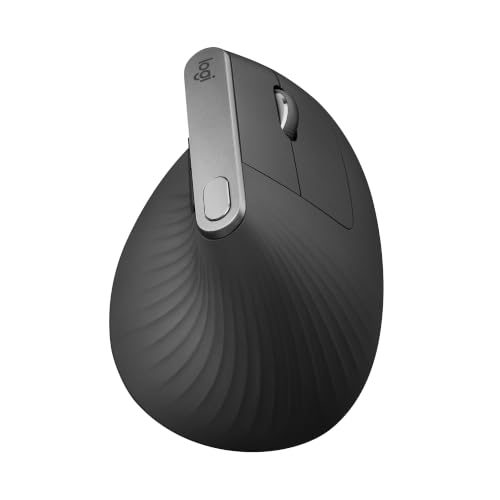 1. Logitech MX Vertical Medium to large hands, and the longer service life
| 57° | 10M clicks · MTTF >150K hr | USB-C, ~4 months | Medium–large | |
| 2 | 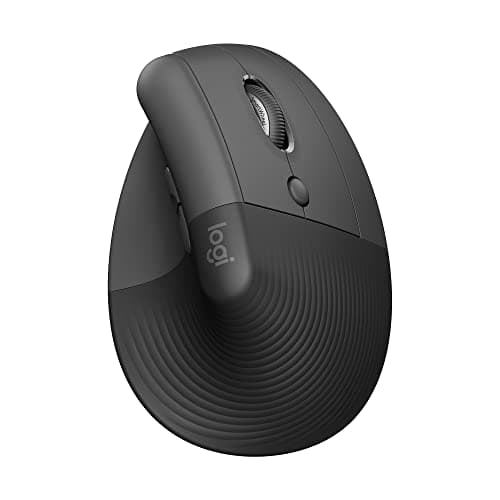 2. Logitech Lift Smaller hands, left-handers, and never charging anything
| 57° | 5M clicks | 24-month AA | Small–medium · 125 g | |
| 3 | 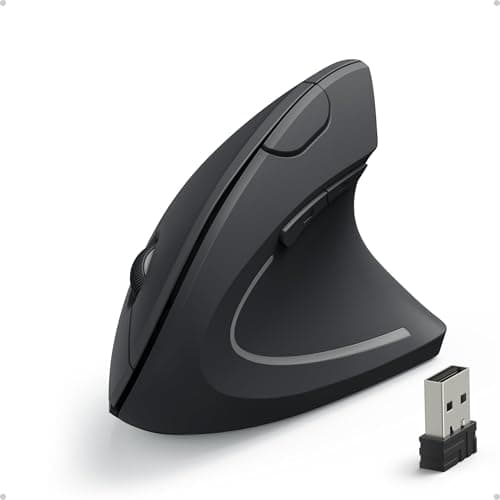 3. Anker 2.4G Wireless Vertical Ergonomic Optical Mouse Budget pick — finding out whether vertical suits you
| — | — | 2 × AAA | Not published |
The angle column settles the question most reviews spend their time on — both Logitechs publish 57°, so neither has better vertical geometry than the other and anyone telling you otherwise is describing a shell, not an angle. The service-life column is the clearest difference: 10 million clicks against 5 million, from the same manufacturer’s own datasheets, plus an MTTF figure on the MX Vertical that almost nothing in this category publishes. The power column is the one you will notice weekly. A 24-month AA is a different relationship with a mouse than a USB-C cable every four months, and which you prefer is not a specification. Logitech’s “10% less muscular strain” claim is not in this table because it has no named study, method or sample size behind it. Every price is read from our live price layer and dated under the picks; prose here carries no dollar figures.
Prices and stock as of November 24, 2026, from Amazon’s API. They change; we show a live number or none at all. #ad — we earn a commission.
Buy the Logitech MX Vertical if your hand is medium or large and you want the longer-lived mouse: Logitech publishes 10 million clicks and an MTTF above 150,000 hours, double the Lift’s rating and a reliability figure its rivals do not state. Buy the Logitech Lift if your hand is small or medium, you are left-handed, or you would rather change an AA every two years than plug in a cable every four months. The published 57° grip angle is identical, so the geometry is not the decision. The budget pick is the Anker 2.4G Wireless Vertical, which is the cheapest way to find out whether vertical suits you — and which publishes no grip angle at all.
The angle is the same. That is the whole starting point.
Vertical mice are sold on their angle, and most comparisons between these two spend their time there. There is nothing to compare: Logitech’s own datasheets publish 57° for the MX Vertical and 57° for the Lift. The hand position the category exists to change is identical on both.
What that leaves is a set of differences that are easier to decide, because they are about you rather than about ergonomics theory: the size of your hand, whether you are left-handed, how long you expect to keep a mouse, and whether you would rather charge something or replace a battery twice a decade.
Where the two genuinely differ
Service life. 10 million clicks on the MX Vertical against 5 millionon the Lift, both from Logitech’s own documentation, plus an MTTF above 150,000 hours that only the MX Vertical publishes. If you keep peripherals for years rather than seasons, that is the most decision-relevant number on the page.
Power. USB-C and roughly four months per charge, against 24 months on one AA. Neither is better; they are different habits.
Shell and hand. The Lift is the smaller shell at 125 g, stated by Logitech as designed for smaller hands, and it is the only one of the two with a left-handed SKU. The MX Vertical is the bigger body.
Sensor. Both publish 400–4000 DPI, so this is not a tie-break either.
The claim we are not using
Logitech markets the MX Vertical with “10% less muscular strain”. There is no named study, method or sample size behind that figure — Logitech’s own footnote concedes as much — so it is not evidence and it is not used anywhere above. The useful consequence is that it does not separate these two mice at all: whatever a 57° angle does for your forearm, both of them do it identically, and the strain line is attached to only one of them for marketing reasons rather than geometric ones.
If neither is right
Two directions worth knowing. If a vertical shell is uncomfortable in your hand regardless of angle, a trackball moves the pointer without moving your arm at all, which is a different solution to the same problem. And if you are coming from a sculpted MX Master, the published posture figure is worth reading first: Logitech states a grip angle for both of these and none at all for the MX Master 3S.
What we can’t tell you
We have not used these three. We cannot tell you how either Logitech shell feels in your specific hand, whether 5 million clicks is enough for your working week, or whether the Lift’s smaller body suits a hand on the boundary between sizes. What this page is, is the published angle, service life, power and sensor figures for both mice, set beside each other so the real differences are visible — with the one unsupported marketing claim named as unsupported. Our methodology says where that evidence stops.
The picks, in detail
1. Medium to large hands, and the longer service life
Logitech MX Vertical
Same published 57° angle as the Lift, in a bigger shell with double the click rating — 10 million against 5 million — and an MTTF figure almost nobody in this category publishes. It charges over USB-C rather than running on a battery for two years.
- Grip angle
- 57°
- DPI
- 400–4000
- Battery / warranty
- 4 mo charge / 1 yr
Buy this one if your hand is medium or large and you want the mouse to outlast the fashion. Logitech publishes a 10 million click service lifefor the MX Vertical — exactly double the Lift’s — and an MTTF above 150,000 hours, which is a reliability figure practically nothing else in this category states at all. The grip angle is 57°, published on Logitech’s own datasheet, and the sensor runs 400–4000 DPI with the nominal 1000 and 1600 values listed separately.
Power is the real difference in daily use: it is rechargeable over USB-C, roughly four months per charge.
Ignore the headline that sells it. Logitech’s “10% less muscular strain”claim has no named study, method or sample size behind it — its own footnote says so — and this page does not use it as evidence. The mouse is still the pick on the published numbers; the strain figure is just not one of them.
Good
- 57° vertical angle is published on Logitech's own datasheet — a real geometric spec you can check against your own hand
- 10 million click service life, double the Lift's 5 million and the highest here
- Logitech publishes an MTTF figure (>150K hours) — almost nobody in this category publishes reliability at all
- 400–4000 DPI adjustable, with nominal values (1000 and 1600) stated separately
- Rechargeable via USB-C, ~4 months per charge
Not so good
- The headline '10% less muscular strain' claim has no named study, method or sample size behind it — Logitech's own footnote says only 'As compared with a traditional non-vertical mouse'
- The datasheet's flat '10%' and the press release's 'up to 10 percent' are different claims, and 'muscular strain' vs 'muscular activity' are different constructs
- US warranty is 1 year; the same datasheet gives EMEA and Japan 2 years for the identical mouse
- Large — at 120mm long it does not suit smaller hands, which is what the Lift exists for
- Right-handed only; no left-handed version
Don’t buy it if: you have small hands, or you are buying because of the 10% figure. On the first: the Lift is the same 57° geometry in a smaller shell and is the better fit. On the second: that number is Logitech's own unpublished marketing claim, and if it is doing the persuading then you are being persuaded by something nobody can check.
$119.99 −35%
Price as of November 24, 2026. #ad — we earn a commission.
Where these numbers came from
- Logitech MX Vertical Advanced Ergonomic Mouse — official B2B datasheet (PDF; source of the 57° angle, 400–4000 DPI, 10 million click service life, 4-month charge, and the '10%' claim with its single footnote) — read 2026-07-16
- Logitech press release, 20 August 2018 — 'Logitech Goes Vertical With Its Most Advanced Ergonomic Mouse' (the 'up to 10 percent' / 'muscular activity' wording, which differs from the datasheet's) — read 2026-07-16
- Logitech Limited Hardware Warranty terms — read 2026-07-16
2. Smaller hands, left-handers, and never charging anything
Logitech Lift
The same published 57° geometry in a smaller, lighter shell, with a 24-month AA instead of a charging cable — and half the click rating. It is the only one of the two with a genuine left-handed version.
- Grip angle
- 57°
- DPI
- 400–4000
- Battery / warranty
- 24 mo battery / 1 yr
Buy this one if your hand is small or medium, if you are left-handed, or if charging things is the part of modern hardware you have had enough of. The published angle is identical at 57° in a shell Logitech states is designed for smaller hands, at 125 g— lighter than the MX Vertical — and it runs 24 months on a single AA, so in normal use you never charge it at all.
The left-handed version genuinely exists (910-006492 / 910-006495), which is rare enough in this category to be the deciding fact for a lot of people. Logitech also publishes per-button click ratings rather than one headline number.
The cost is durability on paper: 5 million clicks, half the MX Vertical’s, on the same brand’s own datasheet. And read the warranty carefully — the datasheet’s two-year hardware term is the business SKU; the consumer version is shorter.
Good
- Identical published 57° angle to the MX Vertical, in a shell Logitech states is designed for smaller hands
- 24-month battery life on a single AA — no charging, ever, in normal use
- Left-handed version genuinely exists (910-006492 / 910-006495), which is rare in this category
- Logitech publishes per-button click ratings, not just one headline number
- Lighter than the MX Vertical at 125g
Not so good
- 5 million click service life — half the MX Vertical's 10 million, on the same brand's own datasheet
- The datasheet says '2-year hardware limited warranty', but that is the BUSINESS SKU. The consumer ASIN gets 1 year
- No battery indicator, per Logitech's own spec table
- No Easy-Switch — you pair to one machine at a time
- The 'Ergo certified' line names no certifier, only 'criteria set out by leading ergonomists'
Don’t buy it if: you have large hands, or you want the longest-lived switches. The MX Vertical is bigger and rated for twice the clicks. The Lift is the fit answer, not the durability answer.
$79.99 −32%
Price as of November 24, 2026. #ad — we earn a commission.
Where these numbers came from
- Logitech Lift for Business Vertical Ergonomic Mouse — official B2B datasheet (PDF; source of the 57° angle, 5 million click service life, 24-month battery life, and the 2-year business warranty figure) — read 2026-07-16
- Logitech Support — LIFT Vertical Ergonomic Mouse specification (400–4,000 DPI; per-button click ratings) — read 2026-07-16
3. Budget pick — finding out whether vertical suits you
Anker 2.4G Wireless Vertical Ergonomic Optical Mouse
Budget pick. A fraction of either Logitech and genuinely vertical, with an 18-month warranty that is longer than Logitech's US consumer term — on a mouse whose maker publishes no grip angle at all.
- Grip angle
- —
- DPI
- 800/1200/1600
- Battery / warranty
- 18 mo warranty
If what you actually want to know is whether a vertical mouse suits your wrist, this is the cheapest way to find out, and it is included here for that reason rather than as a third contender. It is genuinely vertical, publishes three switchable DPI steps (800/1200/1600) on Anker’s own page, runs on two AAAs, and carries an 18-month warranty— longer than Logitech’s one-year US consumer term.
What you give up is every number that would let you compare it with the two above. Anker publishes no grip angle— the 90° figure repeated across the internet has no Anker source, and we checked their own product page — and no click or service-life rating, so there is nothing to set against 5 million and 10 million. The DPI ceiling is 1600.
Good
- By far the cheapest way to find out whether vertical geometry suits you at all
- Three switchable DPI steps (800/1200/1600) are published on Anker's own page
- Runs on 2 AAA batteries — nothing to charge
- 18-month warranty is longer than Logitech's 1-year US consumer term
Not so good
- Anker publishes NO grip angle. The '90°' figure repeated across the internet has no Anker source — we checked their own product page
- 1600 DPI ceiling is a fifth of the MX Master 3S's 8000
- No click/service life rating published, so there is no way to compare durability with the Logitechs' 5M and 10M
- Anker's own product page says only 'Hassle-Free Warranty' with no duration printed on it
- Batteries not included, per Anker's own package contents
Don’t buy it if: you want to know what you are buying. Anker publishes an ergonomic-design claim and three DPI steps and essentially nothing else — no angle, no click rating, no battery life. It may well be a fine mouse. It is an unspecified one.
$29.99 −37%
Price as of November 24, 2026. #ad — we earn a commission.
Common questions
Is the Logitech Lift just a smaller MX Vertical?
On the spec that defines the category, yes — both publish 57°. On everything else, no: the Lift halves the published click rating to 5 million, swaps USB-C charging for a 24-month AA, weighs 125 g, is built for smaller hands and exists in a left-handed version. The MX Vertical adds an MTTF above 150,000 hours, which the Lift does not publish. The vertical mouse roundup ranks both against the rest of the category on that same angle.
Which one should I buy for a smaller hand?
The Lift — Logitech states the shell is designed for smaller hands, and the 125 g weight goes with that. Hand size is the one variable in this comparison that no amount of specification can substitute for, so measure before you choose: ergonomic mice for small hands and ergonomic mice for large hands are the two pages that sort the whole registry by that figure rather than by brand.
Is a vertical mouse actually better for your wrist?
A vertical mouse changes forearm rotation, and that is a geometric claim rather than a medical one: your hand sits closer to a handshake position instead of palm-down. We are not going to tell you it treats anything, and the most-quoted number in this category — Logitech’s “10% less muscular strain” — has no published study behind it, which is why it appears nowhere on this page as evidence. How to choose an ergonomic mouse covers what the published specs can and cannot tell you, and ergonomic mouse vs trackball is the other shape worth considering.
What about the warranty on each?
Read the SKU, not the datasheet headline. The Lift’s datasheet states a two-year hardware limited warranty, but that is the business SKU — the consumer version is shorter. The MX Vertical’s US consumer term is one year. The budget Anker here publishes 18 months, which is the longest of the three and is one of the few comparisons where the cheapest option wins outright.
Sources
Every figure on this page comes from one of these. If a manufacturer doesn’t publish a number, we print “—” rather than estimate it.
- Logitech MX Vertical Advanced Ergonomic Mouse — official B2B datasheet (PDF; source of the 57° angle, 400–4000 DPI, 10 million click service life, 4-month charge, and the '10%' claim with its single footnote) — read 2026-07-16
- Logitech press release, 20 August 2018 — 'Logitech Goes Vertical With Its Most Advanced Ergonomic Mouse' (the 'up to 10 percent' / 'muscular activity' wording, which differs from the datasheet's) — read 2026-07-16
- Logitech Limited Hardware Warranty terms — read 2026-07-16
- Logitech Lift for Business Vertical Ergonomic Mouse — official B2B datasheet (PDF; source of the 57° angle, 5 million click service life, 24-month battery life, and the 2-year business warranty figure) — read 2026-07-16
- Logitech Support — LIFT Vertical Ergonomic Mouse specification (400–4,000 DPI; per-button click ratings) — read 2026-07-16
- Anker 2.4G Wireless Vertical Ergonomic Optical Mouse — Anker's own product page (800/1200/1600 DPI; 'Hassle-Free Warranty' with no duration stated on the page; NO grip angle published anywhere on it) — read 2026-07-16
Read next
The best vertical mice
Both of these ranked against the rest of the vertical category on the published grip angle.
Logitech MX Master alternatives
If you came from a sculpted MX Master and are deciding whether vertical is the move at all.
Ergonomic mice for small hands
The page that decides this comparison for most people, because hand size is the variable neither datasheet covers.
How to choose an ergonomic mouse
What grip angle, DPI and click ratings actually tell you before you compare two models.