The best lighting for a home office with no windows
A basement, a converted closet, an interior room with a borrowed wall. The mistake is buying one brighter lamp. A window was doing four jobs at once — filling the room, lighting the desk, lifting the wall behind the screen and putting light on your face — and each of those is a different fitting with a different published spec.
By Stephen V.Last reviewed
Five layers, and what each maker publishes
These five are not competing with each other — they sit in different layers, and the order is the order to buy them in. Every cell is the manufacturer's own published figure, cited on the roundup each product is ranked on.
| # | Fitting | Published output | Color temp | Longevity figure | Layer | Price |
|---|---|---|---|---|---|---|
| 1 | 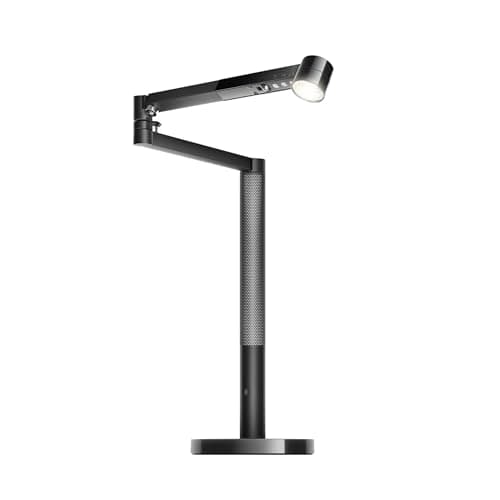 1. Dyson Solarcycle Morph Desk Light (CD06) A room that has to supply its own daylight
| 70 lm/W at 11.2 W | 2700–6500K | 181,000 hr L70 | Ambient + task | |
| 2 | 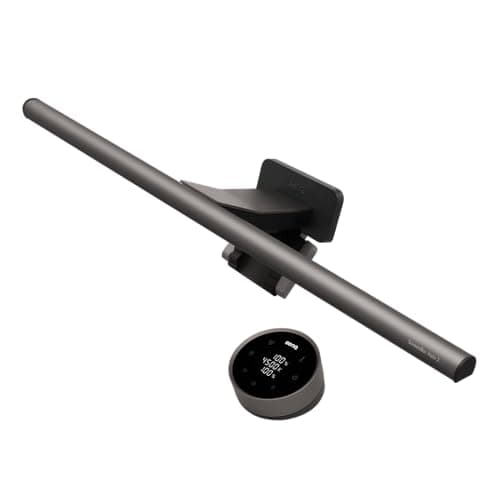 2. BenQ ScreenBar Halo 2 A dark room with a screen at the center of it
| >1000 lux at 50cm | 2700–6500K | 50,000 hr | Screen | |
| 3 | 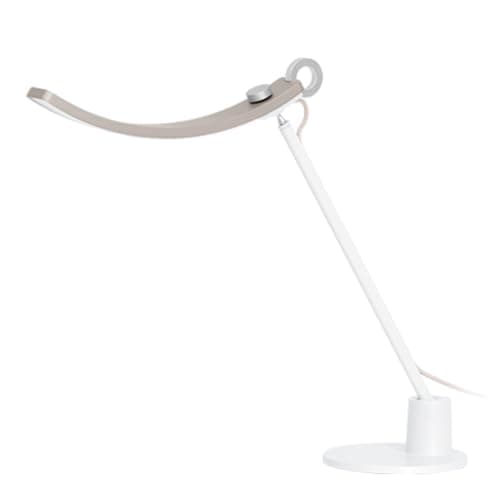 3. BenQ Genie e-Reading Desk Lamp The task layer, cheaply, with the numbers printed
| 1600 lux at 45cm | 2700–5700K | 50,000 hr | Task | |
| 4 | 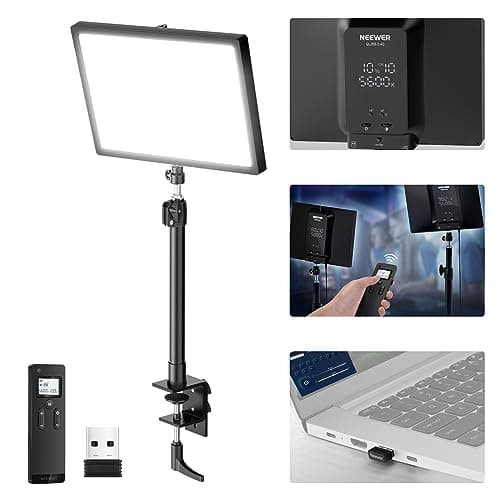 4. Neewer GL25B 12.9″ Streaming Key Light Your face, on calls, in a room with no daylight
| 1400 lm | 2900–7000K | 2 yr warranty | Face / calls | |
| 5 | 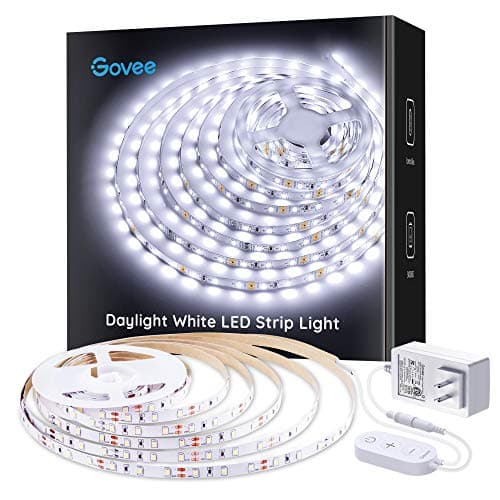 5. Govee Cool White LED Strip Lights 16.4ft, 6500K, Dimmable The wall behind the screen
| — | 6500K | 12 mo warranty | Wall behind screen |
The output column is four different units on purpose. Nobody in this category publishes the same figure as anybody else: Dyson prints efficacy and rated power but no lumen total, BenQ prints point illuminance with a measuring distance, Neewer prints a lumen maximum, and Govee prints nothing at all. Converting between them would mean inventing numbers, so the cells say what each maker says. Not one of the five publishes a room-level figure — no lux at the desk for a room of a stated size — so nothing here tells you how bright your room will be. The longevity column mixes rated lives and warranties because that is what is available, and only Dyson’s names a threshold; how long LED desk lamps last explains why that distinction matters more than the size of the number.
Prices and stock as of October 18, 2026, from Amazon’s API. They change; we show a live number or none at all. #ad — we earn a commission.
The short answer: stop looking for one brighter lamp. The best single buy for a windowless office is the widest tunable light rather than the brightest one — the Dyson Solarcycle Morph at 2700–6500K with a rated life that names its standard, or the BenQ Genie at 1600 lux at 45 cm for roughly half. But the real answer is four fittings, not one, because a window was doing four separate jobs and losing it means replacing all four.
The four jobs a window was doing
Filling the room. Soft, broad light with no single source you can point at. It is why a room with a window does not have hard shadows under the monitor.
Lighting the desk. Enough light on paper, keyboard and hands that your eyes are not jumping between a bright screen and a dim surface a foot below it.
Lifting the wall behind the screen. The one nobody thinks of. In a room with a window the wall behind your monitor gets light for free; without one it is the darkest surface in your field of view, directly behind the brightest. OSHA names that step specifically: “high contrast between light and dark areas of the computer screen, horizontal work surface, and surrounding areas can cause eye fatigue and headaches.”
Putting light on your face. Invisible until you join a call, at which point it is the only thing anybody else can see.
One brighter ceiling fitting addresses the first job and makes the third worse, because a brighter room lights the front of the wall and leaves the strip behind your monitor in shadow. That is the trap this page exists to avoid.
Buy in this order
First, the task layer. A desk lamp that publishes an illuminance figure with a measuring distance — the Genie’s 1600 lux at 45 cm is the clearest example in our coverage — and, in a windowless room specifically, as much tunable color temperature range as you can afford. Fixed 4000K is fine in a room that also gets daylight. It is the only light you will ever see in a room that does not.
Second, the wall behind the screen. The cheapest of the five picks and the biggest change per dollar in a dark room. A 6500K strip aimed at the wall, run dim — the bias-lighting literature suggests keeping it under about 10% of the display’s peak brightness — closes the contrast step without adding glare.
Third, the screen layer. A monitor light bar is the only fitting that lights the desk in front of the monitor with nothing landing on the panel. In a windowless office it is doing the job the window used to do from the side.
Fourth, your face. Only when you have a call that matters. A panel at 1400 lm across 2900–7000K is the most published spec per dollar among the face lights we rank, and it is the one layer you can honestly defer.
The figure nobody publishes
Not one of these five products publishes a room-level number. No lux at the desk for a room of a stated size, no coverage area, nothing you could use to calculate whether your particular box room will be bright enough. What they publish is point illuminance at a stated distance, or a lumen maximum, or an efficacy and a wattage — four different units across five products, which is why the compare table above does not convert between them.
That is a real limitation and worth saying plainly rather than papering over with a confident-sounding figure. The practical consequence is that the layer model is more reliable than any single number: four fittings in four places will light a windowless room better than one fitting producing a bigger lumen total, and you do not need a spec sheet to verify that — you can see it.
The wall and the ceiling you already have
Two things in a windowless room cost nothing and change more than any purchase here. Wall color is the first: every bias strip depends on it, Antec states the requirement outright in its own spec (“placed against light colored wall”), and the bias-lighting literature recommends a neutral gray, “Munsell N5 or N7,” because a colored wall tints reflected light before it reaches you. A dark feature wall behind a monitor is the single worst surface for this.
The second is what the existing overhead fitting is. A single bare downlight directly above a desk produces the hard shadow the task layer then has to fight. Moving the desk out from under it, or swapping a bare lamp for a diffused one, is free and does more than adding a fifth product. In a windowless room, overhead light and desk light are not interchangeable — they are two of the four layers.
What we can’t tell you
We have not measured any of these products, in a windowless room or anywhere else, and we have not measured a room before and after adding them. Every figure on this page is the manufacturer’s own, published, cited and dated, which is how everything on this site works.
We also cannot tell you that any of this substitutes for daylight in a physiological sense. A lamp with a 6500K setting is a lamp with a 6500K setting; the research on light timing and sleep is a different subject with different evidence, handled in how desk lighting affects sleep rather than smuggled into a buying recommendation. What we can say is narrower and still useful: a windowless office loses four distinct lighting jobs at once, and the published specs above tell you which product does which.
The picks, in detail
1. A room that has to supply its own daylight
Dyson Solarcycle Morph Desk Light (CD06)
The widest published color temperature range in our coverage — 2700–6500K — on the only lighting product on this site whose rated life names a standard. In a room with no daylight to track, the range is the feature you are actually buying.
- Color temp
- 2700–6500K
- CRI
- CRI 90+ (R9 48)
- Rated life
- 181,000 hr L70
A windowless office has no outside light to work with, which means the only color temperature the room ever sees is the one you set. This is the product in our coverage with the most of it to set: 2700–6500K, plus a 1800–3400K docked mode for when the working day is over.
It is also the only lighting product on this site that publishes a longevity figure with a threshold and a standard attached — 181,000 hr L70, per IEC 62717 — and the only one that publishes R9 (48 min), the deep-red sample that a CRI headline leaves out. It prints flicker (<1%), beam angle (78°), efficacy (70 lm/W) and rated power (11.2 W) as well, which is more of a photometric picture than anything else here offers.
What it is not is a room light, and no figure above says it is. It is an expensive desk lamp — roughly twice the Genie — and in a windowless room you will still need something on the ceiling. Buy it because you want the range and the cited standard, not because a lamp can replace a window. It cannot.
Good
- The only lamp here that publishes R9 (48 min) — the deep-red sample that Ra excludes and that most affects skin tones
- The only lighting product on this site that names a standard for its longevity number: L70 per IEC 62717
- States its assumption out loud — 181,000 hr is 8 hours a day, and the arithmetic checks
- Widest color temperature range here at 2700–6500K, plus a 1800–3400K docked mode
- Publishes flicker (<1%), beam angle (78°), luminous efficacy (70 lm/W) and rated power (11.2W) — figures most lamp brands never print
Not so good
- Roughly twice the Genie's price
- Its headline CRI (90 or above) is lower than BenQ's Ra>=95
- L70 describes lumen maintenance, not the moment the lamp dies — the driver and electronics are not covered by the figure
- We have not verified IEC 62717's extrapolation limits, so we can tell you the standard is named but not that the projection is conservative
Don’t buy it if: the price is the deciding factor. This is a lot of money for a desk lamp, and the Genie puts a documented Ra>=95 and 1600 lux on your desk for about half. Buy this one because you want the R9 figure and the cited standard, not because it is a Dyson.
Price as of October 18, 2026. #ad — we earn a commission.
Where these numbers came from
2. A dark room with a screen at the center of it
BenQ ScreenBar Halo 2
In a room with no daylight the screen is the brightest object in it, and this is the fitting that lights the desk in front of the screen without putting anything on the glass. Over 1000 lux at 50 cm, with the distance stated.
- Color temp
- 2700–6500K
- CRI
- Ra≥95
- Rated life
- 50,000 hr
The specific problem of a windowless office is that the monitor becomes the light source, and everything around it — keyboard, notepad, hands — sits in its shadow. A monitor light bar is the only fitting that puts light on that surface from above the screen without any of it landing on the panel.
BenQ publishes >1000 lux at 50 cm, which is a photometric claim with a measuring distance attached rather than a bare lux sticker, across 2700–6500K at Ra≥95. The wireless controller matters more here than it does in a bright room: in a windowless office this is the light you adjust several times a day, and reaching over the desk to touch a panel on the bar gets old.
The rated life is 50,000 hours with no threshold and no test method cited, which is the category norm and is not the same kind of claim as Dyson’s L70 figure — we work through why. This also does nothing for the wall behind the screen, which is the fifth pick’s job.
Good
- Wireless controller rather than a touch panel on the bar itself
- Rear backlight, which is the actual reason to pick this over the Pro
- Presence detection plus auto-brightness
- Publishes Rf≥96 alongside Ra≥95 — a modern TM-30 fidelity figure, not just the 1974 one
Not so good
- Draws max 15W against the Pro's 8.5W for the same published >1000 lux at 50cm
- The 50,000 hr figure comes from a blanket BenQ FAQ that does not name the Halo 2, not from its spec page
- 1-year US warranty, on the most expensive bar here
Don’t buy it if: you do not need the backlight. The Pro puts the same published light on your desk for less money and 6.5 fewer watts — the Halo 2's premium is almost entirely the glow behind the monitor.
Price as of October 18, 2026. #ad — we earn a commission.
Where these numbers came from
- BenQ ScreenBar Halo 2 specification page — read 2026-07-16
- BenQ FAQ — color temperature range of ScreenBar Halo 2 — read 2026-07-16
- BenQ FAQ — LED lifespan (the source of the 50,000 hr figure) — read 2026-07-16
3. The task layer, cheaply, with the numbers printed
BenQ Genie e-Reading Desk Lamp
1600 lux at 45 cm and Ra≥95 for roughly half the Dyson. The task layer, with a published illuminance figure and a stated measuring distance — which is rarer on a desk lamp than it should be.
- Color temp
- 2700–5700K
- CRI
- Ra≥95
- Rated life
- 50,000 hr
If the Dyson is more lamp than the budget allows, this is the one that still publishes figures you can check. BenQ states 1600 lux at 45 cm — an illuminance with a distance, which is a real photometric spec and not a marketing number — and Ra≥95 across 2700–5700K.
In a windowless room the task layer does the work the window used to: it puts enough light on paper and keyboard that your pupils are not constantly adapting between a bright screen and a dim desk. How many lumens you need at a desk is the arithmetic for sizing that.
Two honest limits. Its top end is 5700K, not 6500K, so it has less cool range than the Dyson for a room that never sees daylight. And its 50,000-hour rated life cites no threshold at all — a bare hour count, like almost everything in this category.
Good
- Publishes center illuminance with a stated measuring distance — 1600 lux at 45cm — which is a real photometric spec rather than a bare lux claim
- Ra>=95, higher than the Dyson's published figure
- Lights a 90cm width at 500 lux, so it covers a whole desk rather than a pool
- 13 color temperatures across 2700–5700K with an ambient light sensor
- About half the Dyson's price
Not so good
- The 50,000 hr rated life cites no standard, no metric and no test method — we cannot tell you whether it is L70 or something else entirely
- Publishes no R9, so the Ra>=95 figure is a 1974 average with the deep-red sample left out
- Narrower top end at 5700K — it will not reach the 6500K daylight setting the Dyson offers
- Draws max 18W, more than the 11.2W Dyson
Don’t buy it if: you need the lamp to go properly cool. 5700K is the ceiling, and if you are matching a 6500K monitor or a north-facing window, this lamp cannot get there.
Amazon isn’t showing a buyable offer for this one right now.
Price as of October 18, 2026. #ad — we earn a commission.
Where these numbers came from
- BenQ Genie specification page (source of Ra>=95 and 1600 lux at 45cm) — read 2026-07-16
- BenQ Genie product page (source of the 2700-5700K range, 13 color temperatures and the '17 years, 8 hours per day' claim) — read 2026-07-16
- BenQ FAQ — LED lifespan (the blanket source of the 50,000 hr figure) — read 2026-07-16
4. Your face, on calls, in a room with no daylight
Neewer GL25B 12.9″ Streaming Key Light
1400 lumens, 2900–7000K and a two-year warranty — the most published figures per dollar of any face light we rank, and the layer a windowless room fails hardest without.
- Max output
- 1400 lm
- Color temp
- 2900–7000K
- Warranty
- 2 yr
This is the layer people in windowless rooms notice last and complain about first, because they see it only on calls. With no window there is no soft front light on your face, so the camera gets whatever the monitor is emitting — which is blue, uneven, and changing with whatever is on screen.
The Neewer publishes 1400 lm maximum output and 2900–7000K, the widest tunable range of any light here, plus a stated 2-year warranty. Among the five key lights we rank it is the one that prints the most numbers for the least money, which is the only basis on which this site ranks anything.
It is a panel on a stand, so it needs desk space the other picks do not, and a wide CCT range is only useful if you set it to match the rest of the room — two different whites on one face is worse than one wrong one. Lighting for video calls covers placement.
Good
- Publishes 2300 lux at 0.5 m — the only figure on this page that tells you how much light actually arrives somewhere, because it comes with a stated distance
- 1400 lm luminous flux, the second-highest here and well ahead of both Logitechs
- CRI 98+, the highest published figure in the group
- The only product here that prints a warranty term (2 years) on its own product page
- Publishes its LED count (176), input voltage and physical dimensions — a full spec table rather than three marketing bullets
- A 12.9-inch panel is a physically larger source than the Logitech column or the Elgato Neo, and a larger source is a softer one
Not so good
- 623 g on a desk stand needs real desk area, which is exactly what a small home-office desk does not have
- Runs on a DC12V adapter rather than USB, so it occupies a wall socket and cannot be powered from a laptop or a dock
- No rated life published, same as everything else here
- Neewer's cheaper models publish far less than this one does, so the brand name alone is not a guarantee of a spec sheet — check the specific model
- Control is through a 2.4 GHz remote and Neewer's own desktop app rather than an ecosystem most people already run
Don’t buy it if: your desk is already full. This is the largest object in the roundup, and a 12.9-inch panel on a stand in front of a small desk is a genuine loss of working surface. If space is the constraint, the Elgato Neo on its desk-edge clamp or the monitor-mounted Litra Glow do the same job without touching the desktop.
Price as of October 18, 2026. #ad — we earn a commission.
Where these numbers came from
5. The wall behind the screen
Govee Cool White LED Strip Lights 16.4ft, 6500K, Dimmable
16.4 ft of 6500K strip for the wall behind the screen — the cheapest layer here and the one a windowless room needs most, because the wall has no daylight of its own to lift it.
- Color temp (CCT)
- 6500K
- CRI
- —
- Warranty
- 1 yr
In a room with a window, the wall behind your monitor gets some light for free. In a windowless room it gets none, so the contrast step between a bright panel and a dark wall is at its worst — and that step is the one OSHA describes as a cause of eye fatigue and headaches.
16.4 ft at 6500K on a dimmable control box is enough strip for one large monitor or two screens from a single run, and Govee’s 12-month term is the only warranty in the bias category we could confirm on the maker’s own live site.
It publishes no CRI, like every bias strip we have found, and no power draw. It is also the layer that depends most on something you cannot buy: the color of the wall it is pointed at. A magnolia wall will warm a 6500K strip before the light ever reaches you.
Good
- Govee's own Returns & Refunds page lists “Strip lights - 12” months as the warranty term — the only warranty on this page we could confirm directly on a manufacturer's own live site, not a reseller mirror
- 16.4 ft of strip covers a large monitor, a two-monitor spread, or a small TV without buying a second kit — cut it down at the marked segments if you need less
- A plain 6500K white with a dimmable control box; no RGB or color-cycling mode to leave on by accident
- 300 LEDs across the run, for coverage that does not visibly dim toward the far end the way a shorter, sparser strip can
Not so good
- No CRI figure published anywhere we could find, on the listing or on Govee's own site
- No rated-life figure in hours specific to this product — Govee's blog discusses LED lifespan in general industry terms elsewhere, but that is not this product's own published spec, so we are not printing it
- Larger and more expensive than the Luminoodle if a single 24″ monitor is all you have
- A control box and power brick is bulkier than a USB-only strip — more to route behind the desk
Don’t buy it if: you only need to light one small monitor and would rather not deal with a control-box-and-brick setup — the Luminoodle is the tighter kit for exactly that job, at the cost of Govee's documented warranty.
$19.99 −15%
Price as of October 18, 2026. #ad — we earn a commission.
Where these numbers came from
- Govee Cool White LED Strip Lights 16.4ft, 6500K, Dimmable — Amazon product listing (source of the 6500K color temperature, the 300-LED count and the dimmable control box; ASIN B07XHLGSXN) — read 2026-07-26
- Govee US: Returns & Refunds Policy (source of the published warranty period — the policy's own table lists “Strip lights - 12” months, with the warranty period starting “on the date of delivery of the products to the customer”) — read 2026-07-26
Common questions
How many lumens does a windowless home office need?
Nobody selling these products publishes an answer, so treat any single figure with suspicion — including ours. What you can do is size the task layer, which is the one that affects your working day most, and our lumens for a desk guide walks through that arithmetic with the published figures. For the room as a whole, the useful reframing is that a windowless office is not underlit so much as uniformly lit: one overhead fitting produces flat light, strong shadows directly under the screen, and a dark wall behind it. Adding layers fixes that at far lower wattage than making one fitting brighter.
Can a daylight lamp replace a window?
Not as a lighting claim and not as a health claim. What a tunable lamp gives you is a published color temperature range — the Dyson here states 2700–6500K, the Neewer 2900–7000K — so you can set a cool white during the working day and a warm one afterwards, which a fixed fitting cannot. What it does not give you is a window’s intensity, its spectrum, or its spatial variation, and none of these makers claims it does. We treat the circadian literature separately in how desk lighting affects sleep, with its sources, precisely so that a product page never has to carry a health claim.
What color temperature should a windowless office run at?
Cooler during work, warmer after — and the reason to care more in a windowless room is that there is no outside reference competing with whatever you choose. Three of the five picks here publish a range that spans that decision; the BenQ Genie tops out at 5700K rather than 6500K, which is the one real difference between it and the Dyson beyond price. Bias lighting is the exception and should not be tuned: it wants to sit at the display white point, which is why the strips in this category print 6500K and nothing else. Color temperature for a home office is the full version.
Which layer should I buy first if I can only buy one?
The task layer, then the screen layer. A desk lamp with a published illuminance figure — the Genie’s 1600 lux at 45 cm, the Dyson’s cited photometry — fixes the thing you feel all day, which is a bright panel surrounded by an unlit desk. The bias strip is the cheapest of the five and the one with the biggest effect per dollar in a windowless room, because the wall behind your screen gets no borrowed daylight at all. The face light is the one you can defer until you have a call that matters.
Does a monitor light bar or a desk lamp make more sense with no window?
Both, and for different reasons — which is the whole argument of this page. The light bar puts light on the desk in front of the screen with nothing landing on the glass, which is exactly the shadow a windowless room creates. The desk lamp lights the wider work zone and, on the two picks here, carries the better-documented color spec and the wider tunable range. If you genuinely have to choose, desk lamp vs monitor light bar sets out the trade directly.
Sources
Every figure on this page comes from one of these. If a manufacturer doesn’t publish a number, we print “—” rather than estimate it.
- Dyson Solarcycle Morph CD06 desk light — specifications (CRI 90 or above, R9 48 MIN, 181,000 hrs, L70 per IEC 62717) — read 2026-07-16
- BenQ ScreenBar Halo 2 specification page — read 2026-07-16
- BenQ FAQ — color temperature range of ScreenBar Halo 2 — read 2026-07-16
- BenQ FAQ — LED lifespan (the source of the 50,000 hr figure) — read 2026-07-16
- BenQ Genie specification page (source of Ra>=95 and 1600 lux at 45cm) — read 2026-07-16
- BenQ Genie product page (source of the 2700-5700K range, 13 color temperatures and the '17 years, 8 hours per day' claim) — read 2026-07-16
- BenQ FAQ — LED lifespan (the blanket source of the 50,000 hr figure) — read 2026-07-16
- Neewer GL25B 12.9-inch streaming key light — product specifications (“Luminous Flux: 1400lm”; “Maximum Illuminance: 2300lux/0.5m”; “Color Temperature: 2900K-7000K”; “CRI: 98+”; “Maximum Power: 25W”; “Input Voltage: DC12V”; “Number of LEDs: 176”; 268 x 188 x 37.25 mm; 623 g; “2-Year Warranty”). No rated life is published on the page — read 2026-08-15
- Govee Cool White LED Strip Lights 16.4ft, 6500K, Dimmable — Amazon product listing (source of the 6500K color temperature, the 300-LED count and the dimmable control box; ASIN B07XHLGSXN) — read 2026-07-26
- Govee US: Returns & Refunds Policy (source of the published warranty period — the policy's own table lists “Strip lights - 12” months, with the warranty period starting “on the date of delivery of the products to the customer”) — read 2026-07-26
- OSHA eTools: Computer Workstations — Workstation Environment (source of the contrast statement: “High contrast between light and dark areas of the computer screen, horizontal work surface, and surrounding areas can cause eye fatigue and headaches.”) — read 2026-07-26
Read next
How to light a home office
The general version of the layer model, for a room that does have a window to work with.
How many lumens for a desk?
Size the task layer properly — the arithmetic, with the published figures these lamps actually print.
The best desk lamps for a home office
Where the Dyson and the Genie are researched in full, including the CRI and R9 figures quoted here.
The best monitor light bars
The screen layer ranked on its own, including the cheaper bars this page does not pick.
How desk lighting affects sleep
The circadian question, handled with its own sources — and kept off the product pages on purpose.
Lighting for eye strain
Which of these layers actually bears on eye strain, and which causes it does not touch.