The best monitor light bars
A light bar fixes one specific problem: a bright screen in a dim room. Here are four, ranked on what their makers actually publish — including the two that could not give us a straight answer.
By Stephen V.Last reviewed
Quick picks
Ranked, with the manufacturer’s own longevity figure next to each one. Tap a row to jump to the full write-up.
| # | Product | Best for | Longevity | Price |
|---|---|---|---|---|
| 1 | 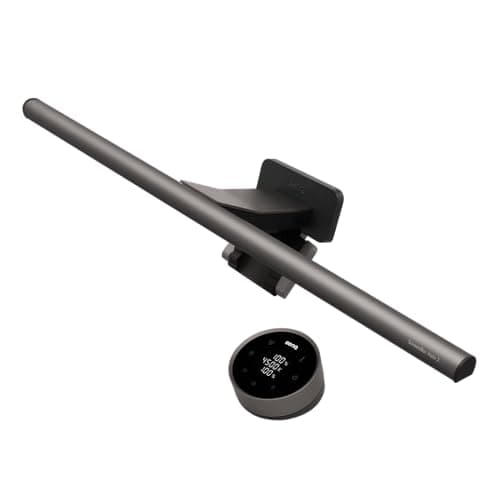 BenQ ScreenBar Halo 2 The most capable bar here, and the extra 6.5W over the Pro buys you the backlight — not more light on the desk. | Dark rooms and long evenings | 50,000 hrRated life | |
| 2 | 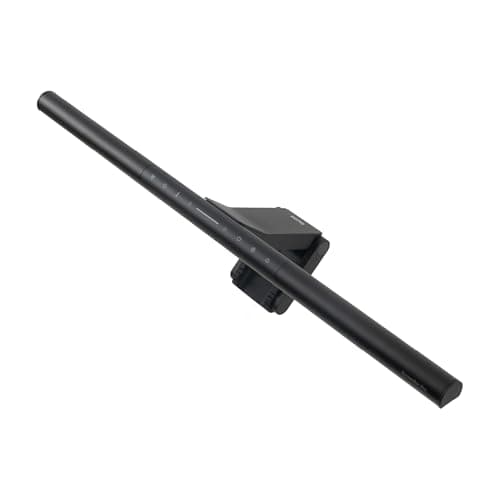 BenQ ScreenBar Pro The same published light output as the Halo 2, at 8.5W and less money. For most desks this is the right BenQ. | Most desks | 50,000 hrRated life | |
| 3 | 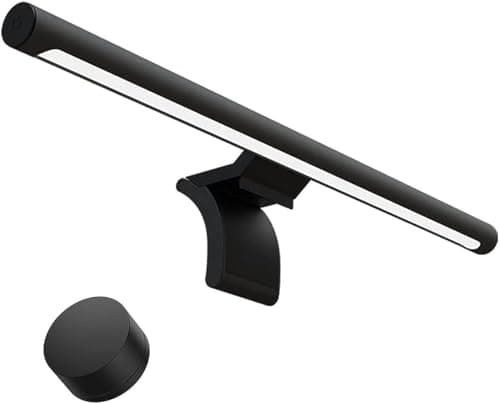 Xiaomi Mi Computer Monitor Light Bar A third of the BenQ's price, half its rated life, and a CRI figure we could not pin down at the source. | Trying the idea cheaply | 25,000 hrRated life | |
| 4 | 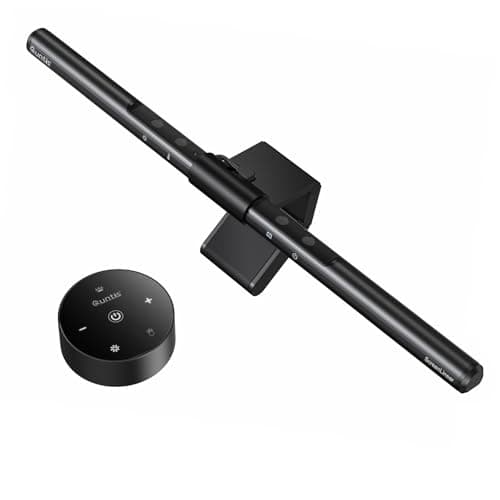 Quntis Monitor Light Bar (Focus 40cm) The cheapest way to test whether you want one. Its own product page cannot agree with itself on the headline spec. | The lowest possible entry price | 40,000 hrRated life |
Prices as of October 18, 2026, from Amazon’s API. They change; we show a live number or none at all.
A monitor light bar solves exactly one problem, and it is worth naming precisely, because if you do not have this problem you do not need one: a bright screen in a dim room forces your eyes to keep adjusting between the two. OSHA’s computer-workstation guidance describes the mechanism directly — high contrast between the screen and its surroundings “can cause eye fatigue and headaches.”
A bar clamps to the top of the monitor and throws light forward onto the desk, not back at the screen. That is the whole idea, and it is a good one. What follows is four of them, ranked on the three numbers their makers publish.
Why there is no lux column
You would expect brightness to be the headline spec. It cannot be, because the four figures are not comparable. BenQ publishes center illuminance at a stated 50cm. Quntis publishes “≥700 lux” with no distance at all. Xiaomi publishes no lux figure whatsoever, only luminous flux.
Illuminance falls off with the square of the distance from the source, so a lux number with no stated distance is not a specification. Putting those three values in one column would imply a comparison that does not exist. So we left it out and used color temperature instead, which everyone publishes on the same terms.
The CRI problem nobody mentions
Every bar here leads with a CRI number, and CRI is a weaker spec than the marketing implies. Ra is the average of eight low-saturation test colors. It excludesR9 — deep red — which is the sample that matters most for skin tones. A lamp can average Ra95 while rendering reds badly, and nothing in the number tells you.
The stronger point comes from the CIE itself, the international body that defined CRI in the first place. In a published position statement they say plainly that Ra “does not agree well with overall perceived color rendering” for LED sources, that the problem is significant for narrow-band LEDs specifically, and that the metric needs updating. CRI was first published in 1965 and last improved in 1974.
Every Ra>95 sticker on a 2026 lamp is a 1974 formula that the organization which wrote it has said in writing is not fit for the light source it is being applied to. That is not our opinion — the statement is free to read and it is in our sources below.
Credit to BenQ for publishing Rf≥96 alongside Ra on the Pro and Halo 2. Rf is the newer TM-30 fidelity index over a far larger sample set. It is a different metric and should never be read as the same number, but its presence means BenQ is at least aware of the problem.
What we can't tell you
We have not switched any of these on. We cannot tell you about flicker, build quality, whether the Halo 2’s controller is delightful or annoying, or how the Quntis holds up after a year. Those need hands, and we do not have them — see our methodology for exactly what that does and does not buy you.
What we can do is read all four spec sheets properly and tell you that two of them do not survive the reading. That is worth something on its own.
The picks, in detail
1. Dark rooms and long evenings
BenQ ScreenBar Halo 2
The most capable bar here, and the extra 6.5W over the Pro buys you the backlight — not more light on the desk.
- Color temp
- 2700–6500K
- CRI
- Ra≥95
- Rated life
- 50,000 hr
Read the two BenQ spec tables side by side and something jumps out: the Halo 2 and the ScreenBar Pro publish the identicalfront-light figures — >1000 lux center illuminance at 50cm, and an 85 × 50cm coverage area at 500 lux. The Halo 2 draws nearly twice the power. That extra wattage is going to the backlight, not onto your desk.
Which makes the choice unusually clean for once: if you want the glow behind the screen, this is the one. If you want light on your keyboard, you are looking at a premium for a feature you did not ask for.
Good
- Wireless controller rather than a touch panel on the bar itself
- Rear backlight, which is the actual reason to pick this over the Pro
- Presence detection plus auto-brightness
- Publishes Rf≥96 alongside Ra≥95 — a modern TM-30 fidelity figure, not just the 1974 one
Not so good
- Draws max 15W against the Pro's 8.5W for the same published >1000 lux at 50cm
- The 50,000 hr figure comes from a blanket BenQ FAQ that does not name the Halo 2, not from its spec page
- 1-year US warranty, on the most expensive bar here
Don’t buy it if: you do not need the backlight. The Pro puts the same published light on your desk for less money and 6.5 fewer watts — the Halo 2's premium is almost entirely the glow behind the monitor.
Price as of October 18, 2026. #ad — we earn a commission.
Where these numbers came from
- BenQ ScreenBar Halo 2 specification page — read 2026-07-16
- BenQ FAQ — color temperature range of ScreenBar Halo 2 — read 2026-07-16
- BenQ FAQ — LED lifespan (the source of the 50,000 hr figure) — read 2026-07-16
2. Most desks
BenQ ScreenBar Pro
The same published light output as the Halo 2, at 8.5W and less money. For most desks this is the right BenQ.
- Color temp
- 2700–6500K
- CRI
- Ra≥95
- Rated life
- 50,000 hr
Good
- Publishes the same >1000 lux at 50cm as the Halo 2, at 8.5W
- Eight color-temperature segments across 2700–6500K
- Motion sensor and auto-dimming
- Explicitly named in BenQ's 50,000 hr FAQ list, which the Halo 2 is not
Not so good
- Touch controls on the bar mean reaching over the desk
- No backlight
- Like every BenQ here, the rated-life figure cites no standard at all
Don’t buy it if: you sit in a room with good ambient light already. A light bar solves screen-versus-room contrast; if your room is already bright, you are solving a problem you do not have.
Price as of October 18, 2026. #ad — we earn a commission.
Where these numbers came from
- BenQ ScreenBar Pro specification page — read 2026-07-16
- BenQ FAQ — color temperature range of ScreenBar Pro — read 2026-07-16
3. Trying the idea cheaply
Xiaomi Mi Computer Monitor Light Bar
A third of the BenQ's price, half its rated life, and a CRI figure we could not pin down at the source.
- Color temp
- 2700–6500K
- CRI
- —
- Rated life
- 25,000 hr
The dash in the CRI slot is not an oversight. Xiaomi’s site returns an error to automated requests, and the two figures circulating from their own regional pages — Ra90 on the US page, Ra95 on the global one — contradict each other for the same model number. The official manual says Ra95.
We could have printed the higher one. Instead: a dash, and this paragraph. If Xiaomi publishes one consistent number, we will use it.
Good
- Roughly a third of the ScreenBar Pro's price
- Full 2700–6500K range, same as the BenQ bars
- Xiaomi publishes luminous flux (270 lm) and a real service-life figure
Not so good
- 25,000 hr rated life — half BenQ's claim
- We could not verify the CRI: mi.com blocks access and its US and global pages appear to disagree (Ra90 vs Ra95)
- Publishes no lux figure at any distance, so its output cannot be compared to the BenQs
- No documented ambient light sensor
Don’t buy it if: color accuracy matters for your work. Not because it is necessarily bad — but because we genuinely cannot tell you what it is, and neither, apparently, can Xiaomi's own two websites.
Price as of October 18, 2026. #ad — we earn a commission.
Where these numbers came from
4. The lowest possible entry price
Quntis Monitor Light Bar (Focus 40cm)
The cheapest way to test whether you want one. Its own product page cannot agree with itself on the headline spec.
- Color temp
- 3000–6500K
- CRI
- —
- Rated life
- 40,000 hr
This one earns its place on the list as much for what it demonstrates as for what it is. Quntis’s product page claims “Ultra-High Ra98 CRI” in the marketing copy and Ra90 in the specifications table, on the same page, at the same time.
And the “≥700 lux” claim comes with no measuring distance. Lux falls off with the square of distance, so a lux figure without a distance is not a specification — it is a number. Hold it close enough to anything and you can hit 700.
Good
- Cheapest bar here by a wide margin
- Auto-dimming against ambient light
- 40,000 hr claimed rated life — higher than Xiaomi's
Not so good
- Quntis's own page claims Ra98 in marketing copy and Ra90 in the spec section
- Publishes '≥700 lux' with no measuring distance, which makes the figure meaningless
- No published power draw at all
- Narrower 3000K floor — it will not go as warm as the others
Don’t buy it if: you want to know what you are buying. Every number on this product's page is either self-contradictory, missing its units of measurement, or absent.
Price as of October 18, 2026. #ad — we earn a commission.
Where these numbers came from
Common questions
Is a high CRI actually worth paying for?
Less than the stickers suggest. CRI (Ra) averages eight low-saturation test colors — and it excludesR9, the deep-red sample that most affects skin tones. A lamp can post Ra95 and still render reds poorly. More pointedly, the CIE, the standards body that defined CRI, published a position statement saying Ra “does not agree well with overall perceived color rendering” for LEDs and needs replacing. The formula was last improved in 1974. So the difference between an Ra90 and an Ra95 sticker is smaller than the marketing, and both rest on a 52-year-old method.
Do monitor light bars actually reduce eye strain?
The mechanism is real and it is about contrast, not brightness. OSHA states that “high contrast between light and dark areas of the computer screen, horizontal work surface, and surrounding areas can cause eye fatigue and headaches.” A bar lights the desk without throwing light at the screen, which narrows that gap. We are not qualified to tell you it will fix your symptoms, and we are not going to — but the geometry is sound and it is documented by people who are.
Why are two of the CRI values blank?
Because we could not verify them. Quntis’s own product page claims Ra98 in its marketing copy and Ra90 in its spec table simultaneously. Xiaomi’s site blocks automated access and its US and global pages appear to publish different figures for the same model. When the manufacturer cannot give one answer, printing either one would be us choosing a number rather than reporting one. So we print a dash.
What does 50,000 hours of rated life actually mean?
Less than you would hope. Rated-life figures like these describe lumen maintenance— how long until the LED fades to a set percentage of its original brightness — not when the lamp stops working. The US Department of Energy’s reliability consortium puts it bluntly: this kind of data “can predict lumen depreciation but not lifetime.” It assumes the driver, power supply and electronics never fail, which in real lamps is frequently what does fail first. Worth noting none of the BenQ bars cites any standard for its 50,000 hr figure at all.
Sources
Every figure on this page comes from one of these. If a manufacturer doesn’t publish a number, we print “—” rather than estimate it.
- BenQ ScreenBar Halo 2 specification page — read 2026-07-16
- BenQ FAQ — color temperature range of ScreenBar Halo 2 — read 2026-07-16
- BenQ FAQ — LED lifespan (the source of the 50,000 hr figure) — read 2026-07-16
- BenQ ScreenBar Pro specification page — read 2026-07-16
- BenQ FAQ — color temperature range of ScreenBar Pro — read 2026-07-16
- Xiaomi MJGJD01YL Computer Monitor Light Bar — official user manual (third-party archive; mi.com blocks direct access) — read 2026-07-16
- Quntis Monitor Light Bar Focus 40cm product page (the page that contradicts itself on CRI) — read 2026-07-16
- CIE Position Statement on CRI and Color Quality Metrics (2015) — the body that defined CRI, on why Ra fails for LEDs — read 2026-07-16
- LED Luminaire Lifetime: Recommendations for Testing and Reporting (US DOE / LED Systems Reliability Consortium, 3rd ed.) — read 2026-07-16
- OSHA eTools: Computer Workstations — Workstation Environment — read 2026-07-16
Read next
BenQ ScreenBar Halo 2 vs ScreenBar Pro
The two BenQ bars side by side: identical published front-light figures, nearly twice the wattage on one.
Are monitor lights worth it?
Not sure you need one at all? The honest worth-it verdict, and the ten-second test to run before you spend.
The best bias lighting
The other screen light: a bar lights your desk, bias lighting lights the wall behind the screen. Different jobs.
What a monitor light bar actually does
The mechanism, in one page, before you spend anything on one.
Desk lamp vs monitor light bar
They solve different problems. Most people need one, not both.
Lighting for eye strain
What OSHA and CCOHS actually say — including where they disagree.
The best desk lamps
If your problem is the whole desk rather than the screen.
Black Friday & Cyber Monday home office deals
BenQ's own documented November discounts on these bars — modest, dated, and on Amazon too.
Best home office gifts under $150
The ScreenBar Pro as a gift: who it suits and what to check about their desk first.