The best under-desk walking pads
A walking pad makes you four to six inches taller, and your desk has to find those inches at the top of its range. So we ranked these on published deck height and weight capacity rather than on top speed — and found a 180 lb spread in capacity, a 1.4 inch spread in height, and not one warranty longer than eighteen months.
By Stephen V.Last reviewed
Compare the four walking pads
The published figures that decide this purchase, side by side. Every cell is the manufacturer's own number for the exact model we link, cited in the write-up below — and one cell is an em-dash because the figure does not exist.
| # | Pad | Deck height | Capacity | Belt (L × W) | Speed | Warranty | Price |
|---|---|---|---|---|---|---|---|
| 1 | 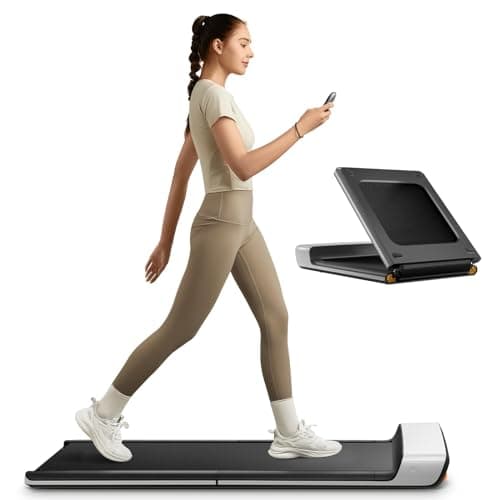 1. WalkingPad P1 Foldable Walking Pad Treadmill Living under a desk that still has to stand up
| 5" | 220 lb | 47 × 16.5" | 0.3–3.75 mph | 1 yr | |
| 2 | 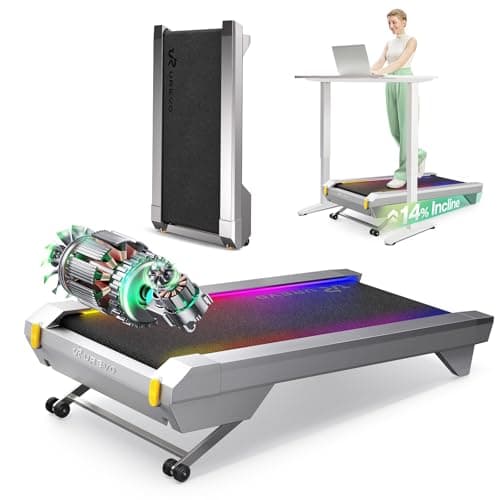 2. UREVO CyberPad Smart Walking Pad Heavier walkers, and anyone who wants incline
| 6.3" | 400 lb | 39.4 × 16.5" | 0.6–4.0 mph | 1 yr + 180 d | |
| 3 | 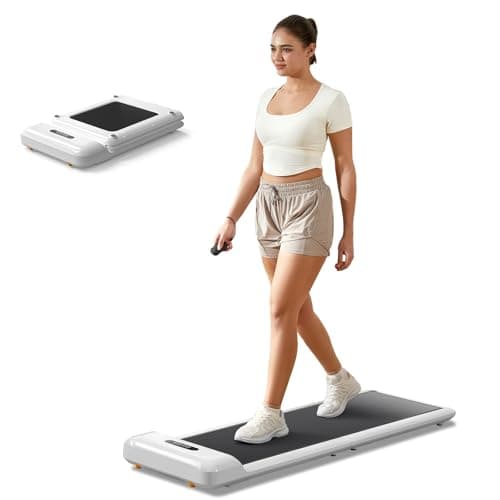 3. WalkingPad C2 Foldable Walking Pad Treadmill A longer belt and an assembled box
| 4.9"* | 220 lb | 47.2 × 15.7" | 1–4 mph | 1 yr | |
| 4 | 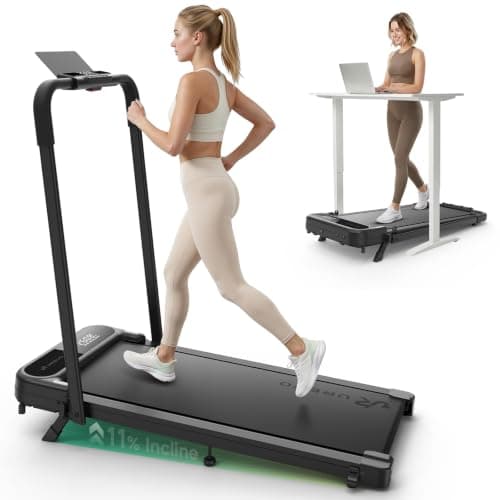 4. UREVO Strol 2E Pro Under Desk Treadmill The lowest price with a real capacity rating
| — | 300 lb | 36.2 × 15.2" | 0.6–6.2 mph | 1 yr + 180 d |
* The C2’s height is a dated figure. KingSmith’s C2 page served us its speed, capacity, walking area, motor and warranty on 2026-10-10 but not its specs table; the 4.9″ deck thickness is from our own read of the same manufacturer page on 2026-07-26. Everything else in this table is a 2026-10-10 read. The em-dash is real: UREVO publishes no deck or folded height for the Strol 2E Pro — its 38.6″ dimension is the upright handle. Incline: only the two UREVO pads publish one (0–14% on the CyberPad, 12% on the Strol 2E Pro); neither WalkingPad has it. Noise: only UREVO publishes a figure at all, approximately 35 dB for the CyberPad, and that is a manufacturer claim we have not measured.
Prices and stock as of October 18, 2026, from Amazon’s API. They change; we show a live number or none at all. #ad — we earn a commission.
Almost every walking pad listing leads with a top speed. It is the wrong number, and it is wrong in a way that costs people the whole purchase.
A walking pad is a slab that goes between the floor and your feet. Stand on one and you are four to six inches taller than you were, and your desk has to find those inches somewhere at the top of its range. That is the constraint that decides whether a pad is usable in your room, and it is a published figure — sometimes. Speed, meanwhile, decides almost nothing for someone who wants to answer email while moving.
So this page ranks four pads that are real, currently-purchasable listings on the two numbers that actually matter: how tall the deck is, and how much weight it is rated for. Every figure was read on the manufacturer’s own site and is cited at the bottom, with the date. One of the cells in the comparison table is an em-dash, and the reason it is empty is one of the more useful things on this page.
What we ranked on, and why
Four criteria, in this order, and the order is the argument.
1. Deck height. The pad’s thickness comes straight off the top of your desk’s usable standing range. ANSI/HFES 100-2007 puts the sit/stand work surface range at 56–118 cm — about 22 to 46.5 in — and the sit-stand desks we rank publish maximum heights between 47.3 in and 50.5 in. Subtract 5 in of pad and the best of them behaves like a 45.5 in desk; subtract 6.3 in and it behaves like a 44.2 in one. This is first because it is the spec that decides whether the pad works at all for you, and because exactly one manufacturer here publishes it in both folded and unfolded states.
2. Published weight capacity. The spread on this page is 220 lb to 400 lb, which is the widest gap in any spec here. A pad under its rating is a motor doing the job it was designed for. A pad over it is a moving surface under your feet carrying a load it was not tested for.
3. Belt size, in both dimensions. Length is stride, width is margin for error, and listings love to quote whichever one flatters the model. We print both: 36.2 in to 47.2 in of length, 15.2 in to 16.5 in of width.
4. The published warranty. The third slot of every Spec Line on this site is the longevity number. In this category it produced the shortest set of terms we have found anywhere on this site, and that finding is below.
What we did not rank on: top speed, app features, LED colors, or “3 HP” claims in isolation. We have not walked a single mile on any of these pads, and our methodology is candid about what reading a spec sheet does and does not buy you.
The finding: the pad costs you desk height, and only one brand tells you how much
This is the arithmetic every listing in this category leaves out.
Your desk has to clear your elbows while you stand. Put a pad under you and the floor moves up, so the desk has to move up too — by exactly the pad’s deck height. Here is what the four pads on this page do to a desk whose published maximum is 47.3 in, the lowest ceiling among the standing desks we rank:
- WalkingPad P1, 5 in — effective maximum 42.3 in.
- WalkingPad C2, 4.9 in (our dated read) — effective maximum 42.4 in.
- UREVO CyberPad, 6.3 in — effective maximum 41 in.
- UREVO Strol 2E Pro — unknown. UREVO publishes no deck height for it.
Those are not small differences. The gap between the slimmest and the tallest pad here is 1.4 in, and it lands at precisely the point where a taller user runs out of desk. Work out your own standing height first — the desk height calculator takes a minute — then add the pad, then check the desk’s published maximum. If the sum does not work, no feature on any of these pads fixes it.
It is also why we rank the P1 first on a page where it does not win a single other spec outright. It is the only pad here that publishes a height for both states, and publishes the same number for both: 5 in unfolded, 5 in folded. You can plan a room around that.
Capacity: the 400 lb outlier, and why it matters more here than on a chair
Three of these four pads are rated at 220 lb, 220 lb and 300 lb. The UREVO CyberPad publishes 400lbs/181kg, which is 180 lb clear of either WalkingPad.
We argue elsewhere — in office chair weight capacity, explained — that a published capacity is a tested design limit rather than a failure point, and that reading 300 lb as “fine at 299, broken at 301” misunderstands what the number is. That still holds. But two things make a walking pad a stricter case than a chair.
The first is dynamic loading. Sitting puts your weight on a seat plate steadily; walking puts it on one foot, landing, repeatedly, on a deck with a motor and a roller under it. The second is the failure mode. A chair that gives up lowers you to the floor. A belt that gives up does it while moving.
So the rule we would apply to this category is tighter than the one for chairs: if you are within 20 to 30 lb of a pad’s published rating, buy the one rated higher. On this page that means the CyberPad is not merely the heavy-duty option, it is the only option above 300 lb — and the cost of that rating is the 6.3 in deck and a belt 7.6 in shorter than the P1’s.
Belt numbers, and the trade the C2 makes
The published walking areas here are 47.2 × 15.7 in, 47 × 16.5 in, 39.4 × 16.5 in and 36.2 × 15.2 in. That is an eleven-inch spread in length and a 1.3 in spread in width, and the two dimensions do what you would expect: length sets how long a stride the belt can take, and width sets how much you can wander before a foot finds the frame.
The C2 is the instructive one. It has the longest belt on the page by two tenths of an inch over the P1 — and the narrowest, by eight tenths of an inch under it. It is the same pad in a photograph. It is not the same pad under your feet, and for desk work, where your attention is on a screen rather than on your feet, we would take the width every time.
At the other end, the Strol 2E Pro’s 36.2 × 15.2 in surface is the smallest here in both directions, and it is paired with the highest published top speed on the page: 6.2 mph. Those two specs argue with each other. A 36 in belt is not a running deck whatever the controller permits, and the honest reading of that pairing is that the speed figure exists for the listing rather than for the user.
The warranty is one year, everywhere
KingSmith states a “1-year warranty with optional extension available” on both the P1 and the C2. UREVO states “1 Year + 180 Days Extended Warranty” on both the CyberPad and the Strol 2E Pro. Eighteen months is the longest term on this page.
Hold that next to the desk the pad is going under. The sit-stand desks we rank publish 3-year, 10-year, 15-year and lifetime frame coverage. A desk frame is two motors and a steel column; a walking pad is a motor, a controller, a belt, a deck and a set of rollers, all of them doing dynamic work every time you use it. The companies building them will stand behind that for twelve to eighteen months.
That is not a reason not to buy one. It is a reason to price a pad as a consumable with a service life rather than as furniture, and to factor the extended-warranty offer into the real cost rather than treating it as an upsell to dodge.
What nobody in this category publishes
Operating noise. One figure on this entire page: UREVO’s approximately 35 dB for the CyberPad, which is a manufacturer claim we have not verified. KingSmith publishes no dB figure for either pad, and UREVO publishes none for the Strol 2E Pro. Third-party measurement of the category reports manufacturer ratings of 42–65 dB and measured output of 42.7–59 dB at 2 mph — above the one claim anybody here makes. If you live above someone, this is the specification you most need and the one the industry least wants to print.
Deck height on 2-in-1 models. UREVO gives the Strol 2E Pro’s dimensions as 42.5 × 21.9 × 38.6 in. The 38.6 in is the upright safety handle. The thickness of the part you stand on — the number that decides whether it fits under your desk — is not published. It is a representative gap rather than a one-off: the moment a pad grows a frame, the dimension set starts describing the frame.
Folded size, on half of these. The P1 publishes 32.5 × 21.5 × 5 in folded. The CyberPad’s published dimension set contains no folded state at all, and neither does the Strol 2E Pro’s. If storage is the reason you are buying a pad rather than a treadmill, that absence is the thing to ask the seller about before you order.
Belt and motor life. Nobody publishes a duty cycle, a belt service interval or an hours rating. The warranty term is the only longevity figure available in this category, which is exactly why it occupies the third slot of every Spec Line above.
Who we left off, and why
Egofit is the conspicuous absence. Its Walker Pro M1 is sold on Amazon right now and is the most compact pad in common circulation, which would have made it genuinely useful on a page that ranks on size. egofit.us does not resolve from our side at all and egofitwalker.com returns a 404 on the product path, so every Egofit figure available to us was a retailer or review-site number rather than a manufacturer specification. It may be a fine pad. We are not in a position to tell you what it does.
UREVO’s SpaceWalk 3S publishes a full and attractive spec set — 51.6 × 22.1 × 6.5 in, a 42.5 × 16.54 in belt, 265 lb, 0–9% auto incline — and it is currently unavailable. We do not rank products you cannot buy, so it is named here and nowhere else on the page.
The unbranded tier — the sub-$150 pads that dominate the category by volume — is off this page as a group. The reason is simple and checkable: there is no manufacturer page to read. No published capacity from the company that built it, no warranty document, frequently no brand that exists outside the listing. That is the one thing every pad above has in common, and it is the floor we set for being rankable at all.
What we can’t tell you
We have not walked on any of these. We cannot tell you whether the C2’s brushless motor is quieter in a room than the CyberPad’s, whether the P1’s belt tracks straight after six months, how any of them sounds through a floor to the apartment below, or whether the Strol 2E Pro’s handle rattles at 4 mph. Those need feet and months, and owner reviews will serve you better there than we can.
What we can do is put the published numbers side by side: a 1.4 in spread in deck height, a 180 lb spread in capacity, an eleven-inch spread in belt length, one dB figure between four products, and not one warranty longer than eighteen months. Every one of those is a manufacturer figure with a link and a date under it.
How to actually choose
Start with the desk, not the pad. Find your standing work-surface height, add the deck height of the pad you are considering, and compare the total with your desk’s published maximum. If you do not already own a desk that reaches standing height, buy that first and read this page afterwards — a pad cannot stand in for one.
If the arithmetic works, buy the WalkingPad P1. It publishes the height you need to plan with, it has the widest belt here, and its 0.3 mph floor is the one speed figure on this page that actually serves desk work.
If you are over about 200 lb, the UREVO CyberPad is not a preference, it is the only pick on this page rated for you. Budget 6.3 in of desk height for it and accept a shorter belt; the incline range and the one published noise figure in the category come along with it.
Buy the WalkingPad C2 if the 3 HP brushless motor and an assembled box matter more to you than eight tenths of an inch of belt width and the price gap over the P1. And if the budget is the binding constraint, the UREVO Strol 2E Prois a published-spec pad from a manufacturer with a warranty document — which is more than most of what it competes against at that price can say. Just do not buy it for the 6.2 mph, and do measure your own deck clearance, because UREVO will not tell you what it is.
The picks, in detail
1. Living under a desk that still has to stand up
WalkingPad P1 Foldable Walking Pad Treadmill
The only pad here that publishes its own height in both states — 5 inches folded and unfolded — next to the largest belt on the page. If the pad has to live under a desk that also has to reach standing height, that 5 inches is the number the whole purchase turns on.
- Capacity
- 220 lb
- Deck height
- 5"
- Warranty
- 1 yr
It wins on one spec that almost nobody thinks about until the pad is in the room: 5 inches, folded or unfolded, published by the manufacturer in both states.
That is the figure that decides whether the pad works at all, because standing on it makes you five inches taller and your desk has to find those five inches somewhere. The standing desks we rank top out at a published 47.3″ to 50.5″, so a 5″ pad turns a 47.3″ desk into a 42.3″ one. For a lot of people that is still fine. For anyone tall it is the end of the idea, and this is the only pad on the page that gives you the number you need to check it before you buy.
The rest of it is the most sensible set of published figures in the category. The walking area is 47 × 16.5 in — the largest here — which matters because belt width is what your feet find when you drift, and 16.5 in is a full eight tenths of an inch wider than the C2’s. The speed range starts at 0.3 mph, which sounds absurd until you have tried to hold a video call at 2 mph; a pad that will crawl is a pad you can work on.
What you are giving up is the weight ceiling and the extras. 220 lb is the floor of this page, not the middle of it. There is no incline, no published noise figure, and the warranty is one year like everything else here.
Good
- KingSmith publishes a full dimension set in both states: "56.5 X 21.5 X 5 in" unfolded and "32.5 X 21.5 X 5 in" folded. The height does not change when it folds, which is what makes it predictable under a desk
- The largest walking area on this page — "47 X 16.5 in (1200 X 415 mm)" — and the widest belt of the four, which is the dimension your feet notice first
- A published speed floor of 0.3 mph, lower than anything else here. A pad that will crawl is a pad you can type on; the ones that start at 0.6 mph have taken that choice away from you
- 180-degree folding, published as such, with a folded length of 32.5 in — it goes flat and slides under a sofa or against a wall rather than needing a cupboard
- Published motor power of 746 W, stated in watts rather than in the "HP" figures the rest of the category prefers
Not so good
- 220 lb (100 kg) max user weight — the lowest ceiling on this page, and 180 lb less than the UREVO CyberPad below. If you are near that figure, this pad is not the one
- 62 lb (28 kg) of product weight. It folds flat; it is still a two-handed lift, and the published weight is the heaviest of the four here
- No incline. Both UREVO pads on this page publish an incline range and this one has none
- No published dB figure. Nobody in this category publishes one except UREVO, and we have not measured any of them
- The 3.75 mph speed ceiling is a walking ceiling. That is honest to what the thing is — but if the plan was to run on it, this is not the pad
Don’t buy it if: you weigh anywhere near 220 lb, or you want a pad for interval work rather than for typing on. The CyberPad below is rated to 400 lb and the Strol 2E Pro publishes 6.2 mph and a 12% incline; the P1 does neither of those things and does not pretend to.
$399.00 −13%
Price as of October 18, 2026. #ad — we earn a commission.
2. Heavier walkers, and anyone who wants incline
UREVO CyberPad Smart Walking Pad
The only pad here rated to 400 lb, and the only one with a published incline range and a published dB claim. It is also the tallest at 6.3 inches, which is 1.3 inches more of your desk's standing range than the P1 takes.
- Capacity
- 400 lb
- Deck height
- 6.3"
- Warranty
- 1 yr + 180 d
This is the pad that exists for the buyer the rest of the category quietly ignores. The published ceiling across this page is 220 lb, 220 lb and 300 lb. UREVO publishes 400 lb.
A capacity rating is not a cliff — the same argument we make about office chair weight capacity applies here, where the rating is a tested design limit rather than the point of failure. But a moving belt with a motor under it is one of the few places in a home office where being over the published figure is a genuinely bad idea, and the 180 lb spread between this pad and the two WalkingPads is the largest gap in any spec on this page.
You pay for it in height and in belt length. At 6.3 init is the tallest pad here, and the running area is 39.4 × 16.5 in, so you are getting the width of the P1 with 7.6 in less length. The incline is real and published — 0 to 14% across 14 steps — and the 35 dB claim is the only operating-noise number any manufacturer on this page is willing to print.
Note what the published dimension set does not include: a folded size. The P1 publishes one. This does not, and we are not going to infer one for you.
Good
- A published maximum load of "400lbs/181kg" — 180 lb more than either WalkingPad here and 100 lb more than the Strol 2E Pro. In a category where 220 lb is the default ceiling, that is the most useful outlier figure on this page
- "0-14% Auto-Incline 14-Level Incline Selection", published as a range with a step count rather than as a single marketing number
- The only operating noise figure published by any manufacturer on this page: approximately 35 dB. It is a claim, not a measurement, and it is still more than its competitors will say
- 16.5 in of belt width, matching the P1 and 1.3 in wider than the Strol 2E Pro
- Warranty stated as "1 Year + 180 Days Extended Warranty" — eighteen months, the longest term on this page even if it is still nowhere near a desk warranty
- 2.5 HP maximum, with a published product weight of 63.1 lb
Not so good
- 6.3 in tall — the tallest pad here, and every inch comes off the top of your desk's usable standing height. On a desk whose published maximum is 47.3 in, this pad leaves you 41 in
- 39.4 in of belt length, the second-shortest here and 7.6 in shorter than the P1. Belt length is stride length; this is the trade the capacity rating costs you
- 63.1 lb, the heaviest product weight on the page, and the published dimensions do not include a folded state — as far as UREVO's page says, this one does not fold
- The 35 dB figure is UREVO's own and unverified by us. Third-party measurements across this category run considerably higher
- 4.0 mph speed ceiling, so like the P1 it is a walking pad and not a treadmill with ambitions
Don’t buy it if: your desk's published maximum height is under about 46 inches and you are taller than average. 6.3 in of deck is the most of anyone here, and no amount of capacity or incline fixes a desk that cannot get above your elbows once you are standing on it.
Price as of October 18, 2026. #ad — we earn a commission.
3. A longer belt and an assembled box
WalkingPad C2 Foldable Walking Pad Treadmill
The longest belt on the page by a fraction, a 3 HP brushless motor, and it arrives assembled. It also costs more than the P1 while publishing a narrower belt and the same 220 lb ceiling, which is a hard trade to argue for.
- Capacity
- 220 lb
- Deck height
- 4.9"
- Warranty
- 1 yr
The C2 is the model that made this category mainstream and it is still a sensible object. It is third here because of an arithmetic problem rather than a quality one.
Its published walking area is 47.2 × 15.7 in. The P1’s is 47 × 16.5 in. So the C2 is two tenths of an inch longer and eight tenths of an inch narrower, and it costs more. Length is stride; width is margin for error. If you have ever drifted sideways on a belt while reading something on a screen, you know which of those two you notice.
What it has that the P1 does not is a 3 HP brushless motor— the highest published motor figure on this page — and KingSmith’s statement that it arrives fully assembled. Both are real. Neither changes the 220 lb ceiling it shares with the P1.
The provenance of the 4.9 in height. walkingpad.com’s C2 page gave us speed, capacity, walking area, motor and warranty on 2026-10-10, but its PERFORMANCE SPECS table did not render to automated access that day. The 4.9 in deck thickness comes from our own read of the same manufacturer page on 2026-07-26, recorded at the time on standing desk vs walking pad. That is a manufacturer figure with a date on it rather than a fresh one, and we would rather print the date than quietly present a three-month-old reading as today’s.
Good
- "47.2 x 15.7 in" walking area — the longest belt on this page, by two tenths of an inch over the P1
- A "3 HP brushless motor", the highest published motor figure here, where the two UREVO pads publish 2.5 HP and 2.25 HP
- 4.9 in of deck thickness unfolded — the slimmest figure on this page, from our dated read of KingSmith's own page (see the provenance note below)
- KingSmith states it arrives fully assembled from the factory, which is not true of flat-packed fitness equipment generally
- Published speed range of "1 - 4 MPH", so the top speed matches the CyberPad
Not so good
- 15.7 in belt width — the narrowest on this page. It buys its two tenths of an inch of length back out of the dimension your feet actually use
- 220 lb max user weight, the same low ceiling as the P1
- Its own spec table would not render to us on 2026-10-10. The deck height in this entry is from our read of the same manufacturer page on 2026-07-26 and is labeled that way on this page; every other figure here is from the live 2026-10-10 read
- A 1 mph speed floor, where the P1 publishes 0.3 mph. For typing at a desk, the slower floor is the more useful spec
- No incline, no published dB figure, one-year warranty
- It is the second most expensive pad here while publishing a narrower belt and the same capacity as the cheaper P1
Don’t buy it if: the fraction of extra belt length is not worth the price gap over the P1 — and for most buyers it is not. Buy this one for the brushless motor and the assembled box, not because it is the bigger pad; on belt width it is the smallest one on the page.
Price as of October 18, 2026. #ad — we earn a commission.
Where these numbers came from
- WalkingPad C2 Foldable Walking Machine — KingSmith's own product page (source of the "1 - 4 MPH" speed range, the "220 LB MAX USER WEIGHT", the "47.2 x 15.7 in" walking area, the "3 HP brushless motor", the SoftStep cushioning and FootSense control claims, the "arrives fully assembled" statement and the "1-year warranty with optional extension available"). Read 2026-10-10; the page's PERFORMANCE SPECS table did not render to automated access on that date. — read 2026-10-10
- WalkingPad C2 — the same manufacturer page as read on 2026-07-26 for our standing desk vs walking pad comparison, and the source of the 4.9 in unfolded deck thickness and the roughly 32.5 x 20.4 x 5.4 in folded footprint quoted here. Recorded on that page at the time of the read. — read 2026-07-26
4. The lowest price with a real capacity rating
UREVO Strol 2E Pro Under Desk Treadmill
The cheapest way onto this page, rated to 300 lb, with a 12% incline and a 6.2 mph ceiling. The catch is the belt: 36.2 x 15.2 in is the smallest surface here, and UREVO publishes no deck or folded height for it at all.
- Capacity
- 300 lb
- Deck height
- —
- Warranty
- 1 yr + 180 d
Ranked last and still worth listing, because what it is competing against at this price is not the P1 — it is the tier of unbranded pads with no manufacturer page, no published capacity and no warranty document at all.
UREVO publishes a capacity (300 lb), a speed range, an incline figure, a motor rating, a product weight and a warranty term, and it publishes them on its own site. That is a complete set by the standards of the cheap end of this category.
The honest problem is the belt. 36.2 × 15.2 in is the smallest surface on this page in both dimensions, and it is paired with the highest published top speed. Those two specs are in tension with each other, and the tension resolves the way you would expect: this is a walking pad with a running number on the box.
And the number an under-desk buyer most needs is missing. The published dimension set reads 42.5 × 21.9 × 38.6 in, and the 38.6 in is the upright safety handle. How thick the deck is — the figure that decides whether your desk can still clear your elbows with you standing on it — UREVO does not publish for this model.
Good
- A published "300lbs/136kg" maximum load, 80 lb above either WalkingPad here, at the lowest price on the page
- "0.6-6.2 MPH" — the only speed ceiling here that goes past walking pace, and a 12% incline published alongside it
- "43.4lbs/19.7kg" product weight, the lightest on this page by nearly 20 lb — the one you can actually move alone
- Warranty stated as "1 Year + 180 Days Extended Warranty", matching the CyberPad and beating both WalkingPads on paper
- A safety handle and upright frame, which is what the 38.6 in in the published dimensions refers to
Not so good
- "36.2"L x 15.2"W" running area — the smallest surface on this page in both directions, 10.8 in shorter and 1.3 in narrower than the P1. At 6.2 mph that is a small belt for a long stride
- No deck height and no folded dimensions published. The "38.6"H" figure in UREVO's dimension set is the upright handle, not the slab you stand on, so the one number an under-desk buyer needs is the one this listing does not give
- No published dB figure, and the upright frame is a second noise and vibration path a flat pad does not have
- 2.25 HP, the lowest published motor figure here, paired with the highest published top speed — which is a combination to be skeptical of rather than impressed by
- A handle makes it a 2-in-1, and a 2-in-1 is a compromise in both directions: taller than a pad under a desk, smaller than a treadmill in front of one
Don’t buy it if: you are buying it for the 6.2 mph. A 36.2 in belt is not a running deck, whatever the controller will do; if running is the goal, this is the wrong product category entirely and a real treadmill is the honest answer.
$219.99 −19%
Price as of October 18, 2026. #ad — we earn a commission.
Where these numbers came from
Common questions
Do I need a standing desk to use a walking pad?
In practice, yes, and the arithmetic is the whole reason this page ranks on height. A pad is four to six inches of deck, so standing on one makes you that much taller and your work surface has to follow. ANSI/HFES 100-2007 puts the sit/stand work surface range at 56–118 cm (about 22–46.5 in), and the standing desks we rank publish maximums of 47.3″ to 50.5″. Put a 5″ pad under a desk that stops at 47.3″ and you have a 42.3″ desk while you are on it. A fixed 29″ desk is not in the conversation at all. We worked this through in full in standing desk vs walking pad: the pad is an accessory to a desk problem you have already solved, not a cheaper way to solve it.
What does the research actually show about walking while you work?
Two separate things, and they get blurred constantly. On energy, a 2021 BMC Public Health meta-analysis of treadmill desks (13 studies, 351 participants) found a significant increase in energy expenditure of 105.23 kcal per hourversus sitting (95% CI 90.41–120.04) under laboratory conditions — while the workplace studies in the same review found no statistically significant changes in other metabolic outcomes, which the authors attribute to underpowered studies rather than to a proven absence of effect. On work output, a 2015 PLOS ONE study at 1.5 mph measured net typing about 13 WPM slowerthan sitting, with recall about 7% lower and a working-memory task about 9% lower — and the authors note that performance in both groups stayed within the normal range. That is what was measured. What it will do for you is not something a review site can tell you.
How loud is a walking pad, really?
Only one manufacturer on this page will say. UREVO states approximately 35 dBfor the CyberPad; KingSmith publishes no dB figure for either WalkingPad, and UREVO publishes none for the Strol 2E Pro. Third-party measurement of the category puts manufacturer ratings between 42 and 65 dB and measured output between 42.7 and 59 dB at 2 mph — higher than the one published claim, from a source that is neither us nor a manufacturer. We have measured none of them. If you share a wall or a floor with someone, treat every number in this paragraph as a starting point for your own test rather than an answer.
What weight capacity do I actually need?
Your weight, with headroom, and read the figure before you read the price. Three of these four pads are rated at 220, 220 and 300 lb; the UREVO CyberPad publishes 400 lb. As we argue in office chair weight capacity, explained, a published capacity is a tested design limit rather than the point at which something breaks — but a motorized belt is one place where running at or above the limit is a genuinely poor idea, because the consequence of a failure is a moving surface under your feet. Walking also loads a deck dynamically: your full body weight lands on one foot, repeatedly, for however long you walk. If you are within 20–30 lb of a pad’s rating, buy the next one up.
Does belt length matter more than belt width?
They matter for different things, and this page is a good illustration. Length is stride: the belts here run from 36.2″ to 47.2″, and the difference between those two is the difference between a shuffle and a walk. Width is margin: 15.2″ to 16.5″ sounds like nothing until you drift sideways while reading something on a screen, which is exactly what you will be doing. The C2 is the interesting case — it has the longest belt on this page and the narrowest, buying two tenths of an inch of length at the cost of eight tenths of an inch of width. For working at a desk rather than training, we would take the width.
Is a 2-in-1 pad with a handle better than a flat one?
It is a different product, and it is worse at the thing this page is about. A handle gives you something to hold at speed and makes the machine usable as a small treadmill in front of a desk rather than under one. It also means the folded object is tall, and in the Strol 2E Pro’s case it means the published dimension set gives you the handle height (38.6″) and no deck height at all. If the pad has to disappear under a desk when you are not on it, a flat pad with a published thickness is the safer purchase. If it is going to live out in the room, the handle is a reasonable thing to want.
Why is every warranty here one year?
Because that is what this category offers, and it is worth seeing plainly. KingSmith states a “1-year warranty with optional extension available” on both WalkingPads. UREVO states “1 Year + 180 Days Extended Warranty” on both of its, which is eighteen months and the longest term on this page. Then look at the desk the pad goes under: the standing desks we rank publish 3-year, 10-year, 15-year and lifetime frame warranties. A walking pad is a motor, a controller and a belt doing dynamic work, and the people who build them will stand behind that for twelve to eighteen months. Price the pad as a consumable, not as furniture.
Why isn't the Egofit Walker Pro on this list?
Because we could not read a single Egofit specification at its source. The Walker Pro M1 is sold on Amazon right now and it is the smallest pad most people have heard of, which would make it genuinely useful here — and egofit.us does not resolve from our side at all, while egofitwalker.com returns a 404 on the product path. Every Egofit figure available to us came from retailer listings and review sites, which is not a manufacturer specification. Same rule that keeps HON off the best filing cabinets and FlexiSpot off the best standing desks; our methodologyexplains why we hold it even when it means leaving a well-known product off a list. UREVO’s SpaceWalk 3S is missing for a simpler reason: it is currently unavailable, and we do not rank things you cannot buy.
Sources
Every figure on this page comes from one of these. If a manufacturer doesn’t publish a number, we print “—” rather than estimate it.
- WalkingPad P1 180° Foldable Treadmill — KingSmith's own product page (source of the "0.3 - 3.75 mph (0.5 - 6 km/h)" speed range, the "220 lb (100 kg)" max user weight, the "47 X 16.5 in (1200 X 415 mm)" walking area, the "56.5 X 21.5 X 5 in (1432 X 547 X 129 mm)" unfolded size, the "32.5 X 21.5 X 5 in (822 X 547 X 129 mm)" folded size, the 746 W motor, the "62 lb (28KG)" product weight, the 180-degree folding design and the "1-year warranty with optional extension available") — read 2026-10-10
- UREVO CyberPad for Office — UREVO's own product page (source of the "42.9"L x 22.8"W x 6.3"H" product dimensions, the "39.4"L x 16.5"W" running area, the "63.1lbs/28.6kg" product weight, the "400lbs/181kg" maximum load, the "0.6 - 4.0 MPH" speed range, the "2.5 HP" maximum horsepower, the "0-14% Auto-Incline 14-Level Incline Selection", the approximately 35 dB operating claim and the "1 Year + 180 Days Extended Warranty") — read 2026-10-10
- WalkingPad C2 Foldable Walking Machine — KingSmith's own product page (source of the "1 - 4 MPH" speed range, the "220 LB MAX USER WEIGHT", the "47.2 x 15.7 in" walking area, the "3 HP brushless motor", the SoftStep cushioning and FootSense control claims, the "arrives fully assembled" statement and the "1-year warranty with optional extension available"). Read 2026-10-10; the page's PERFORMANCE SPECS table did not render to automated access on that date. — read 2026-10-10
- WalkingPad C2 — the same manufacturer page as read on 2026-07-26 for our standing desk vs walking pad comparison, and the source of the 4.9 in unfolded deck thickness and the roughly 32.5 x 20.4 x 5.4 in folded footprint quoted here. Recorded on that page at the time of the read. — read 2026-07-26
- UREVO Strol 2E Pro Smart Treadmill — UREVO's own product page (source of the "42.5"L x 21.9"W x 38.6"H" product dimensions, the "36.2"L x 15.2"W" running area, the "43.4lbs/19.7kg" product weight, the "300lbs/136kg" maximum load, the "0.6-6.2 MPH" speed range, the "2.25 HP" maximum horsepower, the 12% incline and the "1 Year + 180 Days Extended Warranty". No folded height and no dB figure are published on this page.) — read 2026-10-10
- ANSI/HFES 100-2007 (full text) — §8.3.2.4.3 sit/stand work surface adjustment range, 56-118 cm (about 22-46.5 in). The ceiling a walking pad's own height has to fit under. — read 2026-07-26
- Oye-Somefun, Azizi, Ardern & Rotondi, BMC Public Health (2021) — systematic review and meta-analysis of treadmill desks; 13 studies, 351 participants; +105.23 kcal/hour energy expenditure vs. sitting (95% CI 90.41-120.04) in laboratory conditions, and no statistically significant changes in other metabolic outcomes in the workplace studies — read 2026-07-26
- Larson, LeCheminant et al., PLOS ONE (2015) — typing and cognitive performance while walking at 1.5 mph vs. sitting; net typing about 13 WPM slower, AVLT about 7% lower, PASAT about 9% lower, with the authors' own note that "performance of both groups was within the normal range" — read 2026-07-26
- Biology Insights — third-party walking pad noise measurements: "42 dB to 65 dB" manufacturer-rated across the category, "between 42.7 dB and 59 dB" measured at 2 mph. Not our measurement and not a manufacturer figure. — read 2026-07-26
Read next
Standing desk vs walking pad
Read this first if you do not already own a desk that stands up — it is the argument for why the pad is second in that order, not first.
The best standing desks
The desk the pad goes under, ranked on the floor and ceiling of its published height range — which is the number a pad eats into.
The best standing desks for tall people
Published maximum heights, 47.3 to 50.5 inches. Subtract your pad's deck height from these before you buy either.
The best anti-fatigue mats
The cheaper, quieter, zero-maintenance answer to standing for a long time — and the one that adds well under an inch of height.
How long should you stand at a standing desk?
What the sit-stand research actually measured, which is a separate literature from the treadmill-desk studies cited here.
Office chair weight capacity, explained
What a published capacity rating is and is not — the same reasoning applies to the 220 lb and 400 lb figures on this page.