The best anti-fatigue mats for a standing desk
An anti-fatigue mat only does anything if you're actually standing on it. We ranked five mats on the one geometry spec that changes what a mat does — thickness and surface — then checked warranties, and found that four of five publish the identical number.
By Stephen V.Last reviewed
Quick picks
Ranked, with the manufacturer’s own longevity figure next to each one. Tap a row to jump to the full write-up.
| # | Product | Best for | Longevity | Price |
|---|---|---|---|---|
| 1 | 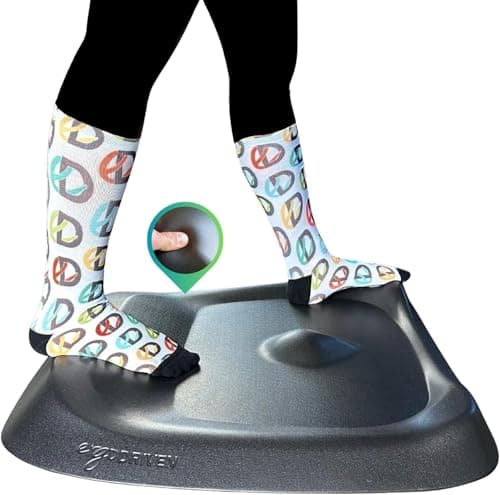 Topo Standing Desk Mat by Ergodriven The only mat here that isn't flat. Ergodriven builds a raised, uneven terrain into the surface instead of a uniform foam slab — the actual mechanism the research points at (small, constant foot-floor movement) rather than plain cushioning. It costs two to three times the flat mats on this page, and its own site can't quite agree with itself on the warranty term. | Foot movement, not just cushioning | 16 yrWarranty | |
| 2 | 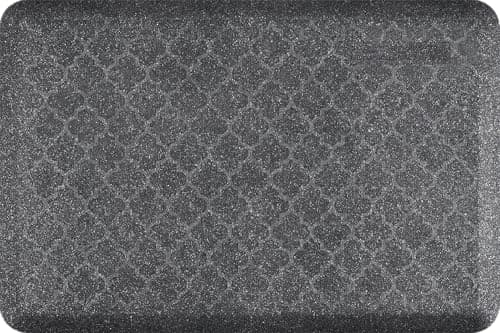 WellnessMats Granite Collection Anti-Fatigue Mat (36″ x 24″) Made in the USA, one-piece polyurethane, and the only mat here with a warranty long enough to be a decision rather than a hedge: 20 years, for residential use. You pay roughly triple the ComfiLife or Sky Solutions price for that number, on a flat mat, not a terrain one. | The longest warranty here, by a lot | 20 yr (residential)Warranty | |
| 3 | 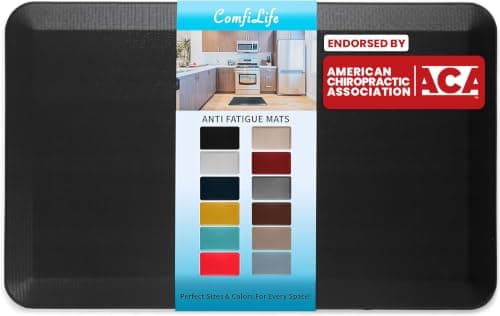 ComfiLife Anti Fatigue Floor Mat (20″ x 32″) The middle of this page in every direction: ¾″ thick, a flat foam slab, and a Home-Depot-documented “Lifetime Replacement Warranty for registered products” that beats every mat here except WellnessMats' 20-year figure, at roughly a third of WellnessMats' price. | The best warranty-to-price ratio here | Lifetime (registered)Warranty | |
| 4 | 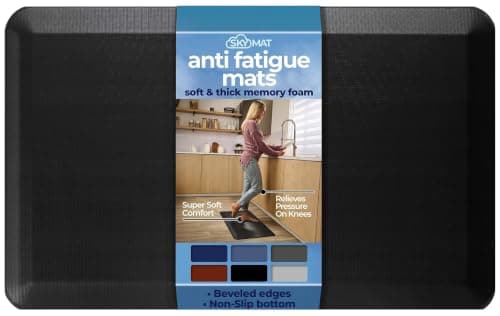 Sky Solutions Anti Fatigue Floor Mat (20″ x 39″) The largest flat footprint on this page for the second-lowest price — 20″x39″ of ¾″ foam — from a brand that, as far as we could find, publishes no warranty term anywhere: not on the Amazon listing, and not on any manufacturer page, because we could not locate one. | The most footprint per dollar | —Warranty | $46.99Amazon $49.99 −6% |
| 5 | 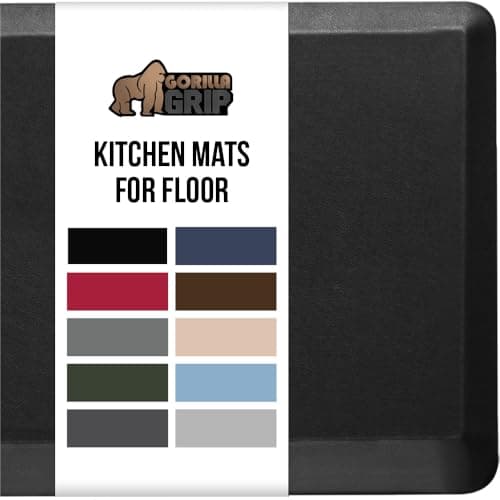 GORILLA GRIP Cushioned Standing Desk Anti Fatigue Mat (20″ x 32″) A recognizable brand with its own product page, a published ¾″ thickness and a genuine construction spec — high-density foam under an SB rubber backing — but, like Sky Solutions, no stated warranty term anywhere beyond a general “Quality Guarantee” with no length attached. | A documented build, at the lowest price here | —Warranty | $42.99Amazon $55.99 −23% |
Prices as of Sep 9, 2026, from Amazon’s API. They change; we show a live number or none at all.
An anti-fatigue mat has exactly one job: make the floor underneath a standing desk less punishing to stand on. It does not do anything for the hours you spend sitting, and it does nothing at all if the standing desk it sits in front of mostly stays down — our own research on how long people actually stand found that the standing half of a sit-stand desk is used a lot less consistently than the marketing around these desks implies. A mat is the second purchase, not the first, and it only pays for itself if the first purchase is actually getting used.
With that said: if you do stand for real hours, what should decide which mat you buy? We looked at five mats from the brands most commonly named in this category with an actual spec page to check against, and found something worth stating plainly before the individual reviews: four of the five are the same mat.ComfiLife, WellnessMats, Sky Solutions and Gorilla Grip all publish an identical ¾″ flat foam construction. The only mat here with a genuinely different surface is Ergodriven’s Topo, which is uneven by design. Once you know that, the ranking question stops being “which foam is best” and becomes “is the terrain worth the premium, and which of the four flat mats backs itself up best.”
What we ranked on, and why
In order, the same way every roundup on this site is built:
- Thickness and surface geometry.The published figure for how thick the mat is, and whether the surface is flat or engineered terrain. A mat that’s too thin barely separates your feet from the floor; a mat that’s too thick or unstable underfoot is its own hazard near a rolling chair. This is the ranking spec.
- Size.The published footprint. A thick, well-made mat that’s too small to cover where you actually stand and shift weight is the wrong mat, the same way a laptop stand that doesn’t fit your laptop is the wrong stand.
- Warranty, or the material behind it. The longevity slot, as on every product page on this site. A mat gets stood on for thousands of hours a year; how long the manufacturer will stand behind it against compression, cracking or curling is the third number.
What we deliberately did not rank on: color, brand recognition, or which mat “feels” best. We have not stood on any of these mats for hours at a time, and a comfort verdict from someone who hasn’t is an invented one — more on that in the methodology section below.
What the research on anti-fatigue mats actually says
This category makes a lot of comfort claims, so it’s worth being precise about what’s actually been measured, and by whom.
Mat beats bare floor, for most people.OSHA’s own ergonomics guidance for retail workers states directly: “Standing on anti-fatigue mats, as compared to bare floors, provides a noticeable improvement in comfort”, and elsewhere in the same document, “Good quality anti-fatigue mats reduce back and leg fatigue”. That guidance is voluntary and advisory — OSHA has no binding standard specific to anti-fatigue mats — but it’s a straight, unhedged statement from an occupational-safety body with no mat to sell.
The effect is real but selective for pain relief specifically.A 2022 study (Winberg et al., Applied Ergonomics) put 16 volunteers — 8 who reliably develop standing back pain, 8 who don’t — through an hour of light standing work on a rigid floor and on an anti-fatigue mat. Reported low back discomfort “was reduced (p = 0.03) in the PD group when on the AFM (3.6 ± 6 mm) compared to the rigid floor (6.8 ± 7 mm)”, measured on a self-reported discomfort scale. The authors’ own conclusion: “AFMs may selectively benefit individuals prone to developing standing-induced back pain by facilitating subtle movements at the foot-floor interface”. Selectively. In a study of 16 people. That is a real, specific, honestly-reported finding — and a much narrower one than “this mat stops back pain,” which is not a claim we’re making or that the study supports.
Which specific mat you buy matters less than you’d think.An earlier study (Wiggermann & Keyserling, Human Factors) had 10 participants stand for 4 hours on each of four different commercial mats plus a bare linoleum-on-concrete control. Discomfort was lower on the two softest mats compared to the bare floor — but there was no significant difference between the four mats themselves. The researchers’ own framing is worth quoting directly, because it undercuts a lot of this category’s marketing: “the effect of hours spent standing is much greater than the effect of flooring surface”, and mat selection “can be based more on criteria such as safety, durability, and cost and less on perception of comfort”. That is exactly why this page ranks on published thickness, size and warranty rather than a comfort score we have no basis to assign.
The bigger question is still whether you’re standing at all.The Cochrane review of sit-stand desks — already covered in detail on our standing-time page — found the health benefits of these desks “still unproven”. A mat sits underneath a premise that’s itself uncertain. None of that means a mat is a bad purchase; it means the honest case for one is “more comfortable while standing,” not a health claim, and OSHA’s plain comfort statement is a perfectly good reason on its own.
Terrain vs. flat: the one real design difference on this page
Once you set aside brand names, four of these five mats are functionally the same object: a rectangle of ¾″ high-density foam with a non-slip bottom. ComfiLife, WellnessMats, Sky Solutions and Gorilla Grip all state that construction on their own product pages, in almost identical language. The differences between them are size, price and warranty — not geometry.
Ergodriven’s Topo breaks that pattern on purpose. Instead of a flat top, it has a deliberately uneven, “calculated terrain” surface — 0.85″ in the flat zones, rising to 2.7″ at the terrain peaks. Ergodriven’s own marketing frames this around keeping your feet moving rather than settling into one position, and that framing lines up with the actual mechanism Winberg et al. described — “subtle movements at the foot-floor interface” — better than a flat slab’s pure-cushioning pitch does. We want to be precise about what that connection is and isn’t: no study we found tested Topo specifically, so this is a design-logic argument, not a tested result. It’s a real reason to pay Topo’s premium if the mechanism persuades you, not a guarantee that it outperforms a flat mat in practice.
The footprint and warranty split
Among the four flat mats, the real variables are size and what the manufacturer will put in writing about longevity — and here too, no mat on this page publishes the best of everything.
WellnessMats has the warranty; ComfiLife has the value.WellnessMats’ stated 20-year residential warranty is more than four times Ergodriven’s disputed 16 (or 7) years, and far ahead of Sky Solutions and Gorilla Grip, which publish no term at all. But WellnessMats also costs roughly triple what ComfiLife does for the same ¾″ thickness, and ComfiLife’s own “Lifetime Replacement Warranty for registered products” gets most of the way to WellnessMats’ promise for a fraction of the price — provided you actually register it.
Sky Solutions has the footprint; Gorilla Grip has the documentation.Sky Solutions’ 20″x39″ mat is the largest single piece on this page for the money, but the only source we could find for it is the Amazon listing itself — no independent manufacturer spec page, and no warranty term anywhere. Gorilla Grip is smaller at 20″x32″ but publishes real construction detail (foam core, SB rubber backing) on its own site — it just doesn’t publish a warranty term either, only a general goodwill guarantee.
Line those four up and there is no single winner, the same way there wasn’t one on this site’s laptop-stand page. Where a manufacturer publishes a number, it’s in the Spec Line. Where one doesn’t, the slot is a dash. Two of the twelve warranty-and-size slots across these four mats are dashes, and both are a brand’s silence, not ours.
What we did instead of testing
We have not stood on any of these mats for four hours, eight hours, or at all. No compression was measured, no foam was cut open, no discomfort was logged. What we did was read each manufacturer’s own product page, pull the numbers that actually decide the purchase, and cite every one so you can check us — the same approach this site takes everywhere, laid out on the methodology page.
That approach has a real limit here. Whether a foam core holds its shape after two years of daily standing, whether a rubber backing stays flat on carpet versus hardwood, whether the two-softest-mats finding from a 10-person lab study generalizes to you specifically — none of that is answerable from a spec sheet, and for that half of the decision, owner reviews over months of use will tell you more than we can. We could have assigned comfort scores anyway and nobody would have checked our math. That is exactly why we didn’t.
How to actually choose
Answer one question honestly before any of these specs matter: are you actually standing for hours at a time, or does the desk mostly sit raised without anyone on their feet? If you’re not sure, the evidence on how long people really stand is worth reading first, and a converter is a cheap way to find out before spending on anything else.
If you do stand for real hours: buy the Ergodriven Topoif the foot-movement mechanism is the thing that persuades you and you’re willing to pay a real premium for engineered terrain over flat foam. Buy WellnessMats if a 20-year warranty is worth roughly double the price of the budget mats to you. Buy ComfiLife if you want most of that warranty confidence for a lot less money, and remember to register it. Buy Sky Solutions if the largest footprint for the least money is genuinely your only criterion. And buy Gorilla Grip if you want a documented, named-brand construction at the lowest price here, accepting that neither budget mat backs itself with a stated warranty.
Whichever you pick, the mat is the second purchase. If the desk in front of it isn’t getting used standing, none of these specs matter at all.
The picks, in detail
1. Foot movement, not just cushioning
Topo Standing Desk Mat by Ergodriven
The only mat here that isn't flat. Ergodriven builds a raised, uneven terrain into the surface instead of a uniform foam slab — the actual mechanism the research points at (small, constant foot-floor movement) rather than plain cushioning. It costs two to three times the flat mats on this page, and its own site can't quite agree with itself on the warranty term.
- Thickness
- 0.85″–2.7″ (terrain)
- Size
- 29″ x 26.25″
- Warranty
- 16 yr
Every other mat on this page is a flat rectangle of foam. This one is not, and that is the entire reason it is ranked first.
Ergodriven states Topo is 29″ wide (along your desk) x 26.25″ back (away from your desk) x 2.7″ tall at highest, and 0.85″ thick in the neutral area. Read that carefully, because it is two numbers, not one: 0.85″ is the flat baseline thickness, and 2.7″ is how tall the raised terrain bumps get at their peak. Nothing else on this page has a second number, because nothing else has a surface that changes height across the mat.
That distinction connects directly to the one finding in the research that actually favors a specific design choice. Wiggermann and Keyserling’s study of four commercial mats found no significant comfort difference between them — their conclusion was that “the effect of hours spent standing is much greater than the effect of flooring surface”. But a separate 2022 study (Winberg et al., Applied Ergonomics) found anti-fatigue mats “may selectively benefit individuals prone to developing standing-induced back pain by facilitating subtle movements at the foot-floor interface”. Movement at the foot-floor interface is precisely what a flat slab does not encourage and an uneven terrain does. We are not claiming Topo was the mat in that study — it was not — only that its design logic is the one the research actually points toward, where the flat mats on this page are betting on cushioning alone.
The material claim is specific too: Ergodriven states Topo is 100% non-toxic polyurethane foam, with “no PFAs, PVC, or plasticizers (like phthalates), or added flame retardants”. That is a real ingredient claim you can hold them to, not a vague “eco-friendly” label.
Now the part we have to flag, because catching this kind of thing is the entire reason this site cites its own sources. Ergodriven’s product page carries a badge reading “16 Year Warranty”, and its FAQ answers the warranty question with “your Topo is protected by a 16-year warranty against manufacturing defects”. But the same site’s footer trust badge separately reads “7 Year Warranty on every Topo Mat”. Two out of three mentions say 16 years, in the more specific, product-page locations, so that is the figure in the Spec Line above — but Ergodriven is telling itself two different numbers on its own site, and you should know that going in.
The trade-off is straightforward: you are paying a real premium for a genuinely different surface, on a mat sized for one person standing in one place. If your priority is the largest flat footprint for the least money, skip to the Sky Solutions mat below.
Good
- The only mat on this page with engineered terrain rather than a flat top — Ergodriven's own description of raised zones built to keep your feet shifting position instead of settling flat and still
- Published dimensions are exact and specific: 29″ wide x 26.25″ deep, 2.7″ at the tallest terrain point, 0.85″ in the flat neutral zone — a real number you can check, not a marketing adjective
- 100% polyurethane foam that Ergodriven states has no PFAs, PVC, plasticizers (like phthalates), or added flame retardants
- A 90-day free-returns window plus, per the product badge and FAQ, a stated 16-year warranty against manufacturing defects — the longest term claimed by any mat on this page, using the figure printed twice rather than the one printed once
- 8 lb and a single molded piece, with nothing to curl at the edges the way thinner foam mats eventually do
Not so good
- It costs roughly two to three times what the flat foam mats on this page cost, for a terrain design that the closest matching independent research studied conceptually but did not test against this specific product
- Ergodriven's own site is not internally consistent about its warranty: the product badge and the FAQ answer both say a “16 Year Warranty” / “16-year warranty against manufacturing defects”, but the site's own footer trust badge separately says “7 Year Warranty on every Topo Mat”. We used the figure stated twice, in the more specific location — but a manufacturer contradicting itself on its own warranty is worth knowing before you buy
- The terrain that makes it interesting also makes it a worse fit for anything that needs a flat surface underfoot — a rolling chair mat or a treadmill base is the wrong use case entirely
- At 29″ x 26.25″ it has a smaller footprint than the budget mats here, which suits one person standing in roughly one spot rather than a wide side-to-side range
Don’t buy it if: you want the biggest flat footprint for the least money, or you're not sure you'll actually use the standing half of your desk in the first place. The terrain premium only pays off if you're standing on it for real hours — see how much standing time is typical before you spend Topo money.
Price as of Sep 9, 2026. #ad — we earn a commission.
Where these numbers came from
- Ergodriven Topo standing desk mat — Ergodriven's own product page (source of the 29″ x 26.25″ footprint, the 2.7″ terrain-peak height, the 0.85″ neutral-area thickness, the 8 lb weight, and the 100% polyurethane, no-PFAs/no-PVC/no-phthalate construction; the same page states both a “16 Year Warranty” badge/FAQ answer and, separately, a “7 Year Warranty” footer badge) — read 2026-07-26
- Ergodriven — “9 Reasons Topo is a Must-Have for Standing Desks” (Ergodriven's own description of the mat's “calculated terrain” and why the surface is deliberately not flat) — read 2026-07-26
2. The longest warranty here, by a lot
WellnessMats Granite Collection Anti-Fatigue Mat (36″ x 24″)
Made in the USA, one-piece polyurethane, and the only mat here with a warranty long enough to be a decision rather than a hedge: 20 years, for residential use. You pay roughly triple the ComfiLife or Sky Solutions price for that number, on a flat mat, not a terrain one.
- Thickness
- 3/4″
- Size
- 36″ x 24″
- Warranty
- 20 yr (residential)
Everything else on this page competes on thickness or footprint. WellnessMats competes on the third slot: how long the manufacturer is willing to stand behind it.
WellnessMats’ own FAQ states the mat carries “an industry-leading 20-year residential warranty, compared to 1–5 years for most competitors”. Read that alongside every other warranty figure on this page: Ergodriven’s disputed 16 (or 7), ComfiLife’s lifetime-if-registered, and two flat dashes from Sky Solutions and Gorilla Grip. Twenty years is not close to any of them. WellnessMats separately states a “5-year performance warranty for commercial use”, so the 20-year figure specifically covers a home office, which is this site’s context — but know the distinction exists before you assume the number travels to a shared workspace.
The build matches the warranty claim on paper. WellnessMats describes a one-piece polyurethane construction under its own Advanced Polyurethane Technology name, at a stated ¾″ thickness— the same thickness figure ComfiLife, Sky Solutions and Gorilla Grip all publish, so the number itself is not the differentiator. What WellnessMats is selling is confidence that the single molded piece holds that thickness for two decades rather than compressing flat the way a cheaper foam core can.
One clarification on the name, because “Granite” could easily be read as a texture claim it is not. WellnessMats describes this collection as bringing “a subtle textured appearance to the smooth mat collection” in which “our Original mat is transformed with flecks of color and metallic highlights”. That is a surface finish— the same mat, the same one-piece polyurethane, the same ¾″. We ranked the Original here until Amazon stopped listing it in this 36″ x 24″ size; the Granite is what that mat is now sold as at this size, and none of the numbers move with it.
So this is still a flat mat, not a terrain one, which matters if you read the Ergodriven Topo entry above: the research on foot-floor movement is not about this mat’s design. WellnessMats is betting on longevity and material, and if that is the trade you want — pay once, twenty years of coverage, no engineered terrain — this is the mat on this page built for exactly that bet.
Good
- WellnessMats states an “industry-leading 20-year residential warranty, compared to 1–5 years for most competitors” — more than four times the next-longest term on this page (Ergodriven's 16 years)
- One-piece polyurethane construction (WellnessMats' own Advanced Polyurethane Technology), the same single-molded-piece logic as a laptop stand machined from one billet of aluminum: fewer seams and layers to separate over years of standing
- ¾″ thick, which WellnessMats states is “50% more mat than many competing premium mats” — we could not verify that against every named competitor, but it is at least consistent with the ¾″ figure the flat mats on this page also publish
- A stated 20° beveled, non-slip edge and non-slip top and bottom, aimed at the trip-and-slide risk OSHA's own retail-mat guidance calls out
- Made in the USA, stated plainly and repeatedly on WellnessMats' own site
Not so good
- Roughly triple the price of the ComfiLife or Sky Solutions mats here for the same ¾″ thickness and a flat, non-terrain top — the extra money buys the warranty and the material claim, not a different surface geometry
- The 20-year figure is specifically the residential warranty; WellnessMats states a separate 5-year term for commercial use, so confirm which one applies before you lean on the number
- This exact listing showed limited stock at the time we checked it — worth confirming current availability before you commit to this specific size and color
- No terrain, no zones — a flat ¾″ slab, so if the foot-movement mechanism in the research matters to you specifically, the Ergodriven Topo above is the mat built around it, not this one
Don’t buy it if: you want the most engineered surface on this page rather than the longest warranty. WellnessMats is pricing itself on the 20-year number, not on geometry — if that's not what you're buying, the ComfiLife below gets you the same ¾″ thickness for roughly a third of the price.
Price as of Sep 9, 2026. #ad — we earn a commission.
Where these numbers came from
- The Granite Collection — WellnessMats' own collection page, and the source of the relationship between this mat and the Original: “Our Granite Collection brings a subtle textured appearance to the smooth mat collection… our Original mat is transformed with flecks of color and metallic highlights.” The listing used here is the 36″ x 24″ Granite Steel option — read 2026-08-17
- The Original WellnessMat — WellnessMats' own product page for the collection this mat is built on (source of the 3'x2' through 6'x3' size range and the “durable, one-piece polyurethane” construction) — read 2026-08-17
- WellnessMats — Frequently Asked Questions (WellnessMats' own FAQ; source of the ¾″ thickness figure and the “50% more mat than many competing premium mats” comparison, the Advanced Polyurethane Technology construction claim, the “industry-leading 20-year residential warranty, compared to 1–5 years for most competitors”, the separate “5-year performance warranty for commercial use”, and the “20-degree no-trip beveled edges that are ADA compliant” with “a non-slip top and bottom surface”) — read 2026-08-17
3. The best warranty-to-price ratio here
ComfiLife Anti Fatigue Floor Mat (20″ x 32″)
The middle of this page in every direction: ¾″ thick, a flat foam slab, and a Home-Depot-documented “Lifetime Replacement Warranty for registered products” that beats every mat here except WellnessMats' 20-year figure, at roughly a third of WellnessMats' price.
- Thickness
- 3/4″
- Size
- 20″ x 32″
- Warranty
- Lifetime (registered)
If the Ergodriven and WellnessMats entries above are the two ends of this page — engineered geometry, or engineered longevity — ComfiLife is the mat for someone who wants neither extreme and a reasonable version of both.
ComfiLife’s own product page states a ¾″ thickness, available in 20″x32″, 20″x39″ and 24″x70″. That thickness figure is the category standard — it is what three of the five mats on this page publish — so ComfiLife is not differentiating on geometry. It is differentiating on the warranty. A ComfiLife warranty card distributed with the product states a “Lifetime Replacement Warranty for registered products”. That single word, registered, is doing real work: this is not an automatic warranty that applies because you own the mat, it is one that applies once you complete ComfiLife’s registration process. Skip that step and the “lifetime” language is not backing anything.
With registration done, this beats every warranty figure on this page except WellnessMats’ stated 20 years — at a price that, at the time we checked, sat at roughly a third of WellnessMats’. That is the actual trade on this page: WellnessMats is selling a number you can quote without an asterisk; ComfiLife is selling nearly the same coverage with one piece of homework attached.
Good
- A documented “Lifetime Replacement Warranty for registered products” — the strongest-sounding term on this page in plain language, ahead of Ergodriven's 16 (or 7) years, though see the registration caveat below
- ¾″ thick, matching the thickness figure of every flat mat on this page, and roughly matching WellnessMats' construction at a fraction of the price
- Available directly from ComfiLife in 20″x32″, 20″x39″ and 24″x70″, so you can size up without changing brand or warranty terms
- Non-slip bottom and stain-resistant top per ComfiLife's own listing — the baseline features this category needs near a desk chair's casters
Not so good
- The warranty requires product registration — the mechanism we found is ComfiLife's own registration page, and a warranty you forget to activate is not a warranty. Register it the day it arrives if you buy it
- No terrain, no engineered zones — a flat foam slab like the Sky Solutions and Gorilla Grip mats here, not the Ergodriven Topo's varied surface
- ComfiLife does not publish an independent thickness-retention or compression figure, so “lifetime” describes the replacement policy, not a tested lifespan for the foam itself
- The warranty documentation we located was distributed via a Home Depot listing rather than posted centrally on comfilife.com, so confirm the registration process works for wherever you actually buy it
Don’t buy it if: you want a warranty term stated in years rather than “lifetime” language tied to registration, or you want the terrain geometry the Topo is built around. This is the safe, unremarkable middle of the page, and that is the entire pitch.
Price as of Sep 9, 2026. #ad — we earn a commission.
Where these numbers came from
- ComfiLife Anti Fatigue Floor Mat — ComfiLife's own product page (source of the ¾″ thickness and the 20″x32″, 20″x39″ and 24″x70″ size options) — read 2026-07-26
- ComfiLife warranty card, distributed with ComfiLife products sold via the Home Depot marketplace — “Lifetime Replacement Warranty for registered products” — read 2026-07-26
4. The most footprint per dollar
Sky Solutions Anti Fatigue Floor Mat (20″ x 39″)
The largest flat footprint on this page for the second-lowest price — 20″x39″ of ¾″ foam — from a brand that, as far as we could find, publishes no warranty term anywhere: not on the Amazon listing, and not on any manufacturer page, because we could not locate one.
- Thickness
- 3/4″
- Size
- 20″ x 39″
- Warranty
- —
This is the largest mat on this page, and the plainest example of this category’s second honest finding: brand name does not reliably predict documentation.
The Amazon listing states ¾″ thick at 20″ x 39″— seven inches longer than the 20″x32″ mats elsewhere on this page, for a price that, at the time we checked, undercut most of them. If square footage of foam is genuinely the thing you are optimizing, this is the mat that gives you the most of it per dollar.
What we could not find is anywhere close to a warranty. We looked for a Sky Solutions manufacturer site the way we found one for Ergodriven, WellnessMats and Gorilla Grip, and came up with a support email address and an Amazon listing, not a spec-bearing company page. The listing itself states no warranty term. Reviews and forum posts scattered across the web mention a one-year policy in one place and a lifetime-replacement claim in another, and neither traces back to anything Sky Solutions itself has published where we could verify it. Rather than average those claims into a plausible-sounding number, the Spec Line shows a dash. That is the same rule this site applies everywhere: an unverifiable warranty claim is worth exactly as much as no warranty claim at all.
Good
- 20″x39″ is the largest single-piece footprint on this page for the price, giving more side-to-side room than the 20″x32″ mats here at roughly the same cost
- ¾″ thick, matching the category standard set by every other flat mat on this page
- Non-slip, stain-resistant construction per the Amazon listing — the same baseline features as the ComfiLife and Gorilla Grip mats
- One of the lower prices on this page for the largest footprint, if size is the spec you actually care about
Not so good
- We could not find a Sky Solutions manufacturer site publishing a spec sheet or a warranty term. The only citable source is the Amazon listing itself, and it states no warranty length. Third-party reviews mention conflicting figures (a one-year term in one place, a lifetime-replacement claim in another) that we could not trace to anything Sky Solutions itself publishes, so the Spec Line shows a dash rather than repeat an unverified number
- No terrain, no differentiated geometry — functionally similar to the Gorilla Grip and ComfiLife mats here, so the real decision between them is warranty and price, not mat design
- Thinner documentation overall than ComfiLife or Gorilla Grip, both of which at least publish their own product pages with construction detail
Don’t buy it if: a documented warranty matters to you at all. This is the mat to buy if footprint-per-dollar is the only variable you care about, and the one to skip if you want anything in writing behind it.
$49.99 −6%
Price as of Sep 9, 2026. #ad — we earn a commission.
5. A documented build, at the lowest price here
GORILLA GRIP Cushioned Standing Desk Anti Fatigue Mat (20″ x 32″)
A recognizable brand with its own product page, a published ¾″ thickness and a genuine construction spec — high-density foam under an SB rubber backing — but, like Sky Solutions, no stated warranty term anywhere beyond a general “Quality Guarantee” with no length attached.
- Thickness
- 3/4″
- Size
- 20″ x 32″
- Warranty
- —
This is the cheapest mat on this page from a brand that at least documents its own construction, which puts it a step ahead of Sky Solutions on paper even though both share the same missing spec.
Gorilla Grip’s own product page states “three quarter inch thick high quality foam” under a “durable, SB rubber backing”, with a “waterproof and stain resistant”pebbled top. That is a genuine two-layer construction claim — foam core, rubber backing — which is more than the Amazon-listing-only brands on this page state about themselves. Six published sizes, from 17″x24″ up to 70″x24″, mean this is also the easiest mat here to size to an unusual footprint.
The gap is the same one Sky Solutions has: no warranty term. Gorilla Grip’s site offers a “Quality Guarantee” stating the company stands behind its products, with no year figure, no registration process, and no written policy we could find. That is a sentiment, not a Spec Line entry, so the warranty slot is a dash. If you are choosing purely between this and Sky Solutions, the decision comes down to footprint (Sky Solutions is bigger) against documentation (Gorilla Grip publishes more about what it’s actually made of) — not warranty, since neither states one.
Good
- Gorilla Grip publishes real construction detail most budget mats don't: “high density foam construction” under a “durable, SB rubber backing”, not just a marketing adjective
- ¾″ thick, matching the category standard, in a 20″x32″ footprint plus five other published sizes from 17″x24″ up to 70″x24″ if you need a different fit
- A waterproof, stain-resistant pebbled top surface, stated directly on Gorilla Grip's own product page
- Typically the lowest or second-lowest price on this page, from a brand with its own dedicated product page rather than an Amazon-listing-only presence
Not so good
- Gorilla Grip's own site offers only a general “Quality Guarantee” — “we stand proudly behind our products” — with no stated length or written terms, which is not a warranty in the sense the Spec Line tracks. That slot is a dash, the same as Sky Solutions
- No terrain, no engineered zones — a flat ¾″ foam slab like the ComfiLife and Sky Solutions mats here
- The SB rubber backing is real construction detail, but there is no independent test of how it holds up to years of caster-chair traffic or desk-leg pressure
Don’t buy it if: you want a warranty term in writing rather than a general goodwill statement, or you're choosing between this and the Sky Solutions mat purely on footprint — Sky Solutions is bigger for close to the same money.
$55.99 −23%
Price as of Sep 9, 2026. #ad — we earn a commission.
Where these numbers came from
Common questions
Do anti-fatigue mats actually work?
The honest answer is: for comfort, probably somewhat, and for a specific group, there’s a real measured effect — but the research is smaller and narrower than the marketing around this category suggests. OSHA’s own retail-ergonomics guidance states plainly that “standing on anti-fatigue mats, as compared to bare floors, provides a noticeable improvement in comfort”. A 2022 study (Winberg et al., Applied Ergonomics) found that anti-fatigue mats reduced reported low back discomfort specifically in people prone to developing standing-induced pain, concluding mats “may selectively benefit individuals prone to developing standing-induced back pain”— selectively, not universally, in a study of 16 people. Separately, an earlier study comparing four different commercial mats against each other (Wiggermann & Keyserling) found no significant comfort difference between the mats themselves, only between mats and bare floor, and concluded “the effect of hours spent standing is much greater than the effect of flooring surface”. Put together: a mat beats no mat, for most people. Which specific mat you buy matters far less than how many hours you actually stand.
How thick should an anti-fatigue mat be?
Four of the five mats on this page publish the identical ¾″figure — ComfiLife, WellnessMats, Sky Solutions and Gorilla Grip all state ¾″ construction, which functions as this category’s default. The Ergodriven Topo is the exception: it publishes 0.85″ in its flat neutral zone and 2.7″at its raised terrain peaks, because its surface deliberately varies in height rather than sitting flat. No source we found establishes a single optimal thickness number in the way OSHA and ANSI establish desk-height ranges elsewhere on this site — the ¾″ figure is a market convention, not a measured threshold, and terrain (uneven height) is a different variable from raw thickness (how tall the mat is at any one point).
Why does the Spec Line show a dash for two of these mats' warranties?
Because Sky Solutions and Gorilla Grip do not publish a warranty term anywhere we could verify. Gorilla Grip’s own site offers a general “Quality Guarantee” with no stated length; Sky Solutions’ only citable source is its Amazon listing, which states no warranty at all. Third-party reviews mention conflicting numbers for both brands that we could not trace back to anything the manufacturers themselves publish. Rather than repeat an unverifiable figure, the Spec Line shows an em-dash — the same rule this site applies everywhere, explained on the methodology page.
Is the Ergodriven Topo's warranty 7 years or 16 years?
Ergodriven’s own site states both, in different places, which is worth knowing before you buy. The product-page badge and the FAQ answer both say a 16-year warrantyagainst manufacturing defects; the same site’s footer trust badge separately reads “7 Year Warranty on every Topo Mat”. We used 16 years in the Spec Line above, since it is stated twice and in the more specific, product-level location — but a manufacturer contradicting itself on its own warranty term is exactly the kind of inconsistency this site flags rather than quietly resolves in the brand’s favor.
Do I need an anti-fatigue mat if I already have a standing desk?
Only if you actually use the standing half. A mat helps the time you spend on your feet; it does nothing for the time you spend sitting with the desk raised for no reason. Our guide to how long people actually stand covers how inconsistently that “standing half” gets used in practice. If you don’t yet know whether you’re someone who will stand for real hours, a converter answers that question for a fraction of a full standing desk’s cost — and it’s worth answering before spending on the mat, too.
Can an anti-fatigue mat fix foot, knee, or back pain?
No, and we’re not going to imply otherwise. The most specific study we found (Winberg et al., 2022) reported a measured reduction in self-reported low back discomfort during a 60-minute standing task, in a small sample, and only in people already prone to developing standing-related pain — the authors’ own word was that mats “may selectively benefit”that group, not that they treat or prevent any condition. Nothing on this page is medical advice, foot and back pain have many possible causes, and the author of this site has no medical credential and isn’t offering one. If pain is persistent, that’s a conversation for a clinician, not a mat.
Sources
Every figure on this page comes from one of these. If a manufacturer doesn’t publish a number, we print “—” rather than estimate it.
- Ergodriven Topo standing desk mat — Ergodriven's own product page (source of the 29″ x 26.25″ footprint, the 2.7″ terrain-peak height, the 0.85″ neutral-area thickness, the 8 lb weight, and the 100% polyurethane, no-PFAs/no-PVC/no-phthalate construction; the same page states both a “16 Year Warranty” badge/FAQ answer and, separately, a “7 Year Warranty” footer badge) — read 2026-07-26
- Ergodriven — “9 Reasons Topo is a Must-Have for Standing Desks” (Ergodriven's own description of the mat's “calculated terrain” and why the surface is deliberately not flat) — read 2026-07-26
- The Granite Collection — WellnessMats' own collection page, and the source of the relationship between this mat and the Original: “Our Granite Collection brings a subtle textured appearance to the smooth mat collection… our Original mat is transformed with flecks of color and metallic highlights.” The listing used here is the 36″ x 24″ Granite Steel option — read 2026-08-17
- The Original WellnessMat — WellnessMats' own product page for the collection this mat is built on (source of the 3'x2' through 6'x3' size range and the “durable, one-piece polyurethane” construction) — read 2026-08-17
- WellnessMats — Frequently Asked Questions (WellnessMats' own FAQ; source of the ¾″ thickness figure and the “50% more mat than many competing premium mats” comparison, the Advanced Polyurethane Technology construction claim, the “industry-leading 20-year residential warranty, compared to 1–5 years for most competitors”, the separate “5-year performance warranty for commercial use”, and the “20-degree no-trip beveled edges that are ADA compliant” with “a non-slip top and bottom surface”) — read 2026-08-17
- ComfiLife Anti Fatigue Floor Mat — ComfiLife's own product page (source of the ¾″ thickness and the 20″x32″, 20″x39″ and 24″x70″ size options) — read 2026-07-26
- ComfiLife warranty card, distributed with ComfiLife products sold via the Home Depot marketplace — “Lifetime Replacement Warranty for registered products” — read 2026-07-26
- Sky Solutions Anti Fatigue Floor Mat (B00M8O122G) — Amazon's own product listing (source of the ¾″ thickness and the 20″ x 39″ size; we could not locate an independent Sky Solutions manufacturer spec page, and the listing states no warranty term) — read 2026-07-26
- Gorilla Grip — Anti Fatigue Mat (Standing Comfort Mat) — Gorilla Grip's own product page (source of the “three quarter inch thick” foam, the 17″x24″ through 70″x24″ size range, and the “high density foam construction” with “durable, SB rubber backing”; the page offers only a general, lengthless “Quality Guarantee”, no stated warranty term) — read 2026-07-26
- OSHA — Guidelines for Retail Grocery Stores: Ergonomics for the Prevention of Musculoskeletal Disorders, OSHA 3192-05N (2004) (“Good quality anti-fatigue mats reduce back and leg fatigue”; “Use footrests and anti-fatigue mats in areas where workers stand for prolonged periods. Standing on anti-fatigue mats, as compared to bare floors, provides a noticeable improvement in comfort.” Voluntary, advisory guidance — the document states it creates no new OSHA duties.) — read 2026-07-26
- Winberg TB, Glinka MN, Gallagher KM, Weaver TB, Laing AC, Callaghan JP — “Anti-fatigue mats can reduce low back discomfort in transient pain developers”, Applied Ergonomics 100:103661 (2022) (16 volunteers, 8 “pain developers”; “LBP experienced during the standing exposure...was reduced (p = 0.03) in the PD group when on the AFM (3.6 ± 6 mm) compared to the rigid floor (6.8 ± 7 mm)”; conclusion: “AFMs may selectively benefit individuals prone to developing standing-induced back pain by facilitating subtle movements at the foot-floor interface”) — read 2026-07-26
- Ergoweb summary of Wiggermann N, Keyserling WM — “Effects of Anti-Fatigue Mats on Perceived Discomfort and Weight-Shifting During Prolonged Standing”, Human Factors (2012/2013) (10 participants, 4 hours standing on each of 4 commercial mats plus a linoleum-on-concrete control; low leg-discomfort tied to the 2 softest mats vs. the control, no significant difference among the 4 mats; “the effect of hours spent standing is much greater than the effect of flooring surface”, so mat choice “can be based more on criteria such as safety, durability, and cost and less on perception of comfort”) — read 2026-07-26
- Cochrane Database of Systematic Reviews CD010912 (Shrestha et al.) plain-language summary — “Health effects of sit-stand desks and interventions aimed to reduce sitting at work are still unproven” (“Standing instead of sitting hardly increases energy expenditure, so we should not expect a sit-stand desk to help in losing weight”) — read 2026-07-26
Read next
The best office chair mats
The other mat under a desk — this one protects the floor and lets a chair roll, matched to carpet or hardwood.
How long to stand at a standing desk
A mat only earns its keep during the hours you're actually on your feet — this is what the evidence says that number really is.
The best standing desks
If the desk itself comes first: the height-adjustable desks a mat is meant to sit in front of.
Standing desk vs converter
Not sure you'll use the standing half at all? Find out cheaply before buying a desk, a mat, or both.
Standing desk vs walking pad
If a mat isn't enough and static standing is the actual problem, this compares standing in place against adding motion.