The best bias lighting for a monitor or TV
Bias lighting doesn't light your desk — it lights the wall behind the screen, closing the contrast gap between a bright panel and a dark room. That only works at a neutral, roughly 6500K white, and most of this market can't tell you whether its white is neutral at all.
By Stephen V.Last reviewed
Quick picks
Ranked, with the manufacturer’s own longevity figure next to each one. Tap a row to jump to the full write-up.
| # | Product | Best for | Longevity | Price |
|---|---|---|---|---|
| 1 | 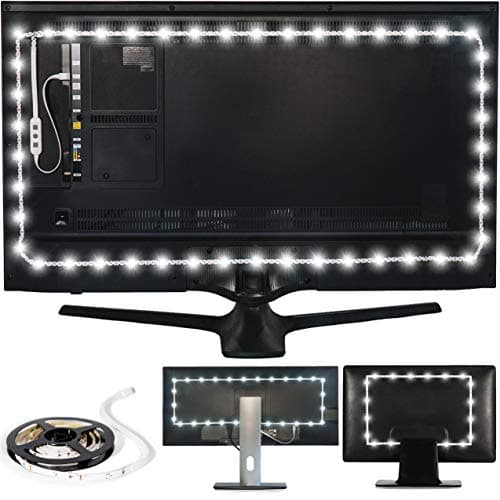 Luminoodle Bias Lighting, Backlight Kit for Monitors up to 24″ The only strip on this page actually sized and marketed for a monitor rather than trimmed down from a TV kit — a plain 6500K true white, no RGB mode to second-guess. Power Practical's own site was unreachable when we checked, so the record here rests on the retail listing rather than a manufacturer page we could browse ourselves. | A single monitor up to 24″ | —Warranty | |
| 2 | 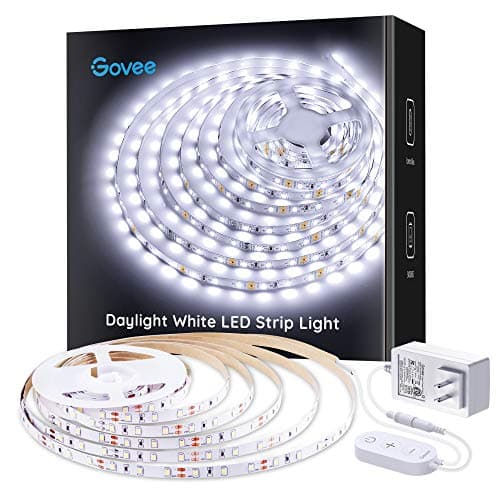 Govee Cool White LED Strip Lights 16.4ft, 6500K, Dimmable The only strip here with a warranty we could confirm on the maker's own live site — Govee's returns policy states a flat 12 months for strip lights, by name. It is also the longest run on this page, and it is a plain 6500K white with no RGB mode. | A stated warranty, and enough strip to spare | 1 yrWarranty | $16.99Amazon $19.99 −15% |
| 3 | 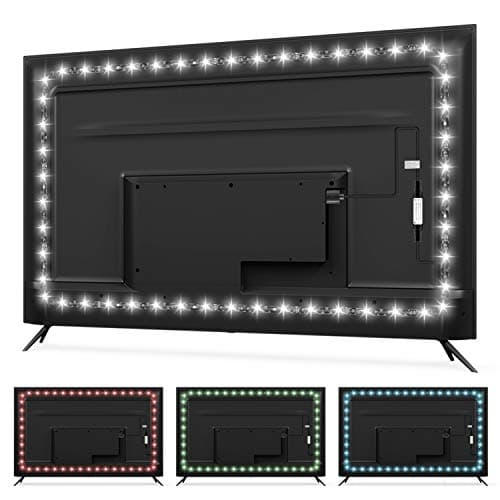 HAMLITE USB TV Bias Lighting 6500K True White (50–55″ TV) A genuine 6500K true white strip, same as the two above it — but sized and priced for a TV, not a monitor, and Hamlite is the one brand here with no independent manufacturer site we could find at all. | A monitor you don't mind trimming a longer strip down for | —Warranty | |
| 4 | 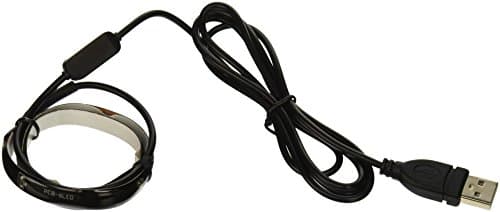 Antec Halo 6 LED Bias Lighting Kit The original, purpose-built for exactly this job — Antec's own requirement line names an “LCD monitor up to 24″ in size placed against light colored wall” — and it carries the longest documented warranty on this page. What it does not do, anywhere we could find, is publish a color temperature or a CRI figure for the white it puts out. | The best-documented warranty on the most monitor-specific design here | 2 yrWarranty | |
| 5 | 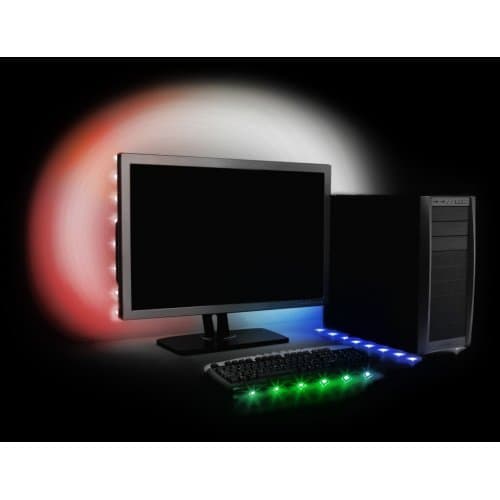 Antec Advance Accent USB Powered Bias Strip Lighting (RGB) The reason this page separates “bias lighting” from “a light strip behind your screen.” Antec sells this one under the same general category as the Halo 6, but it is a 7-color RGB strip with no stated white mode at all — the wrong tool for the neutral-reference job this page is about, however cheap it is. | Mood lighting, not accurate bias lighting | —Warranty |
Prices as of Sep 9, 2026, from Amazon’s API. They change; we show a live number or none at all.
Bias lighting does not light your desk. It lights the wall directly behind your monitor or TV, and it is easy to confuse with a monitor light bar because both exist to close the same gap OSHA names — “high contrast between light and dark areas of the computer screen, horizontal work surface, and surrounding areas can cause eye fatigue and headaches.” A light bar closes it from the front, by lighting the desk. Bias lighting closes it from behind, by lighting the wall the screen sits against, so the panel is no longer a bright rectangle floating in a dark room. Different surface, same idea, and worth keeping straight before you buy either.
The job sounds simple — stick a light strip behind the screen — and the market treats it that way, selling everything from a precise 6500K reference white to a seven-color party strip under the same “bias lighting” search term. They are not the same product. What follows is five of them, ranked on the one spec that actually decides whether a “bias light” does the job a bias light is supposed to do.
What we ranked on, and why
Bias lighting has one job more specific than “add some light”: put a neutral reference white behind a self-lit screen, so the screen is not the only white point in the room your eyes have to judge against. MediaLight, the brand that effectively coined the modern version of this product category, states the requirement plainly on its own site — “a bias light must have a correlated color temperature (CCT) of 6500K (D65 standard).” That is not an arbitrary number. 6500K/D65 is the white point video and photo work is calibrated against, so a bias light that drifts warm or cool introduces a color cast right next to the image on screen — the opposite of what the product is for.
So the ranking, in order:
- Color temperature (CCT).Does the product state a Kelvin figure at all, and is it 6500K — the D65 standard — rather than an RGB mode with no stated white point. This is the whole page.
- CRI. Whether the manufacturer publishes a color rendering figure for that white. Spoiler, covered in full below: none of the five do.
- Warranty.The longevity slot on every product page on this site. None of the five publish an LED rated-life figure in hours, so the warranty term is the longevity number we can use — and only two of the five state one (Govee’s 12 months and Antec’s two years on the Halo 6). The other three publish no warranty either, so those slots are honest em-dashes.
What we deliberately did not rank on: lumens or lux. Illuminance figures for these strips are either unpublished entirely or measured on terms that are not comparable across brands — the same problem we ran into ranking light bars. A bias light is meant to run dim regardless — MediaLight’s own page describes an SMPTE recommendation of under “10% of the display’s peak brightness”— so absolute output matters less here than whether the color is right in the first place.
The CRI problem: zero for five
Every light-bar page on this site has had at least one product with a published CRI figure to compare. This one does not. We checked all five listings here, every reseller mirror we used to fill gaps left by two dead manufacturer sites, and Govee’s own live policy pages — and not one product on this page states a CRI or Ra number for its white output. That includes the RGB Antec Advance Accent, which does not even claim a white mode to have a CRI figure for.
That is not us failing to find a number. It is the market’s own pattern: bias lighting sells almost entirely on Kelvin and color count, and CRI — the number that would tell you whether that Kelvin figure renders colors accurately rather than just reading correctly on a spec sheet — is treated as optional even by brands that publish it on their other product lines.
It is also worth being honest that CRI itself is a weaker guarantee than the marketing around it implies, on the rare product that does print one. The Department of Energy draws a clean line between the two measurements — CCT is “the color appearance of the light itself,” while CRI is “how the light affects the color appearance of objects,”with 80 as DOE’s recommended interior minimum and 90-plus counted as excellent. And the CIE — the international body that defined CRI in the first place — has itself moved on from it: its 2025 position statement recommends the lighting community “begin to adopt the CIE General Colour Fidelity Index, Rf” specifically to replace the older Ra number in “relevant regulations, specifications, and standards.” So even a printed Ra95 sticker would be a formula its own authors are actively trying to retire. Here, that argument is academic twice over — nobody printed the sticker at all.
Why RGB is the wrong tool for this specific job
Search “bias lighting” on Amazon and most of what comes back is color-cycling RGB strips, several of them from the same brands that also sell an honest 6500K option — Antec included, which is why we put one of its RGB strips on this list on purpose. The distinction is not snobbery about color; it is that bias lighting’s mechanism specifically requires a neutral reference. A strip stepping through red, green, blue and every mix between is not attempting to hold a stated 6500K, and none of the RGB listings we read claim it does.
Antec itself draws this line more clearly than most of the market does: it sells the Halo 6 under “Bias Lighting” and the Advance Accent under “Accent Lighting” — two different product names for two different jobs, from the same company, at the same time. Most sellers do not bother with the distinction, and the search term does not enforce it. If a listing does not print a Kelvin number, treat it as decoration until proven otherwise, not as a bias light.
What two dead manufacturer sites tell you about this market
Two of the five brands on this page could not be checked against their own website at all. Power Practical’s storefront (powerpractical.com) returned an HTTP 402 error — the signature of a store whose own billing has lapsed — on every product URL we tried, including a direct variant link. Antec’s former product-page domain, store.antec.com, does not resolve any more; its current antec.com site exists but carries no page for the Halo 6 specifically. Hamlite never had an independent site we could find in the first place.
None of that means the products are fake or unavailable — all five are live, purchasable Amazon listings, verified in stock when we checked. It means the paper trail for a fairly mature, unglamorous product category (the Halo 6 dates to 2011) has partly rotted away, even while the listings themselves keep selling. We sourced the specs above from reseller mirrors that reproduce each brand’s own copy and from retail listings carrying the manufacturer’s part number, and every one of those substitutions is labeled in the product’s own source list rather than smoothed over.
What we can't tell you
We have not switched any of these on. We cannot tell you whether the Luminoodle’s white looks identical to the Govee’s side by side, whether the Hamlite’s metal backing holds its curve on a curved monitor over months of use, or whether the Halo 6’s unstated white reads warm or cool next to a calibrated display. Those need eyes and hands on the actual product, and we do not have them — see our methodology for what reading spec sheets does and does not buy you.
What we can do is tell you which of the five actually state 6500K, which do not, which brand’s own site we could and could not verify, and that not one of them will hand you a CRI number no matter how hard you look. That is a smaller claim than “here is the best one,” and it is the one we can actually stand behind.
How to actually choose
If your screen is a single monitor at 24″ or under and you want the least fuss, buy the Luminoodle— it is sized for exactly that, and it states 6500K. If you want a warranty you can read on the manufacturer’s own live site, or you need more than 24″ of coverage, buy the Govee— same 6500K spec, twelve documented months behind it. If you specifically need to cover a large screen and don’t mind trimming a TV-length strip down, the Hamlite gets there on the same 6500K claim, with no warranty paperwork to fall back on if it fails.
If a two-year warranty matters more to you than a stated Kelvin number — or you trust an established brand’s decade-old, still-selling design over a printed spec you cannot independently check — the Antec Halo 6 is a reasonable, honestly-limited choice. And whatever you do, do not reach for a color-cycling RGB strip and call it bias lighting because the Amazon category page filed it next to one. The Antec Advance Accent is on this list to show you exactly what that looks like: cheap, fun, and not the tool this page is about.
The picks, in detail
1. A single monitor up to 24″
Luminoodle Bias Lighting, Backlight Kit for Monitors up to 24″
The only strip on this page actually sized and marketed for a monitor rather than trimmed down from a TV kit — a plain 6500K true white, no RGB mode to second-guess. Power Practical's own site was unreachable when we checked, so the record here rests on the retail listing rather than a manufacturer page we could browse ourselves.
- Color temp (CCT)
- 6500K
- CRI
- —
- Warranty
- —
This tops the list for the least glamorous reason possible: it is the only product here that says, plainly, “this is sized for a monitor.” Every other true-white strip on this page is a TV backlight kit that happens to also fit a screen, sold in TV-sized feet you then cut down. The Luminoodle skips that step.
The color spec is the one that matters most on this page, and it is stated plainly: 6500K, described in its own product copy as “true white light at six thousand five hundred Kelvin.” That is the D65 standard MediaLight’s own explainer names as the target for bias lighting specifically — see what Kelvin actually measures if the number itself is new to you.
What we cannot do is point you to a live Power Practical spec page. We tried the product page, the collection page, and a variant URL, and every one returned the same HTTP 402 error — the kind of response a storefront gives when its own billing has lapsed, not when a page is merely slow. The specs above come from a reseller that reproduces Power Practical’s own product copy, plus the Amazon listing itself. That is a real source, cited below, but it is a step removed from a manufacturer page we could browse ourselves, and we would rather say so than pretend otherwise.
Good
- Built and sized specifically for “monitors up to 24″” — not a TV strip you cut down and hope fits
- A single 6500K true white LED strip, described in its own materials as “true white light at six thousand five hundred Kelvin” — no RGB or color-cycling mode to accidentally leave switched on
- USB-powered directly from the monitor's own port where it has one, so there is no separate wall adapter to route
- 3M adhesive backing — no tools, no screws, comes off clean if you change monitors
Not so good
- Power Practical's own storefront (powerpractical.com) returned an HTTP 402 error on every product URL we tried, so there is no independent manufacturer spec page to cross-check — only the retail listing, which multiple resellers reproduce identically
- No CRI figure published anywhere we could find
- No rated-life or warranty figure published anywhere we could find
- Capped at 24″ monitors; a wider ultrawide or a small TV needs a longer strip from elsewhere on this page
Don’t buy it if: your screen is larger than 24″, or you specifically want a live manufacturer page to verify a spec against before buying — Power Practical's own site was down when we checked, and the Govee below at least has a warranty page we could load ourselves.
Price as of Sep 9, 2026. #ad — we earn a commission.
Where these numbers came from
- Luminoodle Bias Lighting, Backlight Kit for Monitors up to 24″ — product description as reproduced by an authorized reseller (Power Practical's own site, powerpractical.com, returned an HTTP 402 error on every product URL we tried and could not be independently read; source of the “monitors up to 24″” sizing and the 6500K true-white spec, quoted there as “true white light at six thousand five hundred Kelvin”) — read 2026-07-26
- Luminoodle Bias Lighting — Amazon product listing, ASIN B01LR3O8SI (title and sizing consistent with the reseller-reproduced description) — read 2026-07-26
2. A stated warranty, and enough strip to spare
Govee Cool White LED Strip Lights 16.4ft, 6500K, Dimmable
The only strip here with a warranty we could confirm on the maker's own live site — Govee's returns policy states a flat 12 months for strip lights, by name. It is also the longest run on this page, and it is a plain 6500K white with no RGB mode.
- Color temp (CCT)
- 6500K
- CRI
- —
- Warranty
- 1 yr
Most of the warranty claims on this page come from a reseller mirror or an old spec sheet a retailer still hosts. Govee’s does not — its own Returns & Refunds page, live on us.govee.com when we checked, states the term directly: “Strip lights - 12” months, with the period starting “on the date of delivery of the products to the customer.” It is not a long warranty next to Antec’s Halo 6 below, but it is the one we could verify ourselves rather than take on trust from a third party.
Good
- Govee's own Returns & Refunds page lists “Strip lights - 12” months as the warranty term — the only warranty on this page we could confirm directly on a manufacturer's own live site, not a reseller mirror
- 16.4 ft of strip covers a large monitor, a two-monitor spread, or a small TV without buying a second kit — cut it down at the marked segments if you need less
- A plain 6500K white with a dimmable control box; no RGB or color-cycling mode to leave on by accident
- 300 LEDs across the run, for coverage that does not visibly dim toward the far end the way a shorter, sparser strip can
Not so good
- No CRI figure published anywhere we could find, on the listing or on Govee's own site
- No rated-life figure in hours specific to this product — Govee's blog discusses LED lifespan in general industry terms elsewhere, but that is not this product's own published spec, so we are not printing it
- Larger and more expensive than the Luminoodle if a single 24″ monitor is all you have
- A control box and power brick is bulkier than a USB-only strip — more to route behind the desk
Don’t buy it if: you only need to light one small monitor and would rather not deal with a control-box-and-brick setup — the Luminoodle is the tighter kit for exactly that job, at the cost of Govee's documented warranty.
$19.99 −15%
Price as of Sep 9, 2026. #ad — we earn a commission.
Where these numbers came from
- Govee Cool White LED Strip Lights 16.4ft, 6500K, Dimmable — Amazon product listing (source of the 6500K color temperature, the 300-LED count and the dimmable control box; ASIN B07XHLGSXN) — read 2026-07-26
- Govee US: Returns & Refunds Policy (source of the published warranty period — the policy's own table lists “Strip lights - 12” months, with the warranty period starting “on the date of delivery of the products to the customer”) — read 2026-07-26
3. A monitor you don't mind trimming a longer strip down for
HAMLITE USB TV Bias Lighting 6500K True White (50–55″ TV)
A genuine 6500K true white strip, same as the two above it — but sized and priced for a TV, not a monitor, and Hamlite is the one brand here with no independent manufacturer site we could find at all.
- Color temp (CCT)
- 6500K
- CRI
- —
- Warranty
- —
Good
- 6500K true white stated plainly in the product name and description, matching the Luminoodle and Govee rather than the color-cycling strips most competitors sell
- An RF remote with a memory function, so it returns to the same white setting after being switched off rather than resetting to a default
- At 11.5 ft, covering all four sides of a 50–55″ TV, there is comfortably enough strip left over to wrap an ultrawide monitor after trimming
Not so good
- Sized and priced for a TV — you are buying and cutting down 11.5 ft of strip to fit a monitor, and paying for length you then discard
- No CRI figure published anywhere we could find
- No rated-life or warranty figure published anywhere we could find — not on a manufacturer site (Hamlite has none we could locate; hamlite.com belongs to an unrelated company), and not on the listing itself
- A metal-backed strip is less forgiving around a curved monitor edge than the adhesive-only strips above it
Don’t buy it if: you want any documented warranty at all, or you'd rather not cut a TV-length strip down to size — the Luminoodle is already the right size, and the Govee at least has a warranty page.
Price as of Sep 9, 2026. #ad — we earn a commission.
Where these numbers came from
- HAMLITE USB TV Bias Lighting 6500K True White (50–55″ TV) — product description as reproduced by an authorized reseller (Hamlite publishes no independent manufacturer website we could locate; hamlite.com belongs to an unrelated composite-materials company; source of the 6500K true-white spec, quoted there as “6500K pure white light,” and the 4-side TV coverage) — read 2026-07-26
- HAMLITE USB TV Bias Lighting — Amazon product listing, ASIN B07ZYCHYBQ — read 2026-07-26
4. The best-documented warranty on the most monitor-specific design here
Antec Halo 6 LED Bias Lighting Kit
The original, purpose-built for exactly this job — Antec's own requirement line names an “LCD monitor up to 24″ in size placed against light colored wall” — and it carries the longest documented warranty on this page. What it does not do, anywhere we could find, is publish a color temperature or a CRI figure for the white it puts out.
- Color temp (CCT)
- —
- CRI
- —
- Warranty
- 2 yr
Antec built this in 2011 and, as far as we can tell, has not touched the design since — it is still listed, still in stock, and still the only product on this page whose own requirement line describes a monitor rather than a TV: “LCD monitor up to 24″ in size placed against light colored wall.” That is a more precise match to this page’s subject than anything else here, warranty included.
And the warranty is real: a retail listing carrying Antec’s own part number states “Product Warranty: 2 years”for parts and labor, a figure a second, independent review of the same spec sheet confirms. Two years beats every other warranty figure we could verify on this page, Govee’s twelve months included.
What it will not do is tell you what color white you are getting. We read every retail listing and every archived review we could find, and none states a Kelvin figure or a CRI number for the Halo 6’s LEDs. That is not automatically disqualifying — a decade of “white backlight” reviews with no complaints about a visible tint is its own kind of evidence — but it means you cannot check this one against the 6500K/D65 standard the way you can check the Luminoodle, the Govee, or the Hamlite. If matching that standard specifically is the reason you are buying a bias light at all, that gap matters more than the warranty does.
Good
- Antec's own requirement line describes this page's exact use case: “LCD monitor up to 24″ in size placed against light colored wall”
- A 2-year parts-and-labor warranty, confirmed on a live retail listing carrying Antec's own part number — the longest documented coverage of any product on this page
- A compact 14.6″ strip on a 4′3″ cable, built to sit directly behind one monitor rather than wrap a TV
- Still selling and in stock more than a decade after launch, which is its own kind of longevity evidence even without a rated-hours figure
Not so good
- No color temperature published anywhere we could find — “white backlight” is as specific as Antec's own materials get, so you cannot check it against the 6500K/D65 standard MediaLight's own explainer describes
- No CRI figure published
- Only 14.6″ of strip, the shortest on this page — enough for one monitor, short for a wide one
- Antec's own product-specific page for this kit (formerly on store.antec.com) no longer resolves; the specs above come from retail listings that carry Antec's part number, not a live Antec.com page we could browse
Don’t buy it if: the exact color of white matters to you and you want it printed on a spec sheet before you buy — the Halo 6 doesn't publish a Kelvin number, so you're trusting an unstated “white” rather than a stated 6500K. Buy one of the three strips above it instead.
Price as of Sep 9, 2026. #ad — we earn a commission.
Where these numbers came from
- Antec Halo 6 LED Bias Lighting Kit — Newegg product listing carrying Antec's own part number (0-761345-77020-0) and spec sheet (source of the requirement line “LCD monitor up to 24″ in size placed against light colored wall,” the 14.6″ strip length, the 1300mm cable, and the 2-year parts-and-labor warranty; Antec's own store.antec.com product page for this kit no longer resolves) — read 2026-07-26
- Antec Halo 6 LED Bias Lighting Kit review, reproducing Antec's own spec sheet (confirms “Product Warranty: 2 years” and “Certifications/Safety: CE, RoHS”; no color temperature or CRI figure appears anywhere on the sheet) — read 2026-07-26
5. Mood lighting, not accurate bias lighting
Antec Advance Accent USB Powered Bias Strip Lighting (RGB)
The reason this page separates “bias lighting” from “a light strip behind your screen.” Antec sells this one under the same general category as the Halo 6, but it is a 7-color RGB strip with no stated white mode at all — the wrong tool for the neutral-reference job this page is about, however cheap it is.
- Color temp (CCT)
- —
- CRI
- —
- Warranty
- —
We kept this one on the list on purpose, not despite what it is. Search “bias lighting” on Amazon and a wall of RGB color-cycling strips comes back mixed in with the true-white ones — often from the very brands that also sell an honest 6500K option, Antec included. This is Antec’s own RGB entry, and it is instructive precisely because Antec itself sells both: the Halo 6 as “Bias Lighting” and this as “Accent Lighting.” That is the correct distinction, and most listings on the market do not bother making it.
The mechanism this whole page is about — closing the contrast gap between a self-lit screen and a dark wall — depends on a neutral reference. MediaLight’s own explainer states the requirement directly: “a bias light must have a correlated color temperature (CCT) of 6500K (D65 standard).” A strip that steps through seven saturated colors every few seconds is not attempting to meet that spec, and its own listing does not claim it does. Buy it for what it is — cheap, simple, colorful desk ambiance — not as a substitute for the four strips above it.
Good
- The cheapest strip on this page by a wide margin
- A physical on/off toggle switch between seven colors, plus an auto-cycle mode that steps through them roughly every three seconds — no app, no remote to lose
- Genuinely simple to install: one USB plug, one switch, done
Not so good
- No 6500K or neutral-white mode of any kind — the listing describes seven discrete colors and an auto-cycle, not a stated white you can set and leave
- No CRI figure published, and with no white mode to begin with, a CRI number would not tell you what you actually need to know
- No rated-life or warranty figure published on the listing we could find
- Sold by the same company as the Halo 6 under a different name (“Accent Lighting” rather than “Bias Lighting”) — worth noticing that Antec itself draws that line
Don’t buy it if: you actually want the contrast-reducing mechanism this page describes. A cycling RGB strip is ambient decoration, not bias lighting in the D65/6500K sense MediaLight's own explainer defines — buy any of the three 6500K-labeled strips above instead.
Price as of Sep 9, 2026. #ad — we earn a commission.
Where these numbers came from
Common questions
Does bias lighting actually reduce eye strain?
The mechanism is real and it is about contrast, not brightness. OSHA states that “high contrast between light and dark areas of the computer screen, horizontal work surface, and surrounding areas can cause eye fatigue and headaches.” A bias light raises the wall directly behind the panel without putting any light on the glass itself, which narrows that specific gap. We have not tested any of these strips, we are not qualified to tell you it will fix your symptoms, and we are not going to — the mechanism is documented by OSHA and reported in more detail on lighting for eye strain.
What's the difference between bias lighting and a monitor light bar?
Direction. A monitor light bar clamps to the top of the screen and throws light forward, onto the desk in front of you — it solves a dark keyboard and a dark desk surface. Bias lighting is a strip on the back of the monitor or TV, throwing light backward onto the wall the screen sits against — it solves a bright panel floating in a dark room. Both narrow a contrast gap OSHA names, but they light two different surfaces and neither substitutes for the other. If you are not sure which gap you actually have, desk lamp vs monitor light bar walks through the desk-facing half of that decision.
Why does bias lighting need to be 6500K specifically?
Because 6500K is the D65 white point video and photo work is calibrated against, and a bias light that drifts warm or cool from it introduces a color cast right next to the image you are trying to judge accurately. MediaLight’s own bias-lighting explainer states it plainly: “a bias light must have a correlated color temperature (CCT) of 6500K (D65 standard).” The same page describes a Society of Motion Picture and Television Engineers recommendation that the light stay under roughly “10% of the display’s peak brightness”and that the wall itself be neutral — “Munsell N5 or N7” gray. We have not independently read the underlying SMPTE document ourselves, so we are reporting what MediaLight’s own page states about it rather than citing SMPTE directly. Three of the five strips on this page state 6500K outright; two do not state any Kelvin figure at all.
Is CRI actually meaningful for a bias light strip?
Less than the marketing on lighting products generally implies, and on this specific page it is moot: none of the five strips we checked publish a CRI figure, the RGB entry included. The Department of Energy draws the useful line — color temperature (CCT) is “the color appearance of the light itself,” while CRI measures “how the light affects the color appearance of objects,” with a minimum of 80 recommended for interior lighting and 90-plus counted as excellent. Separately, the CIE — the body that literally defined CRI — has moved to recommend replacing it: its 2025 position statement says the lighting community should “begin to adopt the CIE General Colour Fidelity Index, Rf” in place of the older Ra metric. Even a published CRI number would be a 1974-vintage formula the people who wrote it no longer fully trust. Here, it is a moot point twice over: unpublished, on a metric its own authors are moving away from.
Can't I just use a cheap RGB LED strip set to white?
You can set one to a color it calls “white,” but that is a different claim than a stated 6500K. Every RGB strip we looked at for this page, including the Antec Advance Accent included above, either offers no white mode at all or does not state what color temperature its white lands on — which means you cannot check it against the D65 standard MediaLight’s own page describes, the way you can check the three strips on this page that print “6500K” directly. A strip with no stated CCT is not necessarily bad light. It is simply light you cannot verify, and verification is the entire premise of this site.
How bright should a bias light be?
Dim, by design. MediaLight’s own explainer describes an SMPTE recommendation that intensity “should not exceed 10% of the display’s peak brightness,” and notes most installs settle around “5% for most environments.” None of the five products on this page publish a lumen or lux figure we could compare on equal terms — the same problem this site has run into with light bars, where illuminance figures are measured at different, sometimes unstated, distances. Every strip here includes some form of dimmer or brightness control, so treat the control as the spec: start low, and raise it only until the wall stops looking noticeably darker than the screen.
Sources
Every figure on this page comes from one of these. If a manufacturer doesn’t publish a number, we print “—” rather than estimate it.
- OSHA eTools: Computer Workstations — Workstation Environment (source of the contrast statement: “High contrast between light and dark areas of the computer screen, horizontal work surface, and surrounding areas can cause eye fatigue and headaches.”) — read 2026-07-26
- CIE Position Statement on Colour Quality Metrics, 2nd Edition (CIE PS 002:2025) — the international body that defines CRI, recommending the newer Rf fidelity index “replace the CIE General Colour Rendering Index in relevant regulations, specifications, and standards” — read 2026-07-26
- US Department of Energy: LED Basics (source of the CCT/CRI distinction — CCT is “the color appearance of the light itself” while CRI describes “how the light affects the color appearance of objects” — and the minimum-CRI-80 / CRI-90-plus figures) — read 2026-07-26
- MediaLight (Bias Lighting.com): Bias Lighting Fundamentals — cited for the mechanism only; MediaLight is not currently sold on Amazon and is not a ranked product on this page (source of the D65/6500K color-temperature standard, the note that intensity “should not exceed 10% of the display's peak brightness,” and the neutral-gray-wall recommendation, “Munsell N5 or N7”) — read 2026-07-26
- Luminoodle Bias Lighting, Backlight Kit for Monitors up to 24″ — product description as reproduced by an authorized reseller (Power Practical's own site, powerpractical.com, returned an HTTP 402 error on every product URL we tried and could not be independently read; source of the “monitors up to 24″” sizing and the 6500K true-white spec, quoted there as “true white light at six thousand five hundred Kelvin”) — read 2026-07-26
- Luminoodle Bias Lighting — Amazon product listing, ASIN B01LR3O8SI (title and sizing consistent with the reseller-reproduced description) — read 2026-07-26
- Govee Cool White LED Strip Lights 16.4ft, 6500K, Dimmable — Amazon product listing (source of the 6500K color temperature, the 300-LED count and the dimmable control box; ASIN B07XHLGSXN) — read 2026-07-26
- Govee US: Returns & Refunds Policy (source of the published warranty period — the policy's own table lists “Strip lights - 12” months, with the warranty period starting “on the date of delivery of the products to the customer”) — read 2026-07-26
- HAMLITE USB TV Bias Lighting 6500K True White (50–55″ TV) — product description as reproduced by an authorized reseller (Hamlite publishes no independent manufacturer website we could locate; hamlite.com belongs to an unrelated composite-materials company; source of the 6500K true-white spec, quoted there as “6500K pure white light,” and the 4-side TV coverage) — read 2026-07-26
- HAMLITE USB TV Bias Lighting — Amazon product listing, ASIN B07ZYCHYBQ — read 2026-07-26
- Antec Halo 6 LED Bias Lighting Kit — Newegg product listing carrying Antec's own part number (0-761345-77020-0) and spec sheet (source of the requirement line “LCD monitor up to 24″ in size placed against light colored wall,” the 14.6″ strip length, the 1300mm cable, and the 2-year parts-and-labor warranty; Antec's own store.antec.com product page for this kit no longer resolves) — read 2026-07-26
- Antec Halo 6 LED Bias Lighting Kit review, reproducing Antec's own spec sheet (confirms “Product Warranty: 2 years” and “Certifications/Safety: CE, RoHS”; no color temperature or CRI figure appears anywhere on the sheet) — read 2026-07-26
- Antec Advance Accent USB Powered Bias Strip Lighting (RGB) — Amazon product listing (source of the 7-color toggle and the roughly 3-second auto-cycle description; ASIN B07FN84X35; no color-temperature, CRI or warranty figure is published on this listing) — read 2026-07-26
Read next
Bias lighting vs monitor light bar
Two different jobs behind and above the screen, and which one you need.
The best monitor light bars
The desk-facing sibling to this page — same contrast mechanism, opposite direction, and its own two blank CRI slots.
Desk lamp vs monitor light bar
If your actual gap is the desk surface rather than the wall behind the screen, this is the decision to make first.
Lighting for eye strain
The OSHA contrast statement this whole page leans on, and what the sources do and don't actually support.
Color temperature for a home office
What a Kelvin number actually measures, and why 6500K is a different question from CRI.