How to replace office chair casters
Casters are the cheapest, easiest part to swap on an office chair — most press out with a firm tug and press back in by hand. The only thing that trips people up is the stem, so measure before you buy.
By Stephen V.Last reviewed
Replacing office chair casters is the easiest repair on the entire chair, and it is worth saying that plainly because the job intimidates people out of all proportion to what it actually involves. On the overwhelming majority of chairs there are no tools, no bolts, and no mechanism to take apart. You pull the old wheels out, you push the new ones in, and you are done in the time it takes to read this paragraph twice. The only step that ever goes wrong is buying the wrong stem, so we are going to spend most of our effort there and treat the physical swap as the afterthought it is.
There are exactly two things you need to know before ordering: what kind of stem your chair uses, and what size that stem is. Get those right and everything else is a firm tug.
The two stem types
The stem is the post sticking up out of the top of the caster that anchors it into the base. Nearly all office chairs use one of two kinds.
The grip-ring stemis the standard, and it is what you almost certainly have. It is a smooth cylindrical post — commonly about 11 mm in diameter and roughly 22 mm long, sometimes written as 7/16 inch — with a small sprung metal ring near the top that snaps into a groove inside the base’s socket. That ring is the whole retention mechanism: it lets the caster push in until it clicks and holds it there by friction, which is why the wheel does not fall out but still pulls free when you yank it. Because this size is so close to a de facto standard, most aftermarket casters — including the rollerblade kind — are built for it.
The threaded stem screws into the base instead of pressing in, and you will find it on some chairs, stools, and heavier commercial designs. If your caster unscrews rather than pulling out, this is what you have, and you need to match the thread size and pitch, not just the diameter. It is the less common case, but it is exactly the case where a grip-ring replacement will not fit no matter how hard you push.
The practical rule: pull one caster and look at the stem. Smooth post with a little ring near the top, grip-ring. Screw thread, threaded. Do not order on the assumption that yours is standard until you have looked.
Measure before you buy
“Most common” is not “universal,” and stem sizes do vary — gaming chairs, some European chairs, and heavy-duty commercial chairs all deviate from the usual 11 mm. So measure your stem’s diameter and length with calipers or even a ruler before you order. It takes seconds and it is the one measurement that decides whether the part fits. If yours is threaded, measure the thread size too, or take the old caster to match it. This is not fussiness; it is the difference between a five-minute repair and a return.
Pulling the old casters out
For grip-ring stems, the method is brute and simple. Lay the chair on its side or turn it upside down so the base is up. Grip the wheel of one caster with both hands, brace a foot or your other hand against the base, and pull hard and straight out along the line of the stem. The sprung ring gives way and the caster pops free. Some come out easily; a caster that has sat in a dusty socket for years can be stubborn, and for those a flat pry bar, or the claw of a hammer with a rag under it to protect the base, gives you the leverage to lever it out evenly. Working it side to side while you pull helps break a seized one loose. Threaded stems simply unscrew.
There is no trick beyond force and patience, and nothing under there is delicate. The socket is just a hole; the ring is just a spring. You are not going to break anything by pulling too hard, only by pulling crooked and marring the base, which the rag prevents.
Choosing casters by floor
This is the decision that should actually drive which casters you buy, and it matters more than brand or looks. The wheel needs to match the floor it rolls on. Hard casters — the small hard-plastic wheels most chairs ship with — are meant for carpet, where a soft wheel would sink and drag. Put those same hard wheels on wood or laminate and they roll away from you, mark the surface, and clatter. Soft polyurethane casters are the opposite: gentle and grippy on hard floors, but they can feel sluggish on thick carpet. Getting this backwards is one of the most common reasons a chair “rolls badly,” and it is the whole subject of casters for hardwood vs carpet, which is worth reading before you order rather than after.
There is also a case where the right answer is not a caster at all. If you do not want the chair to roll — a chair that keeps drifting away from a standing desk, say — static glides replace the wheels entirely and hold the chair put. That trade, and when it makes sense, is on wheels vs glides.
Rollerblade casters
The single most popular caster upgrade is the rollerblade style: larger wheels, usually polyurethane, built on the same principle as inline-skate wheels. On a hard floor they are a genuine improvement — smoother to roll, quieter, and easier on wood and laminate than the small hard wheels most chairs come with — and they are cheap enough that they are one of the best value upgrades on the whole chair. Because they almost all use the standard grip-ring stem, they are a straight swap for most chairs. On carpet the benefit is smaller, so the honest advice is the same as everywhere else on this page: buy for the floor you actually have, not the photo on the box.
Pushing the new ones in
Installation is the easy half. Line the new stem up with the socket and push firmly and straight until the grip ring clicks home — you will feel it seat. A little pressure by hand is all it takes; if a stem does not want to go, it is usually because it is a hair too large or the wrong type, which is your cue to stop and check rather than force it. Threaded stems screw in. Do all five at once even if only one failed, because mismatched wheels roll unevenly and the cost of a full set over a single caster is trivial. Stand the chair up, roll it around, and confirm all five turn freely and sit level.
The verdict
Replacing casters is the repair with the best effort-to-payoff ratio on any office chair. The parts are among the cheapest you can buy for a chair, the job needs no tools on most chairs, and matching the right wheel to your floor can make a mediocre-feeling chair roll like a much better one. The only place to be careful is the order, not the install: measure the stem, confirm grip-ring versus threaded, and buy for the surface you actually roll on. Get that right and you never have to think about your casters again — which, for the part of the chair that touches the ground all day, is exactly the outcome you want.
The small stuff that finishes the job
Inexpensive parts that make the main purchase work properly. They are not picks and they are not ranked — each one is here because this page describes the job it does, and each carries the same published-spec treatment as everything else we link.
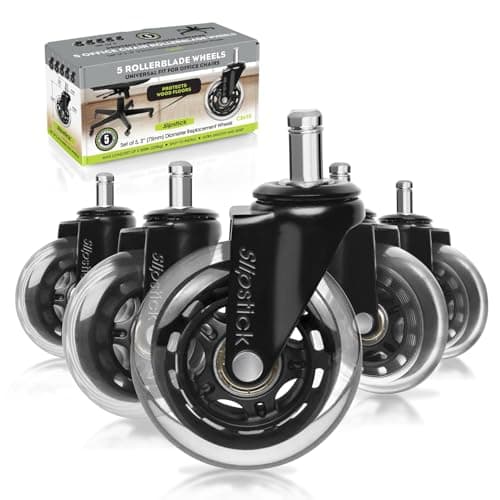
Slipstick CB690 rollerblade casters (set of 5)
A five-wheel rollerblade set for the common grip-ring stem, with a published 500 lb capacity and a lifetime replacement warranty. Pull one old caster out and measure the stem before you order.
Prices as of Sep 14, 2026, from Amazon’s API. They change; we show a live number or none at all. Why these are affiliate links.
Common questions
Are office chair casters universal?
Mostly, but not quite, and the gap is exactly where people order the wrong part. The large majority of office and task chairs use the same grip-ring stem— a smooth post about 11 mm in diameter that pushes into a socket in the base and is held by a sprung ring — so a huge share of replacement casters will fit a huge share of chairs. But some chairs use a threaded stem that screws in, and stem diameters and lengths do vary. Pull one old caster out and measure the stem before you buy anything.
What size stem do office chair casters use?
The most common by a wide margin is the grip-ring stem at 11 mm diameter and roughly 22 mm long — often written as 7/16 inch — which is close enough to a standard that most aftermarket casters are built for it. That said, “most common” is not “universal.” Gaming chairs, some European chairs, and heavier commercial chairs deviate, and threaded stems come in several thread sizes. Measuring your own stem takes ten seconds and saves a return, so do not skip it on the strength of the average.
How do I get the old casters out?
For a grip-ring stem, grip the wheel, brace a foot on the base, and pull hard and straight — they are held by friction and a sprung ring, not bolted, so they come free with a firm tug and sometimes a satisfying pop. A flat pry bar or the claw of a hammer with a rag under it gives you leverage on a stubborn one. A threaded stem unscrews instead. If a caster is truly seized in a dirty socket, work it side to side while pulling rather than yanking harder in one direction.
Are rollerblade casters worth it?
On a hard floor, usually yes. Rollerblade-style casters use larger polyurethane wheels — the same idea as inline-skate wheels — that roll more smoothly and are gentler on wood and laminate than the small hard-plastic wheels most chairs ship with. They are one of the cheapest upgrades that genuinely changes how a chair feels day to day. On carpet the difference is smaller. Either way, match the wheel to your floor rather than the marketing, which is the whole point of choosing casters by surface.
Do I still need a chair mat if I put better casters on?
Softer polyurethane casters reduce the case for a mat on a hard floor, but they do not eliminate every reason for one, and on carpet the mat is doing a different job entirely — giving small wheels a firm, rollable surface. Whether you need a mat, and which kind, is its own decision we work through on the best office chair mats. Changing casters and adding a mat are not either/or; they solve overlapping but different problems.
Read next
Casters for hardwood vs carpet
The decision that should drive which casters you buy — matching the wheel to the floor it rolls on.
Wheels vs glides
When the right answer is not a better caster at all, but a static glide instead.
The best office chair mats
The other half of the floor question: whether new casters need a mat under them, and which kind.
How long do office chairs last
Casters are one of the first wear parts to go — where they sit in the order a chair fails.