SIHOO Doro C300 Pro vs Steelcase Series 1
One of these chairs publishes the dimension that decides whether it fits you. The other publishes two heights that look like it and are not. We read both manufacturers' own documents — here is what separates them, and why the price gap is smaller than the badge gap.
By Stephen V.Last reviewed
The two documents, side by side
Every cell is the manufacturer's own published figure. The em-dash in row one is not an oversight on our part — it is the number SIHOO does not print.
| # | Chair | Seat height | Capacity | Warranty | Standard named | Adjustment figures published | Price |
|---|---|---|---|---|---|---|---|
| 1 | 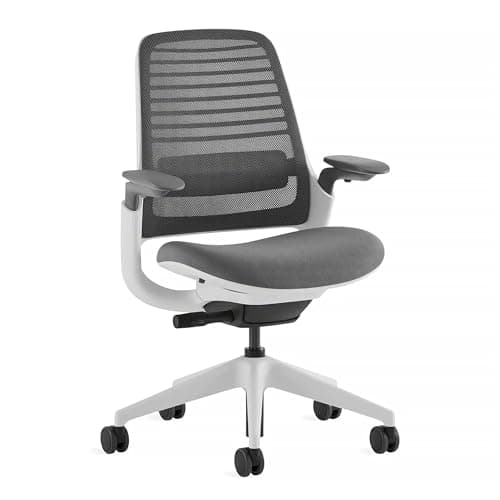 1. Steelcase Series 1 Knowing what you bought, and fitting the edges of the range
| 16½–21½" (short 14¾–17¾", tall 17¼–22") | 400 lb | 12 yr, parts + labor, 24/7 | BIFMA LEVEL 3, SCS Indoor Advantage Gold | 2¼" lumbar, 2¼" seat depth, 4" arm width | $549.00 Check Price on Amazon |
| 2 |  2. SIHOO Doro C300 Pro Armrest adjustment and a published hip width
| — | 330 lb | 3 yr | “BIFMA and SGS”, no standard number | Seat depth 16.81–17.76", hip width 20.28", 6D arms |
SIHOO publishes two heights, and neither one belongs in column one. Its page gives “General Dimensions: 28″W x 28″D x 45″-51″H” (floor to the top of the chair) and “Chair back lifting height: 44.72″ - 50.91″” (the backrest’s travel). A seat height for a task chair lives somewhere near 16–22″, so either figure in that column would be wrong by roughly two feet — which is exactly the mistake a hurried comparison makes. Note also that the overall-height line read 42–49″ when we first read it in July and 45–51″ today; both are SIHOO’s. The Steelcase figures are from Steelcase’s own Series 1 spec guide and cut sheet, cited below, and the warranty wording is theirs: twelve years, multi-shift, parts and labor. Neither chair carries a BIFMA X5.1 statement — nor does any chair in our roundup.
Prices and stock as of November 8, 2026, from Amazon’s API. They change; we show a live number or none at all. #ad — we earn a commission.
The short answer: buy the Steelcase Series 1if you want to know what you are getting — it publishes a 16½–21½″ seat height, a 400 lb rating and twelve years of parts-and-labor cover, and it sells short and tall cylinders for bodies the standard range misses. Buy the SIHOO Doro C300 Pro if 6D armrests and a published hip width matter more to you than a published seat height, and the live price gap in the buy rows above is wide enough on the day to justify it. That gap is usually narrower than people assume.
Why this comparison gets searched
SIHOO built its reputation by putting contract-furniture features on a direct-to-consumer chair: synchronized recline, a dynamic lumbar, 6D arms, a 330 lb rating. Steelcase is the company office managers buy from when the chair has to survive a decade of eight-hour days. So the question underneath the query is reasonable: has the cheap chair caught up?
On features, mostly yes. On published evidence, no — and the gap is not where most reviews put it. It is not about mesh quality or how the recline feels, neither of which we can tell you about because we have not sat in either chair. It is that one of these companies prints the numbers that decide whether the chair fits your body and backs them for twelve years, and the other prints a feature list and three.
The seat height, and the two numbers that look like it
Here is the single most useful thing on this page. Steelcase publishes a seat height of 16½ to 21½ inches, and lists two alternative cylinders — short at 14¾–17¾″, tall at 17¼–22″— which is a manufacturer quietly admitting that one range does not fit everybody.
SIHOO publishes no seat height at all. What it publishes is a “General Dimensions: 28″W x 28″D x 45″-51″H” line and a “Chair back lifting height: 44.72″ - 50.91″” line. The first is floor to the top of the chair. The second is how far the backrest travels. Both are plausible-looking, both are SIHOO’s own, both are on the right page — and both are wrong by roughly two feet if you read them as the height of the seat.
We flag that specifically because it is the trap a comparison written in a hurry falls into, and because the figure moved under us: in July SIHOO’s page gave the overall height as 42–49″, and today the same page says 45–51″. No model change announced. Both numbers are SIHOO’s; we print the current one and tell you it changed, because a spec that drifts is a spec to verify with a tape measure rather than trust.
What that means practically: if you are at the short or tall end of the range, the Steelcase is the only one of the two you can buy with confidence before it arrives. If you are of average height, the missing figure costs you less — most task chairs land in the same 16–21″ neighborhood — and the honest version is that you are relying on that, not on anything SIHOO has told you.
Capacity: 400 lb against 330, and how the wordings differ
Steelcase publishes 400 lbon its cut sheet. SIHOO’s page says “Maximum load: 330 lbs”and, in its benefits list, “Supports up to 330 lbs”. Those are both real published ratings, and 330 lb is the second-highest number in our chair coverage, so this is not a weak spot — it is a smaller margin.
The thing worth understanding is that a capacity rating is a static figure, not a promise about how the chair behaves at 90% of it for three years. Headroom is what you are buying when you compare these two: the same sitter leaves 70 lb of margin on the SIHOO and 140 lb on the Steelcase. Our weight capacity explainer covers why that margin, rather than the number itself, is the useful way to read it — and the heavy-duty roundup lines these two up against the rest of the field with each maker’s exact wording in its own column.
Three years against twelve, and the word “labor”
This is where the money argument actually lives, because an office chair does not fail at the frame. It fails at the gas cylinder that stops holding height, the caster that cracks, the mechanism that develops a click.
Steelcase publishes twelve years, rated for multi-shift 24/7 use, covering parts and labor. SIHOO publishes “(3) years”, with no shift rating and no labor language that we could find. Three years is enough to catch a manufacturing fault. Twelve is enough to catch the thing that actually ends a task chair, and the difference shows up in cost per year rather than cost.
Two cautions, in both directions. A long warranty is a published promise from a company that has to still exist and still honor it — it is not a measured lifespan, and nobody in this category publishes failure rates. And a three-year term is not an admission of fragility; plenty of chairs outlive their cover. But if you are choosing between two chairs whose live prices sit closer together than their badges suggest, the warranty is the clearest published difference you can actually bank on.
What each one publishes that the other doesn’t
It is worth laying this out plainly, because it cuts both ways and the SIHOO is not simply the less-documented chair.
Only Steelcase publishes:the seat height range, alternative cylinder ranges, lumbar travel (2¼″), seat-depth adjustment (2¼″), total arm width adjustment (4″), a named standard (BIFMA LEVEL 3), an environmental certification (SCS Indoor Advantage Gold), and a parts-and-labor warranty term with a shift rating.
Only SIHOO publishes:a seat depth range (16.81–17.76″), a maximum hip width (20.28″) — genuinely useful and rare at any price — overall chair dimensions, and the backrest’s travel range. Its 6D armrest and dynamic lumbar are described rather than dimensioned, but they are described.
If your deciding question is “will my hips fit between the arms”, SIHOO has told you and Steelcase has not. If it is “will my feet reach the floor”, Steelcase has told you and SIHOO has not. That asymmetry is the real content of this comparison.
So which one
Take the Steelcase if you are shorter or taller than average, if you want the 400 lb headroom, if you intend to keep the chair past the five-year mark, or if you simply want to buy on figures rather than on a feature list. On current prices that decision costs less than the brand gap implies, which is the main thing a 2026 buyer should know about these two.
Take the SIHOO if the live gap in the buy rows is wide on the day you shop, if the hip-width figure solves your specific problem, if you want the most armrest adjustment per dollar, and if you are buying somewhere with a real return window so the missing seat height is a reversible risk rather than a permanent one.
Take neitherif your complaint is back pain rather than fit. A chair is one input and the desk height above it is another, and we are not qualified to treat anything — start with choosing a chair when your back hurts and the free geometry on how to sit properly at a desk.
What we can’t tell you
We have not sat in either chair. There is no hands-on testing behind this page and it would be worth nothing if we pretended otherwise: every figure above is the manufacturer’s own published number, read at the source and dated in the list below. Steelcase’s come from its Series 1 spec guide and cut sheet; SIHOO’s from its own product page, re-read for this comparison.
So we cannot tell you which mesh breathes better, whether the SIHOO’s lumbar actually tracks your spine, or how either feels at hour seven. Those need a body in the chair, and owner reviews will serve you better than we can. What we can do is tell you which questions each manufacturer has answered in writing — and on the one question your own body asks first, only one of them has. That is the method, and it is the whole of what this page claims.
The picks, in detail
1. Knowing what you bought, and fitting the edges of the range
Steelcase Series 1
Publishes the number that decides whether a chair fits you — a 16½–21½" seat height, plus short and tall cylinder options — along with 400 lb and twelve years of parts AND labor. The price gap over the SIHOO is far smaller than the brands suggest.
- Seat height
- 16½–21½"
- Capacity
- 400 lb
- Warranty
- 12 yr
The Steelcase wins this comparison on one unglamorous thing: it tells you how high the seat goes. 16½–21½″, in a published spec guide, with a short cylinder (14¾–17¾″) and a tall cylinder (17¼–22″) listed as options for people the standard range misses.
That matters more than any feature either chair advertises, because seat height is the one chair dimension set from your body rather than from taste. Your feet have to reach the floor with your thighs level; if they do not, nothing further up the chair can fix it. The method is on how to adjust your chair, and it starts with a number this chair publishes and the SIHOO does not.
The rest of the published set is the widest here. 400 lb capacity against the SIHOO’s 330. Twelve years, rated multi-shift 24/7, covering parts and labor— that last phrase is doing real work, because a warranty that ships you a cylinder but not the hour to fit it is a different product. And it prints its adjustment ranges as numbers: 2¼″ of lumbar travel, 2¼″ of seat-depth adjustment, 4″of total arm width adjustment. It also names what it was tested against — BIFMA LEVEL 3 and SCS Indoor Advantage Gold.
Two honest catches. Steelcase markets a “Limited Lifetime Warranty” umbrella while the figure published for this chair is twelve years, so buy on the twelve. And like every chair we rank, it carries no BIFMA X5.1 certification statement— LEVEL 3 is a sustainability and performance program, not the X5.1 structural test people assume it is.
Good
- 12-year warranty, multi-shift 24/7, parts AND labor — in a published cut sheet
- 400 lb capacity, the highest here by 70 lb
- Publishes real adjustment numbers: 2¼" lumbar travel, 2¼" seat depth, 4" total arm width
- Short (14¾–17¾") and tall (17¼–22") cylinder options for people the standard range misses
- BIFMA LEVEL 3 and SCS Indoor Advantage Gold certified
Not so good
- The most expensive chair here
- Steelcase markets a "Limited Lifetime Warranty" umbrella, but the figure published for this chair is 12 years
- No BIFMA X5.1 statement — like every chair on this page
Don’t buy it if: your budget is under $400 and you are of average height. The Series 1's real advantage is that it fits people at the edges of the range and is documented to the millimeter — if you sit comfortably in the middle of any chair, you are paying for precision you will not use.
Price as of November 8, 2026. #ad — we earn a commission.
Where these numbers came from
2. Armrest adjustment and a published hip width
SIHOO Doro C300 Pro
330 lb and 6D armrests at a price that has sat below the Steelcase — but it publishes no seat height at all, and the two heights it does publish are not it. Three years of warranty against twelve.
- Seat height
- —
- Capacity
- 330 lb
- Warranty
- 3 yr
The SIHOO is not a bad chair and this is not a page about a bad chair. It publishes several things the Steelcase does not: seat depth 16.81–17.76″, a max hip width of 20.28″, and 6D armrests with tilt-lock and synchronized recline. For a wide sitter, that hip-width figure is a genuinely useful number that most chairs at any price leave out.
Its capacity is the second-highest of any chair we rank — “Maximum load: 330 lbs”in SIHOO’s own words — and it has historically listed well under the Steelcase, which is the entire reason this comparison gets searched.
Then the hole. SIHOO publishes no seat-to-floor height, and it publishes two other heights that look exactly like one if you are skimming: a “General Dimensions: 28″W x 28″D x 45″-51″H” line, which is floor to the top of the chair, and a “Chair back lifting height: 44.72″ - 50.91″” line, which is the backrest’s travel. Drop either into a seat-height slot and you are wrong by about two feet. We have seen both numbers quoted as seat height on other sites.
Worth knowing too: that overall-height figure has changed on SIHOO’s own pagesince we first read it in July, when it said 42–49″. Both are SIHOO’s figures; we print today’s. A spec that moves without a model change is a reason to measure your own chair rather than trust a listing.
The warranty is the other gap: “(3) years” against twelve, with no parts-and-labor language. Its certification line reads “Certified by BIFMA and SGS for quality and durability” with no standard number and no certificate reference, which is not the same kind of claim as naming LEVEL 3. And the line has several near-identical variants — C300, C300 Pro, C300 Pro V2, footrest versions — whose specs differ, so check that the listing you open is the one you read about.
Good
- 330 lb capacity — second only to the Steelcase, at a third of the price
- 6D armrests with tilt-lock and synchronized recline
- Publishes seat depth (16.81–17.76") and max hip width (20.28")
Not so good
- No seat-to-floor height published anywhere
- 3-year warranty, the shortest here
- "Certified by BIFMA and SGS" with no standard number and no certificate reference
- Several near-identical variants (C300, C300 Pro, C300 Pro V2, footrest versions) with differing specs
Don’t buy it if: you are shopping on seat height. You cannot — SIHOO does not publish it, and the two height figures they do publish are not it.
Price as of November 8, 2026. #ad — we earn a commission.
Where these numbers came from
- SIHOO Doro C300 Pro product page — 330 lb max load, 3-year warranty — read 2026-07-16
- SIHOO Doro C300 Pro — SIHOO's own product page, re-read for this comparison: “Maximum load: 330 lbs”, “General Dimensions: 28"W x 28"D x 45"-51"H”, “Chair back lifting height: 44.72" - 50.91"”, “Seat depth: 16.81"-17.76"”, “Max hip width: 20.28"”, “Warranty: (3) years warranty”, “Certified by BIFMA and SGS for quality and durability”. No seat-to-floor height is published anywhere on the page. Note that the overall-height figure has changed since our 2026-07-16 read, which recorded 42-49" — read 2026-10-31
Common questions
Is the SIHOO actually much cheaper than the Steelcase?
Less than people expect, and the gap moves week to week — which is why there is no multiple written into this page. Check both live prices in the buy rows above before you decide anything: the SIHOO listing moved by the better part of a hundred dollars inside two weeks while we were writing this page. The useful way to think about it is per year of published warranty rather than per chair: three years against twelve changes the arithmetic far more than the sticker gap does. Our how much should you spend on an office chair page works through that.
Why does a missing seat height matter so much?
Because it is the only chair dimension your body dictates. Your feet have to be flat with your thighs roughly level, which fixes the seat height within an inch or two; everything else — lumbar, arms, recline — is set after that and can be adjusted around your preferences. If the seat does not come low enough you sit with your feet dangling or perched, and if it does not go high enough you cannot reach desk height without a keyboard tray. Steelcase prints the range and sells two alternative cylinders for the people it misses. SIHOO prints neither, so you are buying on the return window. The whole fitting order is on matching desk and chair height.
Does the SIHOO's 6D armrest beat Steelcase's 4-inch arm adjustment?
They are different claims and only one of them is a measurement. “6D” is a count of directions the armrest moves — up, down, in, out, forward, back — with no ranges attached. Steelcase’s 4″ is how far the two arms move apart in total. A count tells you the mechanism exists; an inch figure tells you whether it will reach your elbows. If you want the arm question settled properly rather than by marketing shorthand, office chair armrests explained sets out what each axis actually does for your shoulders.
Is "Certified by BIFMA and SGS" the same as BIFMA certification?
It is not a comparable claim, and the difference is the standard number. BIFMA publishes specific standards — X5.1 for office seating structure, the LEVEL program for sustainability — and a claim is checkable when it names one. Steelcase names BIFMA LEVEL 3 and SCS Indoor Advantage Gold. SIHOO’s page says “Certified by BIFMA and SGS for quality and durability” with no standard, no number and no certificate reference, which we can report but cannot verify. Worth being even-handed here: no chair we rank, Steelcase included, publishes an X5.1 certification statement, so nobody in this category gets to claim the test people assume. More on reading these claims: what an office chair warranty actually covers.
Which SIHOO am I actually buying — C300, C300 Pro or C300 Pro V2?
Check the listing title against the spec page before you order, because SIHOO sells several near-identical variants of this chair (C300, C300 Pro, C300 Pro V2, plus footrest versions) and their published figures are not identical. The figures on this page are the Doro C300 Propage as read on the date in our sources list. This is the same class of problem as the Humanscale arm whose page now shows its replacement’s weight rating: a first-party number on the wrong model is still the wrong number.
If I buy the Steelcase, which configuration should I get?
Match the casters to your floor and the cylinder to your height, and both are configuration choices rather than upgrades. Steelcase sells this chair with carpet casters and with hard-floor casters — the wrong ones either dig into a rug or skate on wood, and swapping them later is a purchase you did not need to make. The caster guide covers that. Then, if you are notably short or tall, the short (14¾–17¾″) or tall (17¼–22″) cylinder is the part that makes the chair fit at all — see chairs for short people and chairs for tall people.
Sources
Every figure on this page comes from one of these. If a manufacturer doesn’t publish a number, we print “—” rather than estimate it.
- Steelcase Series 1 spec guide (PDF) — seat height ranges, lumbar and arm adjustment — read 2026-07-16
- Steelcase Series 1 cut sheet (PDF) — weight capacity, warranty, certifications — read 2026-07-16
- SIHOO Doro C300 Pro product page — 330 lb max load, 3-year warranty — read 2026-07-16
- SIHOO Doro C300 Pro — SIHOO's own product page, re-read for this comparison: “Maximum load: 330 lbs”, “General Dimensions: 28"W x 28"D x 45"-51"H”, “Chair back lifting height: 44.72" - 50.91"”, “Seat depth: 16.81"-17.76"”, “Max hip width: 20.28"”, “Warranty: (3) years warranty”, “Certified by BIFMA and SGS for quality and durability”. No seat-to-floor height is published anywhere on the page. Note that the overall-height figure has changed since our 2026-07-16 read, which recorded 42-49" — read 2026-10-31
Read next
The best ergonomic office chairs
Both chairs in the full six-chair ranking, with HON, Branch and Duramont alongside them.
Steelcase Series 1 vs Gesture
The other side of the Steelcase question: same 400 lb, same 12-year warranty, roughly triple the price.
The best office chairs under $500
Where both of these chairs land when the budget is the constraint, with the cheaper field around them.
What an office chair warranty actually covers
Three years against twelve is the real gap here — this is how to read the tiers and the exclusions.
How to tell if an office chair is good quality
The checks that work before you can sit in it, when one maker publishes everything and the other publishes a sentence.
The best office chairs for heavy people
Where the 400 lb and 330 lb ratings on this page sit against the rest of the field, and how the wordings differ.