The best under-desk footrests for a too-tall desk
OSHA's fit test for a chair is simple: the entire sole of the foot on the floor. Raise the seat to meet a too-tall desk and that test fails first. We ranked four footrests on the number that restores it — how far they actually reach — and found warranty length runs the opposite way from how precisely each one publishes its own mechanism.
By Stephen V.Last reviewed
Quick picks
Ranked, with the manufacturer’s own longevity figure next to each one. Tap a row to jump to the full write-up.
| # | Product | Best for | Longevity | Price |
|---|---|---|---|---|
| 1 | 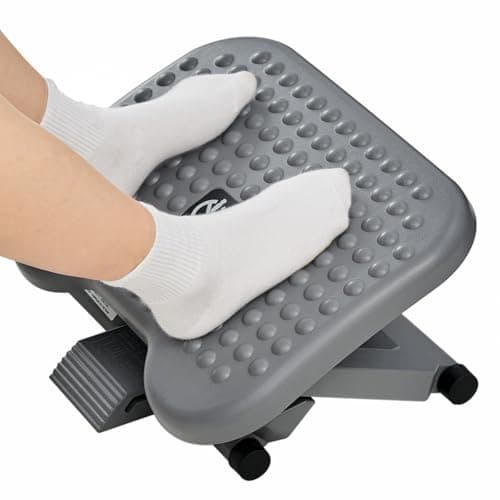 HUANUO Adjustable Desk Footrest, 3 Height Position & 30° Tilt Three stepped heights instead of one — 3.9, 5.3 and 6.5 inches — topping out taller than anything else on this page, on a platform that rocks through 30 degrees instead of holding one angle all day. The tradeoff is the shortest warranty here: one year, published plainly rather than dressed up as more. | The widest published reach | 1 yrWarranty | |
| 2 | 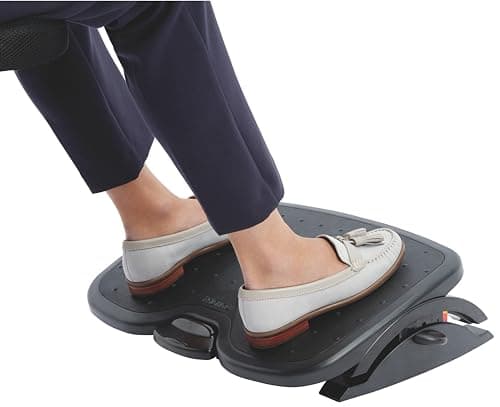 Kensington SoleMate Plus Adjustable Footrest, SmartFit (KMW52789) A continuous 3.5-to-5-inch slide and a 30-degree tilt, both reset with a foot pedal so you never bend down or stand up to change them — and Kensington backs the mechanism with a two-year warranty, the longest term on this page that comes attached to a published spec rather than a general schedule. | Adjusting without bending down | 2 yrWarranty | |
| 3 | 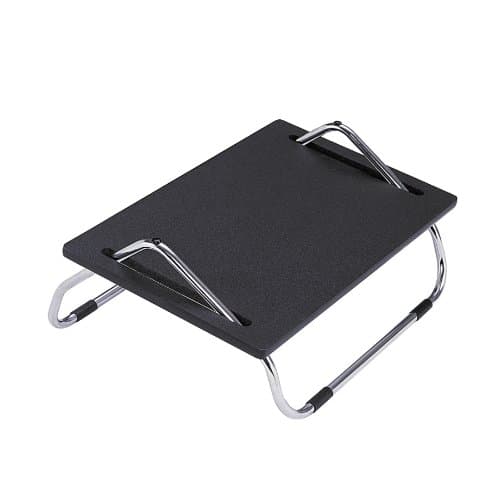 Safco Ergo-Comfort 8″ Adjustable Footrest, Chrome Stand (2106) One sliding ramp, angling up to 8 inches — the tallest single figure on this page — on a steel frame with a chrome stand. Safco doesn't publish a separate tilt degree because the same slide sets both height and angle at once, and the tradeoff for that simplicity is a warranty schedule broad enough, on its own terms, to cover the footrest for as long as you own it. | The single tallest reach | LifetimeWarranty | |
| 4 | 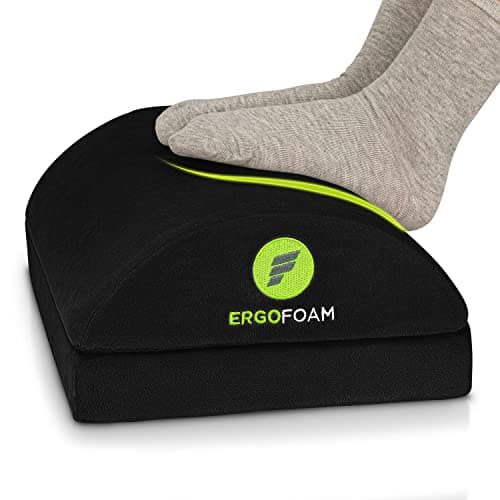 ErgoFoam Foot Rest for Under Desk at Work, Adjustable (Velvet) A molded foam wedge, not a mechanism — no lever, no pedal, no published height range or tilt angle for this model, just a 17.3 by 11.5 by 5.9-inch block and a lifetime replacement promise ErgoFoam states in plain language: email a photo, no questions asked. | A soft edge, not a mechanism | LifetimeWarranty |
Prices as of Sep 9, 2026, from Amazon’s API. They change; we show a live number or none at all.
A desk that’s too tall for you creates a choice, and both options are bad. Keep the chair low enough that your feet stay flat on the floor, and your elbows sit below the desk all day — typing with your shoulders hiked up to reach it. Or raise the chair until your elbows meet the desk properly, and your feet stop touching the floor. Most people, without ever deciding to, end up doing the second one.
OSHA’s Computer Workstations eTool doesn’t define correct chair height as a number. It defines it as a fit test: “The chair height is appropriate when the entire sole of the foot can rest on the floor with the back of the knee slightly higher than the seat of the chair.” Raise the seat to reach a desk that’s taller than you need, and that test is the first thing to break. Your elbows are fine. Your feet are now several inches above a floor they used to touch.
A footrest doesn’t fix the desk. It fixes the floor — it moves the floor up to wherever your feet actually ended up, at the seat height your desk forced on you. That makes the spec that decides this purchase obvious before you compare a single product: how far up does the platform actually reach, and does it hold your foot at one fixed angle all day or let the ankle move. Warranty is this site’s usual third slot. Here it turned out to run in the opposite direction from the other two, and that tension is what this page is built around.
What we ranked on, and why
Three criteria, in order, and the first two are the ones that decide whether the footrest does its actual job:
- Reach.The manufacturer’s own published platform-height figure — how far above the floor the top surface sits. This is the number that closes (or doesn’t close) the gap your raised chair created.
- Tilt / rock.Whether the platform is fixed at one angle or moves, and how far, per the manufacturer’s own figure. We report the mechanism; we make no claim about what moving does for you physically.
- Warranty.The longevity slot, as on every product page on this site — a footrest takes sustained downward pressure for years, and how long a manufacturer stands behind that is worth knowing before you buy.
What we deliberately did not rank on: color, the specific pattern of a massage-roller texture, or how any of these feel under a sock for eight hours. None of that is on a spec sheet, and a comfort verdict from someone who hasn’t sat on the product is an invented one.
The split: the clearer the mechanism, the shorter the warranty
Here is the finding, and it shapes every entry on this page. The two footrests that publish the most precise mechanics carry the shortest warranties, and the two with the longest warranty language publish the fewest numbers.
HUANUO and Kensington print exact figures for both height and tilt.HUANUO states three stepped heights — 3.9″, 5.3″, 6.5″ — and a 0–30° rocking platform, backed by a one-year warranty stated on a separate page of its own site. Kensington states a continuous 3.5–5″ slide and a 30° pedal-adjusted tilt, backed by a two-year warranty printed in the same structured spec block as the mechanism itself. Both numbers, on both products, are things you can check against the gap you measured before you buy.
Safco and ErgoFoam publish less of the mechanism and more of the promise.Safco’s single sliding ramp reaches the tallest figure on this page — 8″ — but sets height and angle together, so there is no separate tilt-degree figure to print. Its warranty, read from Safco’s own general schedule rather than a line naming this SKU, works out to lifetime by the schedule’s own default clause. ErgoFoam publishes no height-adjust figure and no tilt figure at all for this model — just a footprint — and backs it with the plainest lifetime-replacement language on the page.
Three of the twelve Spec Line slots across these four products are dashes. One is a genuine one-motion mechanism with nothing separate to report — Safco’s tilt, coupled to its single height slide. Two are a manufacturer simply not printing a number for this model — ErgoFoam’s height and tilt, both. Unstated details that aren’t part of the Spec Line itself, like Kensington’s missing weight capacity, show up in that product’s cons list instead. None of it is a guess.
How tall a footrest do you actually need
There is no universal answer, and every page that gives you one number is guessing at your body and your desk. The honest version: sit the way your desk height calculator result and chair-adjustment order actually put you — elbows at the desk, seat set from that — then measure straight down from the bottom of your dangling heel to the floor. That distance is the platform height a footrest needs to close for you specifically. It is different for a 5″2″ person and a 6″1″ person on the same desk, because it’s a function of your own leg length and how far your particular desk forced the seat up — not a constant anyone can publish for you.
Once you have that number, the four products here sort themselves. A small gap fits inside Kensington’s 3.5–5″ slide. A larger one needs HUANUO’s 6.5″ top step or Safco’s 8″ ramp. If you don’t yet know your number and just want to find out whether a footrest helps at all, ErgoFoam’s block is the cheapest way to test the idea — you simply can’t plan the exact height in advance the way you can with the other three.
What the money buys
Not a clean line from cheap-and-basic to expensive-and-premium. HUANUO, the least expensive footrest that fully publishes its mechanism, gives you the tallest stepped reach and a moving platform for the shortest warranty. Kensington costs more for a narrower range, and what that premium buys is the foot-pedal mechanism and a warranty a full year longer. Safco costs the most of the four and buys a steel-and-chrome build plus the broadest warranty language on the page, on a simpler single-slide mechanism than either of the two cheaper picks. ErgoFoam sits in the middle of the price range for something with no adjustable mechanism at all — you are paying for the foam and the no-questions-asked replacement promise, not for a number you can plan a desk gap around.
What we did instead of testing
We have not sat on any of these for an eight-hour day. No goniometer measured whether HUANUO’s platform actually swings the full 30 degrees it states, no pedal was cycled a thousand times to see whether Kensington’s mechanism still resets cleanly after a year, and ErgoFoam’s foam was not compressed and timed to see how long it takes to recover its shape. What we did was read each manufacturer’s own product page and, where the product page didn’t carry it, its own separate warranty documentation, and report the numbers that were actually printed — with a dash wherever one wasn’t. Our methodology pagesets out what reading a spec sheet does and doesn’t buy you; for footrests, the comfort half of that equation is squarely in the part we can’t give you.
How to actually choose
Do the fifteen-second measurement first: sit properly, let your feet hang, and measure the gap to the floor. That number, more than anything below, decides which of these four is even a candidate.
If your gap is moderate and you want a platform that moves through the day, buy the HUANUO— it publishes the widest combination of reach and tilt for the lowest price of the four, and accepts a shorter warranty in exchange. If you’d rather adjust without bending down and you value a longer stated warranty over the widest range, buy the Kensington. If your gap is large and you want the tallest reach on the page, or you want the strongest possible cover in exchange for a simpler mechanism, buy the Safco. And if you just want to find out whether a footrest helps you before committing to a mechanism at all, the ErgoFoamis the lowest-friction way in — at the cost of not knowing the exact height or angle before it arrives.
Whichever you pick, remember what a footrest actually fixes: the floor, not the desk. If the real problem is that your desk is fundamentally the wrong height for the room — not just a few inches off — the more complete fix is a height-adjustable desk or a chair built for the gap in the first place, like the ones in our drafting-chair roundup, which are designed to sit taller from the start. A footrest is the cheap, immediate version of the fix. It is a very good one for what it actually does.
The picks, in detail
1. The widest published reach
HUANUO Adjustable Desk Footrest, 3 Height Position & 30° Tilt
Three stepped heights instead of one — 3.9, 5.3 and 6.5 inches — topping out taller than anything else on this page, on a platform that rocks through 30 degrees instead of holding one angle all day. The tradeoff is the shortest warranty here: one year, published plainly rather than dressed up as more.
- Height adjust
- 3.9–6.5″ (3 positions)
- Tilt / rock
- 0–30°
- Warranty
- 1 yr
This is the top pick because it is the only footrest here that publishes both halves of the mechanism — how far it reaches and how it moves — and reaches the farthest while doing it.
HUANUO states three fixed platform heights: 3.9″, 5.3″ and 6.5″. That top figure is the tallest published reach of any footrest on this page, which matters directly for the arithmetic this whole roundup is built on: raise your chair to meet a desk that’s too tall for you and your feet lose the floor by however many inches the seat went up. A taller top step means the footrest can close a bigger gap. The platform also tilts 0 to 30 degreesand, per HUANUO’s own description, “rocks back and forth” rather than parking at one fixed angle — a mechanical claim we can quote and describe, not a circulation or posture claim we are making ourselves.
The honest tradeoff sits in the third slot. HUANUO’s own warranty schedule lists “Foot Rest — 1 Year”, plainly, on a separate page from the product listing itself. That is the shortest term on this page. If the length of the promise matters more to you than the precision of the mechanism, read the Safco and ErgoFoam entries below before you buy this one.
Good
- Three fixed heights — 3.9″, 5.3″ and 6.5″ — published by HUANUO itself, so you can check the top step against the gap you actually measured before you buy
- 6.5″ is the tallest figure any footrest on this page publishes, which matters if your chair has to go up a lot to meet a fixed desk
- The platform tilts 0–30° and, in HUANUO's own words, “rocks back and forth” rather than locking at a single angle, so there's somewhere for the ankle to go besides holding one position for hours
- A textured surface with rollers across the middle gives a second, lower-effort way to shift foot position without lifting a foot off the platform
- The only footrest here that publishes a full height range and a tilt angle at the lowest price of the four
Not so good
- HUANUO's own warranty schedule lists “Foot Rest — 1 Year”, the shortest published term of the four — both Safco and ErgoFoam claim lifetime cover
- Three fixed steps, not a continuous slide. If the gap you measured lands between 3.9″ and 5.3″, you get whichever is closer, not the exact number
- Plastic construction, and the rolling texture is a comfort feature we can describe from the listing, not verify — nothing on this page has been sat on and judged
- No published weight capacity, so a heavier user has no manufacturer figure to check before buying
Don’t buy it if: you want a promise longer than a year behind the mechanism, or you need to lock the platform dead flat on a hard floor or over a chair mat. The rock is 0 to 30 degrees by design here, not something you switch off.
Price as of Sep 9, 2026. #ad — we earn a commission.
Where these numbers came from
- HUANUO Adjustable Desk Footrest — HUANUO's own product page, listed as “Textured Surface Footrest” (source of “Height is manually adjustable to 3 different positions: 3.9″, 5.3″, 6.5″” and “EASY ANGLE ADJUSTMENT - Tilts 0 - 30° ... It rocks back and forth”) — read 2026-07-26
- HUANUO Warranty Information — HUANUO's own warranty schedule (“Limited Warranty Periods” table; the “Foot Rest” row reads “1 Year”) — read 2026-07-26
2. Adjusting without bending down
Kensington SoleMate Plus Adjustable Footrest, SmartFit (KMW52789)
A continuous 3.5-to-5-inch slide and a 30-degree tilt, both reset with a foot pedal so you never bend down or stand up to change them — and Kensington backs the mechanism with a two-year warranty, the longest term on this page that comes attached to a published spec rather than a general schedule.
- Height adjust
- 3.5–5″
- Tilt / rock
- 30°
- Warranty
- 2 yr
This is the pick for not wanting to bend over five times a day. Every other footrest on this page is reset by hand — lifting the unit, resetting a peg, flipping it over. Kensington’s SmartFit system uses a foot pedal for both height and angle, so the whole adjustment happens without leaving the chair.
The published range is 3.5″ to 5″ in height and up to 30 degreesof tilt, both stated on Kensington’s own product page in the same breath. It is a narrower total range than HUANUO’s stepped design below — 1.5 inches of travel against 2.6 — so if the gap between your raised seat and the floor is large, measure it before assuming this one reaches. Where it wins is the paperwork: a stated two-year warranty, the longest term on this page tied to a product that also publishes exact numbers for what it does.
Nothing here is a comfort verdict. We have not sat on this footrest for eight hours and judged the pedal action after a year of use — that is precisely the kind of claim our methodology pagesays we won’t manufacture. What we can confirm is that the two published numbers match between Kensington’s marketing copy and its structured spec data, which is more than every footrest on this page can say.
Good
- Height and tilt both adjust via a foot-operated pedal — Kensington's own line is you can make adjustments “while remaining seated” — so resetting it through the day never means reaching down or getting up
- A published two-year warranty: the longest term on this page attached to a product whose height and tilt are also both stated numbers, rather than a general schedule you have to interpret
- Both figures — 3.5–5″ height, up to 30° tilt — sit in the same sentence on Kensington's own product page, so there's nothing to reconcile between a spec block and a marketing bullet
- SmartFit is a mechanical system Kensington sells across several of its ergonomic accessories, which is at least evidence the pedal mechanism isn't a one-off design
- A non-skid surface, per Kensington's own listing, for a platform that's under sustained downward foot pressure all day
Not so good
- 3.5–5″ is the shortest total range of the two footrests here that publish a range at all — 1.5 inches of travel against HUANUO's 2.6 inches
- The most expensive of the two footrests with fully published mechanics, for a slide-and-pedal design that isn't fundamentally different in kind from HUANUO's stepped one
- Kensington states no weight capacity and no platform material beyond “non-skid”, so anything past height and tilt is unstated on the page we read
- No published product weight or shipping dimensions on Kensington's own page, so you're confirming two numbers and taking the rest on the brand's reputation
Don’t buy it if: the gap you measured is closer to 6 inches than 3. The 5-inch ceiling here is real, and HUANUO's 6.5-inch top step will close a bigger gap that this one physically cannot reach.
Amazon isn’t showing a buyable offer for this one right now.
Price as of Sep 9, 2026. #ad — we earn a commission.
3. The single tallest reach
Safco Ergo-Comfort 8″ Adjustable Footrest, Chrome Stand (2106)
One sliding ramp, angling up to 8 inches — the tallest single figure on this page — on a steel frame with a chrome stand. Safco doesn't publish a separate tilt degree because the same slide sets both height and angle at once, and the tradeoff for that simplicity is a warranty schedule broad enough, on its own terms, to cover the footrest for as long as you own it.
- Height adjust
- Up to 8″
- Tilt / rock
- —
- Warranty
- Lifetime
This is the tallest reach on the page, and the simplest mechanism. Safco’s own product page describes a single angled surface that “easily slides to adjust to any position”, topping out at 8″ H. One slide does two jobs: as the platform rises, its angle changes with it. That is why there is no separate tilt-degree figure to publish and no dash to apologize for — the mechanism genuinely only has one number to give.
The warranty took real work to run down. Safco’s own PDF warranty schedule sets a default lifetime term on “all products, parts, and components except as set forth below”, then lists named exceptions — outdoor products, motors, drawer slides, glides and casters at three years; polymer parts, upholstery, foam and chrome seating components at five. A footrest with a vinyl-covered top and a chrome stand isn’t named in either list. By the schedule’s own default clause, that puts it in the lifetime bucket — but that is our reading of a general document, not a line that names this SKU, and we’re saying so rather than presenting it as a direct quote.
What you’re paying the most for here is the steel-and-chrome build rather than a more elaborate mechanism — if you want an independently adjustable angle, the Kensington above publishes one and this footrest does not.
Good
- 8″ at the top of the slide is the tallest figure published by any footrest on this page — for a desk that's a lot too tall, this is the one with the most room to close a bigger gap
- One motion sets both height and angle: Safco's own description says the surface “easily slides to adjust to any position”, so there's no separate lever or setting to find
- A steel frame and a chrome stand rather than the all-plastic construction of the cheaper picks here — the more traditional office-furniture build
- Safco's own written warranty schedule sets a lifetime term on “all products, parts, and components” by default, and this footrest isn't named in any of the schedule's exception categories
- Independent retailer listings for this exact model describe it the same way — “limited lifetime warranty” — which at least corroborates the reading, even though Safco's own schedule doesn't name footrests by model
Not so good
- No separate tilt angle is published — height and angle are the same adjustment on this design, so the Spec Line's tilt slot is a dash by mechanism, not a hidden number we missed
- The lifetime-warranty read is our inference from Safco's general schedule, not a line that says “Ergo-Comfort footrest: lifetime” — the schedule speaks in categories, and this product isn't named in any of them
- The most expensive footrest on this page, for a single-slide mechanism that is mechanically simpler than the pedal or the stepped designs above it
- No published weight capacity, and the chrome stand is the one component here we'd most want a number on before trusting it under sustained daily pressure
Don’t buy it if: you want an angle you can set independent of height, or a stated number instead of an inference for the warranty. The ramp does both jobs with a single slide, and Safco's own page states a height, not a degree.
Price as of Sep 9, 2026. #ad — we earn a commission.
Where these numbers came from
- Safco Ergo-Comfort® 8″ Adjustable Footrest (2106) — Safco's own product page (“features an angled surface that easily slides to adjust to any position ... The adjustable footrest angles up to 8” H.”; spec table lists Maximum Height 9.75″, Maximum Width 15.75″, Maximum Depth 20″, Finished Product Weight 6.2 lbs, Secondary Materials “Steel (frame); Vinyl covered MDF”; no separate tilt-degree figure published) — read 2026-07-26
- Safco Limited Warranty for the United States (PDF, “Last Updated: March 2026”) — Safco's own warranty schedule (Lifetime term for “all products, parts, and components except as set forth below”; named exceptions run three years for outdoor/electrical/motors/drawer-slides/glides/casters and five years for polymer/upholstery/foam/chrome-seating/user-adjustable work-surface parts; footrests are not named in any exception) — read 2026-07-26
4. A soft edge, not a mechanism
ErgoFoam Foot Rest for Under Desk at Work, Adjustable (Velvet)
A molded foam wedge, not a mechanism — no lever, no pedal, no published height range or tilt angle for this model, just a 17.3 by 11.5 by 5.9-inch block and a lifetime replacement promise ErgoFoam states in plain language: email a photo, no questions asked.
- Height adjust
- —
- Tilt / rock
- —
- Warranty
- Lifetime
Every other footrest on this page is a mechanism: a slide, a pedal, a set of stepped positions. This one is a molded block of foam, and it is on the page because of what it does and doesn’t publish, which is the cleanest version of the split this whole roundup is built around.
ErgoFoam states the footprint plainly — 17.3″ × 11.5″ × 5.9″ — and nothing about how far the platform actually adjusts. The listing markets it as letting you “add or remove inches ... for maximum comfort”, which is a real feature — a removable layer — described without a number attached. No tilt or rock figure is published for this model either. Both Spec Line slots are dashes, and neither is a gap in our reading of the page: ErgoFoam simply doesn’t print those numbers here.
What it does print, in full sentences rather than a table, is the warranty: “a limited lifetime warranty… email us a photo of the issue and ErgoFoam will replace your office foot stool, no questions asked.”That is the strongest, plainest warranty language of any footrest here — it just arrives on a product where you cannot check the two numbers that would tell you, before buying, whether it actually closes your gap.
Good
- A published, plain-language lifetime warranty — ErgoFoam's own line is “simply email us a photo of the issue and ErgoFoam will replace your office foot stool, no questions asked” — no schedule to interpret, no category to check yourself against
- High-density, compression-resistant foam rather than a hollow plastic shell, so the platform doesn't flex or click the way a mechanical footrest's moving joints can over time
- A published footprint — 17.3″ × 11.5″ × 5.9″ — so you at least know the footprint under the desk, even without a height-adjust figure to plan around
- No moving parts to loosen, squeak or fail — the same fixed-mount argument this site's laptop-stand roundup makes for its no-hinge pick: nothing to adjust is also nothing to break
- Velvet or breathable-mesh cover options, so there's a version for a cooler-running or a softer surface
Not so good
- No published height-adjust figure for this model. ErgoFoam markets it as letting you “add or remove inches to your foot rest for maximum comfort” without stating what those inches are, so the Spec Line's first slot is a dash rather than a number we could check
- No published tilt or rock figure either — if a moving platform matters to you, HUANUO states an angle and this one states none
- A block of foam has no manufacturer figure for how many inches it actually removes; you would have to measure the piece against your own gap after it arrives, not before you buy
- The softest platform on this page is also the one offering the least structural support under sustained downward pressure — a construction inference, not a comfort verdict, since nothing here has been sat on
Don’t buy it if: you need to know the exact height or angle before you buy, or you specifically want a platform that tilts or rocks. ErgoFoam publishes neither figure for this model — buy it for the lifetime promise and the foam, not for a number you can plan a desk gap around.
Price as of Sep 9, 2026. #ad — we earn a commission.
Where these numbers came from
Common questions
How do I know if I need a footrest?
Sit the way your desk actually forces you to sit, then check OSHA’s own test: “The chair height is appropriate when the entire sole of the foot can rest on the floor with the back of the knee slightly higher than the seat of the chair.” If you set your seat from your desk — the correct order, covered on how to adjust your chair — and your feet no longer rest flat, that fit test has failed and a footrest is the fix that doesn’t involve lowering the seat again and losing the elbow height you just set.
What height footrest do I need?
Measure it rather than guess it. Sit with your elbows at the height your desk height calculator result calls for, let your feet hang the way they actually do, and measure straight down from the bottom of your heel to the floor. That distance is the platform height you need — not a universal number, because it depends on your own popliteal height and how far your particular desk forced the seat up. HUANUO’s 6.5″ top step and Safco’s 8″ slide both publish room for a larger gap; Kensington’s 5″ ceiling is for a smaller one.
Does the footrest need to tilt or rock?
That depends on what you want from it, and we can only tell you what moves and by how much — not whether moving is better for you. HUANUO publishes a 0–30° rocking platform and Kensington a 30° pedal-adjusted tilt; Safco’s single slide sets angle and height together with no separate figure; ErgoFoam is a static foam block with no tilt claim at all. We have not measured whether a moving platform changes anything for a given person over a working day — that would be a clinical claim, and this site doesn’t make those.
Why don't some of these footrests list a tilt angle?
Two different reasons, and they’re not the same kind of gap. Safco’s Ergo-Comfort uses one sliding ramp that sets height and angle in the same motion, so there genuinely is no separate tilt-degree figure to publish — the mechanism only has one number. ErgoFoam is simply a molded foam wedge with no adjustable mechanism at all for this model, and no figure is published for either height or tilt. Both show as dashes in the Spec Line. Neither is us declining to look; both are what each manufacturer actually states, or doesn’t. Our methodology page explains why a dash beats a guess.
Will a footrest fix a desk that's too tall?
It fixes the part of the problem that’s about your feet, not the part that’s about your desk. A too-tall desk forces the seat up to get your elbows right, and that’s the good outcome — the bad one is that your feet leave the floor. A footrest restores the floor at the new seat height. It does nothing for the desk surface itself. If the desk is simply the wrong height for the room, the other fixes are a height-adjustable desk or, cheaper, a keyboard tray that drops the input surface instead of raising the chair. The full order to set all of it in is on the ergonomic desk setup page.
Do footrests improve circulation or posture?
Several manufacturers on this page make some version of that claim in their own marketing copy, and we’ve quoted it as theirs where it appears — we have not tested any of it, and Stephen V., who writes this site, has no clinical credential to evaluate it with. What we can verify is geometry: whether the entire sole of a foot rests on a surface, per OSHA’s own fit test, and how far up and at what angle each platform here holds it. Whether that produces a measurable health benefit for a given person is a question for a doctor or physiotherapist, not an affiliate roundup.
Sources
Every figure on this page comes from one of these. If a manufacturer doesn’t publish a number, we print “—” rather than estimate it.
- HUANUO Adjustable Desk Footrest — HUANUO's own product page, listed as “Textured Surface Footrest” (source of “Height is manually adjustable to 3 different positions: 3.9″, 5.3″, 6.5″” and “EASY ANGLE ADJUSTMENT - Tilts 0 - 30° ... It rocks back and forth”) — read 2026-07-26
- HUANUO Warranty Information — HUANUO's own warranty schedule (“Limited Warranty Periods” table; the “Foot Rest” row reads “1 Year”) — read 2026-07-26
- Kensington SmartFit SoleMate Plus Foot Rest (KMW52789) — Kensington's own product page (“Height adjusts from 3.5”-5” and angle adjusts up to 30 degrees”, foot-pedal operation, and a structured spec field reading “Warranty: Limited 2-year warranty”) — read 2026-07-26
- Safco Ergo-Comfort® 8″ Adjustable Footrest (2106) — Safco's own product page (“features an angled surface that easily slides to adjust to any position ... The adjustable footrest angles up to 8” H.”; spec table lists Maximum Height 9.75″, Maximum Width 15.75″, Maximum Depth 20″, Finished Product Weight 6.2 lbs, Secondary Materials “Steel (frame); Vinyl covered MDF”; no separate tilt-degree figure published) — read 2026-07-26
- Safco Limited Warranty for the United States (PDF, “Last Updated: March 2026”) — Safco's own warranty schedule (Lifetime term for “all products, parts, and components except as set forth below”; named exceptions run three years for outdoor/electrical/motors/drawer-slides/glides/casters and five years for polymer/upholstery/foam/chrome-seating/user-adjustable work-surface parts; footrests are not named in any exception) — read 2026-07-26
- ErgoFoam Foot Rest, Adjustable (Velvet) — ErgoFoam's own product page (“Size: 17.3” x 11.5” x 5.9””; “LIFETIME WARRANTY - ErgoFoam is backed by a limited lifetime warranty. Simply email us a photo of the issue and ErgoFoam will replace your office foot stool, no questions asked.”; no height-adjust range or tilt/rock figure published for this model) — read 2026-07-26
- OSHA Computer Workstations eTool — Chairs (“The chair height is appropriate when the entire sole of the foot can rest on the floor with the back of the knee slightly higher than the seat of the chair.”) — read 2026-07-26
- OSHA Computer Workstations eTool — Desks (“Clearance for the legs, under the desktop, should generally be between 20-28 inches (50-72 cm) high.”; OSHA prescribes no desk-surface height) — read 2026-07-26
Read next
How to use a footrest correctly
When you need one and how to set its height and angle.
How to position your feet at a desk
Why feet flat and supported is the reason to add a footrest.
Desk height calculator
The number that starts this whole chain — set your desk and seat from this before you measure the footrest gap.
How to adjust your chair
Where OSHA's seat-height fit test comes from, and the exact move — raising the chair — that creates the gap a footrest fills.
The full ergonomic desk setup
Where a footrest fits in the order, alongside the keyboard tray and monitor height decisions around it.
The best standing desks
If the real fix is a desk that goes low enough to meet you, rather than a footrest that meets the desk halfway.